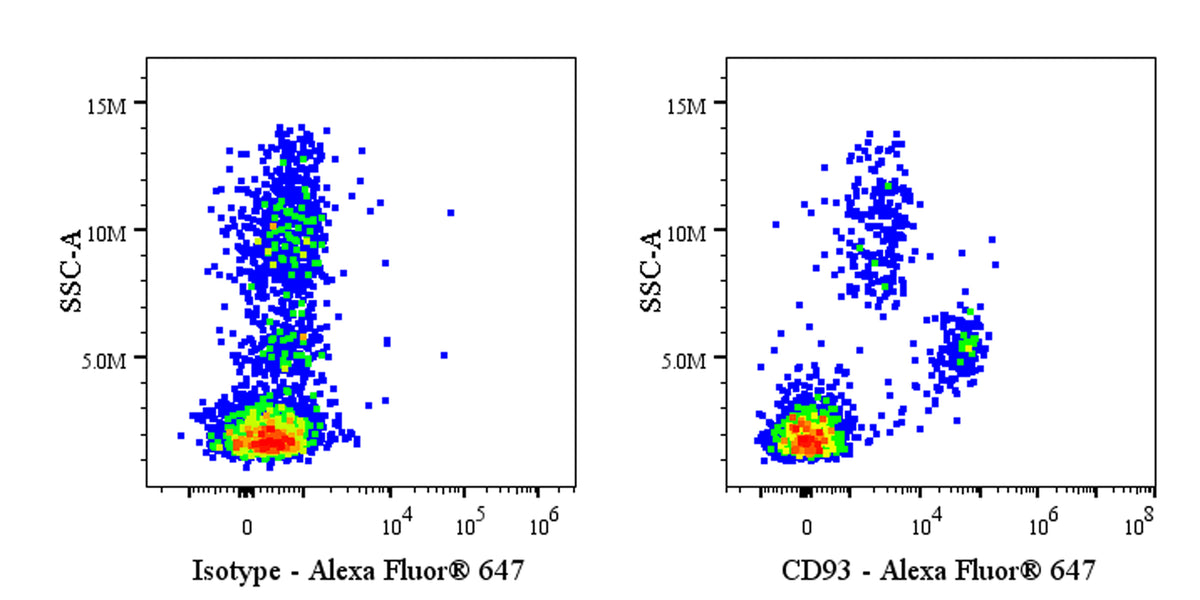
Flow cytometric analysis of human peripheral blood cells labelling human CD93 antibody at 1/200 dilution (1 μg) / (right panel) compared with a Mouse IgG2b Isotype Control / (left panel). Goat Anti- Mouse IgG Alexa Fluor®647 was used as the secondary antibody. Flow cytometry and data analysis were performed using Agilent NovoCyte Quanteon and FlowJo™ software.
Mouse Anti-Human CD93 Antibody (S-4392)
Mouse Anti-Human CD93 Antibody (S-4392)
Price:
Regular price
$100 USD
Regular price
Sale price
$100 USD
Unit price
per
For shipping services or bulk orders, you may request a quotation.
Secure checkout with

View full details
Product Details
Product Details
Product Specification
| Host | Mouse |
| Antigen | CD93 |
| Synonyms | Complement component C1q receptor; C1q/MBL/SPA receptor (C1qR; C1qR(p); C1qRp); CDw93; Complement component 1 q subcomponent receptor 1; Matrix-remodeling-associated protein 4; C1QR1; MXRA4 |
| Location | Cell membrane |
| Accession | Q9NPY3 |
| Clone Number | S-4392 |
| Antibody Type | Mouse mAb |
| Isotype | IgG2b |
| Application | FCM |
| Reactivity | Hu |
| Positive Sample | Human peripheral blood cells |
| Purification | Protein A |
| Concentration | 2 mg/ml |
| Conjugation | Unconjugated |
| Physical Appearance | Liquid |
| Storage Buffer | PBS pH7.4 |
| Stability & Storage | 12 months from date of receipt / reconstitution, 2 to 8 °C as supplied |
Dilution
| application | dilution | species |
| FCM | 1:200 | Hu |
Background
CD93 is a highly glycosylated type I transmembrane protein encoded by the C1QR1 gene (also known as CDw93 or ECSM3) on chromosome 20p11.21. Its extracellular region comprises a C-type lectin-like domain (CTLD), five epidermal growth factor (EGF)-like domains, and a mucin domain. Initially misidentified as a receptor for complement C1q, CD93 is now understood to primarily interact with Moesin via its intracellular tail to mediate cytoskeletal remodeling. On endothelial cells, it binds ligands such as multimerin-2 (MMRN2) or insulin-like growth factor binding protein 7 (IGFBP7) to activate the β1 integrin/FAK signaling axis, thereby promoting fibronectin fibrillogenesis and filopodia formation—processes that drive tumor angiogenesis and vascular maturation. Furthermore, CD93 exerts dual immunomodulatory functions on monocytes and macrophages. On one hand, its extracellular CTLD can directly bind bacterial CpG DNA and present it to Toll-like receptor 9 (TLR9), exacerbating inflammatory responses. On the other hand, in hepatocellular carcinoma, glycolysis-induced upregulation of CD93 on monocytes enhances PD-L1 expression via the AKT-GSK3β axis and induces secretion of the extracellular matrix component Versican, collectively suppressing CD8⁺ T cell activation and intratumoral infiltration. Blocking CD93 with therapeutic monoclonal antibodies has been shown to normalize tumor vasculature by upregulating adhesion molecules (ICAM1/VCAM1), significantly improving the infiltration efficiency of adoptive T cell therapies in solid tumors. Simultaneously, specific blockade of CD93 on monocytes can reverse the immunosuppressive microenvironment. These attributes position CD93 as a next-generation pan-cancer therapeutic target capable of simultaneously modulating angiogenesis and adaptive immune tolerance.
Picture
Picture
FC