Human IL-4 Kit (HICA)
Human IL-4 Kit (HICA)

Product Details
Product Details
Product Specification
| Stability & Storage | Store at 2~8°C protected from light for 18 months; after reconstitution, the standard can be aliquoted and stored at -20°C, avoiding repeated freeze-thaw cycles. |
Background
Principle of the Assay:
This kit employs a homogeneous immuno chemiluminescence assay (HICA) based on the double-antibody sandwich method for the detection of cytokine concentrations. The operation is simple and requires no washing steps.
The detection system consists of two types of microspheres: receptor microspheres conjugated with antibody 1 targeting the protein of interest, and donor microspheres conjugated with streptavidin, along with biotin-labeled antibody 2. During the reaction, the target protein binds with the antibodies and microspheres to form an immune complex, bringing the two types of microspheres into close proximity. When the distance between the donor and receptor microspheres is less than 200 nm, singlet oxygen generated by light excitation can transfer to the receptor microspheres and trigger chemiluminescence. Conversely, if the target protein is absent, the distance between the microspheres remains too large, resulting in no signal.
By measuring the intensity of the chemiluminescent signal, quantitative analysis of the target protein can be achieved. This method is characterized by its simplicity, rapid reaction, and high sensitivity.
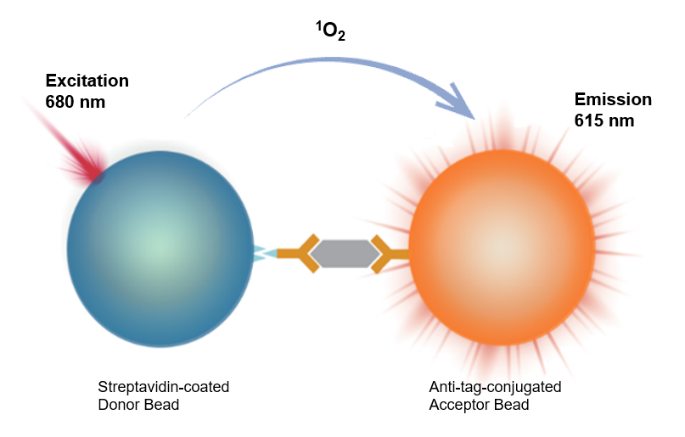
Components
Name |
Specification |
Component Specification |
Detection ReagentR1 |
500T |
2mL/Vial×1 |
2000T |
8ml/Vial×1 |
|
10000T |
40ml/Vial×1 |
|
Detection ReagentR2 |
500T |
2mL/Vial×1 |
2000T |
8ml/Vial×1 |
|
10000T |
40ml/Vial×1 |
|
Detection ReagentR3 |
500T |
5mL/Vial×1 |
2000T |
20ml/Vial×1 |
|
10000T |
100ml/Vial×1 |
|
Standard |
500T |
0.05μg Lyophilized Powder×1 |
2000T |
0.05μg Lyophilized Powder×2 |
|
10000T |
0.05μg Lyophilized Powder×5 |
|
Standard Buffer |
500T |
6mL/Vial×1 |
2000T |
12ml/Vial×1 |
|
10000T |
30ml/Vial×1 |
Note: Recommended plates for use are microplates (384 or 96-well plates, white, shallow wells)
Protocol
I. Sample Requirements
1. To remove impurities from the samples, centrifuge the samples at 1000 ×g for 10 minutes before testing.
2. When detecting the target protein in serum samples, the standard should be diluted with negative serum having a background value below the lower limit of detection, and a standard curve should be established accordingly to calculate the actual concentration.
3. If the measured sample concentration exceeds the highest value of the standard curve, dilute the sample appropriately and retest to ensure the result falls within the valid measurement range.
II. Assay Procedure
2.1 Preparation of Standard Gradient Samples: Reconstitute the lyophilized standard with 50μL of deionized water, then dilute with Standard Buffer. The recommended dilution scheme is as follows:
Gradient |
Concentration (pg/mL) |
Standard(μL) |
Diluent (μL) |
C12 |
100000 |
20μL Standard |
180 |
C11 |
30000 |
60μL C12 |
140 |
C10 |
10000 |
60μL C11 |
120 |
C9 |
3000 |
60μL C10 |
140 |
C8 |
1000 |
60μL C9 |
120 |
C7 |
300 |
60μL C8 |
140 |
C6 |
100 |
60μL C7 |
120 |
C5 |
30 |
60μL C6 |
140 |
C4 |
10 |
60μL C5 |
120 |
C3 |
3 |
60μL C4 |
140 |
C2 |
1 |
60μL C3 |
120 |
C1 |
0 |
— |
140 |
2.2 Assay Procedure:
Assay Procedure |
Procedure1 (37°C Rapid Assay) |
Procedure2 (Room Temperature Assay) |
Step 1: |
Add 2µL sample to 8µL pre-mixed R1+R2* |
Add 2µL sample to 8µL pre-mixed R1+R2* |
Incubation |
Mix by shaking at 400 rpm for 1 min, incubate at 37°C for 15 min |
Mix by shaking at 400 rpm for 1 min,incubate at room temperature for 60 min |
Step 2: |
Add 9µL R3, Protect from light/ Under green light |
Add 9µL R3, Protect from light/ Under green light |
Incubation |
Mix by shaking at 400 rpm for 1 min, incubate at 37°C for 10 min, Protect from light/ Under green light |
Mix by shaking at 400 rpm for 1 min, incubate at room temperature for 30 min, Protect from light/ Under green light |
Read |
Read with instrument, Protect from light/ Under green light |
Read with instrument, Protect from light/ Under green light |
* Note: Before testing, pre-mix R1 and R2 at a volume ratio of 1:1. Use within 1 hour after mixing.
* If testing RPMI samples, you may additionally add RPMI enhancer solution (Catalog No.: UA086145). Pre-mix 50 μL of R3 with 100 μL of RPMI enhancer solution before adding, which significantly improves reagent performance.
III. Performance Testing
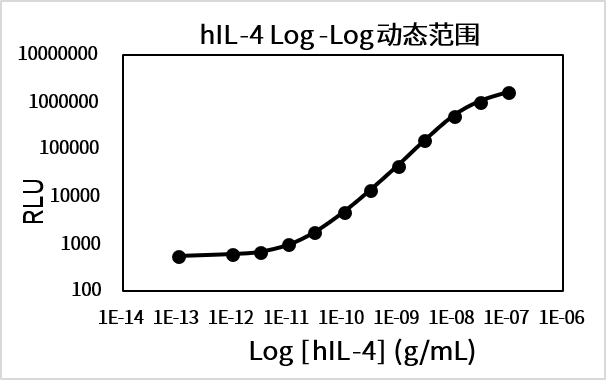
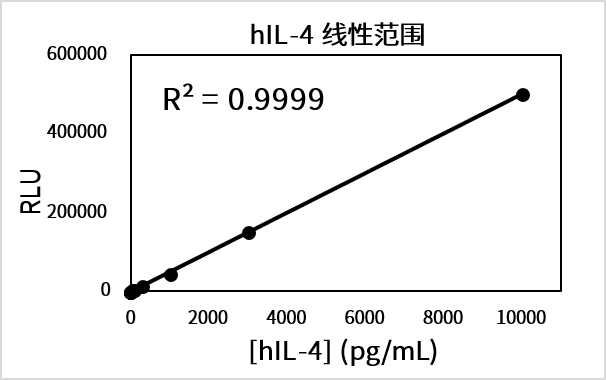
3.1 Example of Complete Standard Curve:
3.2 Validation of Performance Parameters:
LOD: Measure 20 replicates of Standard C1, calculate the mean signal and SD. Use the standard curve to calculate the concentration corresponding to Mean Signal+2×SD, which is the Limit of Detection (LOD).
Assay Procedure |
Matrix |
LOD (pg/mL) |
Quantitative Range(pg/mL) |
Dynamic Range(pg/mL) |
Procedure 1 |
Buffer |
0.40 |
0.4~10000 |
0~100000 |
DMEM |
4.56 |
4.6~10000 |
||
RPMI |
9.24 |
9.2~10000 |
||
Human Serum |
1.43 | 1.4~10000 |
||
Procedure 2 |
Buffer |
0.13 |
0.1~10000 |
Precision (Precision):
Intra-assay Precision (Intra-Precision): On a single plate in one experiment, replicate samples of known low, medium, and high concentrations are tested 10 times each to evaluate intra-assay precision. Standards and samples are tested using different procedures. The coefficient of variation (%CV) for all sample concentrations is below 10%, indicating good reproducibility within the same batch.
Assay Procedure |
Matrix |
Reproducibility |
|
Low Concentration |
High Concentration |
||
Procedure 1 |
Buffer |
1.0% |
2.0% |
DMEM |
2.0% |
1.5% |
|
RPMI |
2.5% |
3.5% |
|
Human Serum |
1.4% |
2.2% |
|
Procedure 2 |
Buffer |
1.6% |
2.2% |
Inter-assay Precision (Inter-Precision): Samples of known low, medium, and high concentrations are tested across 5 independent experiments. Standards and samples are tested using Procedure 1 with 5 replicates. The results for all sample concentrations show low coefficients of variation (%CV < 10%), indicating good reproducibility between different batches.
Assay Procedure |
Matrix |
Inter-assay Precision |
|
Low Concentration |
High Concentration |
||
Procedure 1 |
Buffer |
2.2% |
2.7% |
Accuracy (Recovery):
High and low concentration controls are mixed at a 1:9 ratio to test their recovery. All values fall within 80%-120% , indicating good accuracy of the method.
Assay Procedure |
Matrix |
Recovery |
Procedure 1 |
Buffer |
90.8% |
DMEM |
89.4% |
|
RPMI |
92.9% |
|
Human Serum |
85.4% |
|
Procedure 2 |
Buffer |
86.2% |
Specificity: The following proteins are diluted with Standard Buffer to 0.3μg/mL to test for cross-reactivity.
Assay Procedure |
Analyte |
Cross-reactivity Rate |
Procedure 1 |
Mouse IL-4 |
0.00% |
Rat IL-4 |
0.00% |
•Traceability: Tested against reference material NIBSC 88/656, 1 IU/mL ≈ 50pg/mL.
Guidelines
Reagent R3 should be protected from light during use. Sample addition and incubation are recommended to be performed under green light (<100 LUX).
Recalibration is required for each test. Each concentration point of the standard should be tested in at least duplicate, and a four-parameter (weight 1/Y²) fitting calculation should be applied.
Temperature and time should be strictly controlled during incubation. The microplate should be covered with a film, and a microplate reader with ALPHA function is recommended.
The dilution matrix of the calibrator should be consistent with the test sample. It should be used within 2 hours after reconstitution.
Components from different reagent kit batches must not be mixed.