Human IgG Acceptor Beads
Human IgG Acceptor Beads

Product Details
Product Details
Product Specification
| Stability & Storage | Store at 2-8°C away from light; product shelf life is 12 months. |
Background
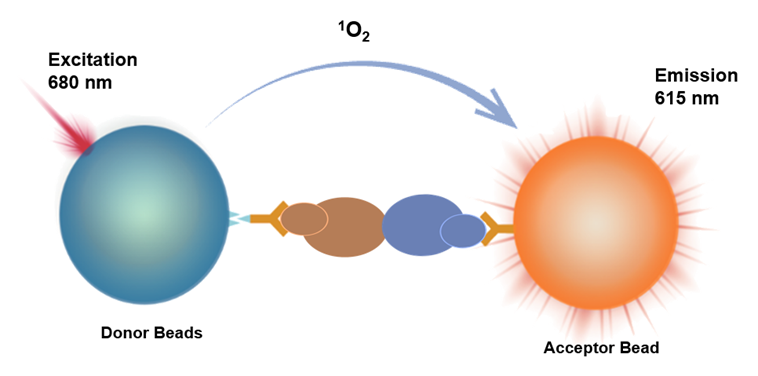
Homogeneous Immuno Chemiluminescence Assay (HICA) is a homogeneous immunoassay method based on energy transfer between donor beads and acceptor beads at close proximity to generate chemiluminescence.
Donor beads recognize protein 1 (Tag1 label), while acceptor beads recognize protein 2 (Tag2 label). When protein 1 binds to protein 2, the distance between the beads becomes less than 200 nm. Upon excitation at 680 nm, the donor beads generate singlet oxygen, which diffuses to the acceptor beads. The acceptor beads then undergo a redox reaction, emitting light at 615 nm. The signal intensity is directly proportional to the strength of the protein interaction.
This product features a simple operation process, requires no washing, and offers fast results with high sensitivity. It is capable of detecting weak interactions.
Components
Specification |
Fill Volume |
250 μg |
50 μL |
5 mg |
1 mL |
25 mg |
1 mL x 5 |
Protocol
[Required Reagents]
Name |
Catalog No. |
| Human IgG Acceptor Beads | UA086099 |
| Streptavidin Donor Beads | UA086104 |
| Universal Buffer 1 | UA086113 |
[Assay Procedure for Reference]
Assay Procedure |
Protocol 1 (37℃ Rapid Assay) |
Protocol 2 (Room Temperature Assay) |
Step 1: |
4μL Tag1-M1 +4μL Tag2-M2+ 6μL Acceptor Beads,Protect from light / Green light |
4μL Tag1-M1 +4μL Tag2-M2+ 6μL Acceptor Beads,Protect from light / Green light |
Incubation |
37℃ shaking incubation for 20 minutes,Protect from light / Green light | Room temperature incubation for 60 minutes,Protect from light / Green light |
Step 2: |
Add 6μL Donor Beads,Protect from light / Green light |
Add 6μL Donor Beads,Protect from light / Green light |
Incubation |
37℃ shaking incubation for 10 minutes,Protect from light / Green light |
Room temperature incubation for 30 minutes,Protect from light / Green light |
Reading |
Instrument Reading |
Instrument Reading |
[Performance Validation]
•Sample Preparation:
Dilute biotinylated anti-human IgG (Bio-anti-hIgG) to 15 μg/mL (100 nM) using Universal Buffer 1 as the stock solution, then perform serial dilutions according to the following scheme:
No. |
Final Concentration (nM) |
Universal Buffer 1 Volume (μL) |
High Conc. Add Volume (μL) |
C12 |
1.0E+01 |
210 |
90 μL Stock Solution |
C11 |
3.0E+00 |
210 |
90 μL C12 |
C10 |
1.0E+00 |
180 |
90 μL C11 |
C9 |
3.0E-01 |
210 |
90 μL C10 |
C8 |
1.0E-01 |
180 |
90 μL C9 |
C7 |
3.0E-02 |
210 |
90 μL C8 |
C6 |
1.0E-02 |
180 |
90 μL C7 |
C5 |
3.0E-03 |
210 |
90 μL C6 |
C4 |
1.0E-03 |
180 |
90 μL C5 |
C3 |
3.0E-04 |
210 |
90 μL C4 |
C2 |
1.0E-04 |
180 |
90 μL C3 |
C1 |
0 |
180 |
/ |
•Detection Reagent Preparation:
Name |
Working Concentration |
Diluent |
| Human IgG Acceptor Beads | 25 μg/mL |
Universal Buffer 1 |
| Streptavidin Donor Beads | 25 μg/mL |
Universal Buffer 1 |
•Results for 37℃ Incubation Mode:
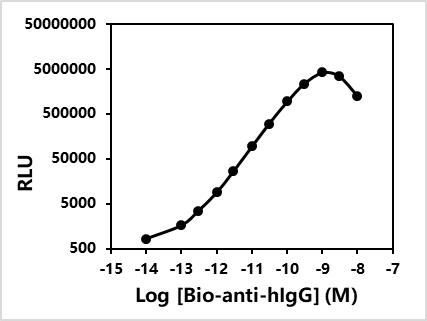
Maximum Signal: 4291669
Minimum Signal: 852
EC50= 0.454 nM
•Results for Room Temperature Incubation Mode:
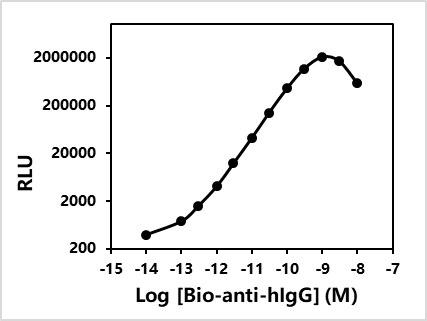
Maximum Signal: 2103393
Minimum Signal: 399
EC50= 0.432 nM
Guidelines
1. This experiment is light-sensitive; ensure all operations are performed under light-protected conditions. It is recommended to conduct preparation, sample loading, and incubation steps under green light (illuminance below 100 LUX).
2. This product is compatible with multifunctional microplate readers equipped with Alpha detection modules.
3. Vortex thoroughly before use, or briefly centrifuge (2000×g, 5–10 seconds) to ensure complete sample retrieval.
4. It is recommended to use the accompanying dilution buffer from our company for reagent preparation and sample dilution. If additional components are required, they can be directly added to this buffer.
5. To ensure comparability of experimental data across different batches, strictly control incubation temperature and duration.
6. Avoid generating bubbles during sample loading.