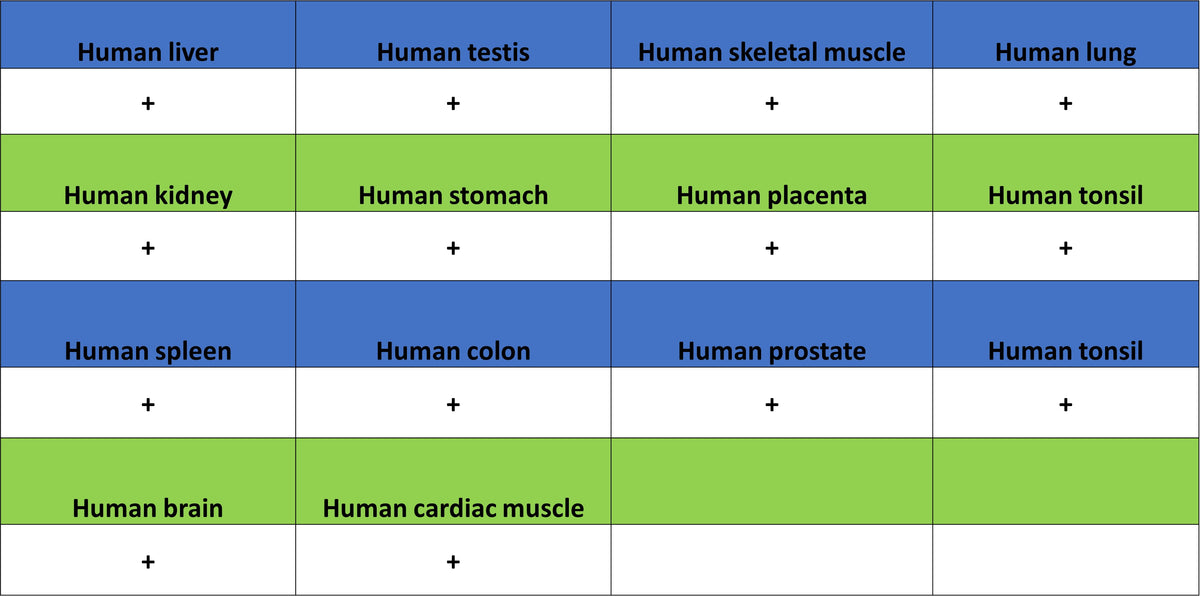
IHC shows positive staining in paraffin-embedded human cardiac muscle. Anti-HLA Class I-A antibody was used at 1/250 dilution, followed by a HRP Polymer for Mouse IgG (ready to use). Counterstained with hematoxylin. Heat mediated antigen retrieval with Tris/EDTA buffer pH9.0 was performed before commencing with IHC staining protocol.
HLA Class I-A Recombinant Mouse mAb (S-3834)
HLA Class I-A Recombinant Mouse mAb (S-3834)
Price:
Regular price
$100 USD
Regular price
Sale price
$100 USD
Unit price
per
For shipping services or bulk orders, you may request a quotation.
Secure checkout with

View full details
Product Details
Product Details
Product Specification
| Host | Mouse |
| Antigen | HLA Class I-A |
| Synonyms | HLA class I histocompatibility antigen, A alpha chain; Human leukocyte antigen A (HLA-A); HLAA; HLA-A |
| Location | Cell membrane, Endoplasmic reticulum |
| Accession | P04439 |
| Clone Number | S-3834 |
| Antibody Type | Mouse mAb |
| Isotype | IgG |
| Application | IHC-P, ICC |
| Reactivity | Hu |
| Positive Sample | Jurkat |
| Purification | Protein A |
| Concentration | 2 mg/ml |
| Conjugation | Unconjugated |
| Physical Appearance | Liquid |
| Storage Buffer | PBS, 40% Glycerol, 0.05% BSA, 0.03% Proclin 300 |
| Stability & Storage | 12 months from date of receipt / reconstitution, -20 °C as supplied |
Dilution
| application | dilution | species |
| IHC-P | 1:250 | Hu |
| ICC | 1:500 | Hu |
Background
Human Leukocyte Antigen Class I-A molecules (HLA Class I-A, typically referring to the classical HLA-Ia molecules: HLA-A, HLA-B, and HLA-C) are core members of the Major Histocompatibility Complex (MHC) Class I family, widely expressed on the surface of nearly all nucleated cells. Their primary function is to serve as critical immunological "identity cards" for immune surveillance by binding short peptide fragments (typically 8–10 amino acids) derived from intracellular proteins—including self-proteins, viral proteins, or tumor mutation products—and presenting them on the cell surface for specific recognition by CD8+ cytotoxic T lymphocytes (CTLs) via their T-cell receptors (TCRs). Structurally, these molecules consist of a transmembrane heavy chain (α-chain, encoded by highly polymorphic HLA genes that determine peptide-binding specificity and individual differences in transplant rejection) non-covalently associated with a non-polymorphic light chain (β2-microglobulin, β2m). This architecture not only ensures normal self-cells are spared from attack (by transmitting "self" signals through inhibitory receptors such as KIRs or LILRB1) but also triggers CTL-mediated lysis of target cells when they are infected by viruses or undergo malignant transformation through the presentation of abnormal antigenic peptides. Consequently, HLA Class I-A molecules play an indispensable and decisive role in antiviral immunity, anti-tumor immunity, and the matching and rejection processes in organ transplantation.
Picture
Picture
Immunohistochemistry
IHC shows positive staining in paraffin-embedded human tonsil. Anti-HLA Class I-A antibody was used at 1/250 dilution, followed by a HRP Polymer for Mouse IgG (ready to use). Counterstained with hematoxylin. Heat mediated antigen retrieval with Tris/EDTA buffer pH9.0 was performed before commencing with IHC staining protocol.
IHC shows positive staining in paraffin-embedded human breast cancer. Anti-HLA Class I-A antibody was used at 1/250 dilution, followed by a HRP Polymer for Mouse IgG (ready to use). Counterstained with hematoxylin. Heat mediated antigen retrieval with Tris/EDTA buffer pH9.0 was performed before commencing with IHC staining protocol.
IHC shows positive staining in paraffin-embedded human cervical squamous cell carcinoma. Anti-HLA Class I-A antibody was used at 1/250 dilution, followed by a HRP Polymer for Mouse IgG (ready to use). Counterstained with hematoxylin. Heat mediated antigen retrieval with Tris/EDTA buffer pH9.0 was performed before commencing with IHC staining protocol.
Immunocytochemistry
ICC shows positive staining in Jurkat cells (top panel) and negative staining in K562 cells (below panel). Anti- HLA Class I-A antibody was used at 1/500 dilution (Green) and incubated overnight at 4°C. Goat polyclonal Antibody to Mouse IgG - H&L (Alexa Fluor® 488) was used as secondary antibody at 1/1000 dilution. The cells were fixed with 4% PFA and permeabilized with 0.1% PBS-Triton X-100. Nuclei were counterstained with DAPI (Blue). Counterstain with tubulin (Red).