WB result of GluN3B Recombinant Rabbit mAb
Primary antibody: GluN3B Recombinant Rabbit mAb at 1/1000 dilution
Lane 1: CHO transfected with empty vector whole cell lysate 20 µg
Lane 2: CHO transfected with GluN3B-Myc-His fusion protein whole cell lysate 20 µg
Secondary antibody: Goat Anti- rabbit IgG, (H+L), HRP conjugated at 1/10000 dilution
Predicted MW: 113 kDa
Observed MW: 115 kDa
GluN3B Recombinant Rabbit mAb (S-2320-3)
GluN3B Recombinant Rabbit mAb (S-2320-3)
Price:
Regular price
$100 USD
Regular price
Sale price
$100 USD
Unit price
per
For shipping services or bulk orders, you may request a quotation.
Secure checkout with

View full details
Product Details
Product Details
Product Specification
| Host | Rabbit |
| Antigen | GluN3B |
| Synonyms | Glutamate receptor ionotropic, NMDA 3B; GRIN3B |
| Immunogen | Recombinant Protein |
| Location | Cell membrane |
| Accession | O60391 |
| Clone Number | S-2320-3 |
| Antibody Type | Recombinant mAb |
| Isotype | IgG |
| Application | WB, ICC |
| Reactivity | Hu, Ms |
| Positive Sample | CHO transfected with GluN3B-Myc-His fusion protein |
| Purification | Protein A |
| Concentration | 0.5 mg/ml |
| Conjugation | Unconjugated |
| Physical Appearance | Liquid |
| Storage Buffer | PBS, 40% Glycerol, 0.05% BSA, 0.03% Proclin 300 |
| Stability & Storage | 12 months from date of receipt / reconstitution, -20 °C as supplied |
Dilution
| application | dilution | species |
| WB | 1:500-1:1000 | Ms |
| ICC | 1:500 | Ms |
Background
GluN3B, encoded by the GRIN3B gene, is a unique and atypical subunit of the N-methyl-D-aspartate receptor (NMDAR) that fundamentally alters the receptor's functional properties when co-assembled with obligatory GluN1 subunits and conventional GluN2 subunits. Unlike other NMDAR subunits, GluN3B contains a distinct ligand-binding domain that renders the resulting heterotrimeric or heterotetrameric receptors insensitive to the co-agonist glycine and significantly reduces their calcium permeability and single-channel conductance, effectively acting as a dominant-negative modulator that dampens excitatory synaptic transmission. Primarily expressed in specific brain regions such as the thalamus, striatum, and during early postnatal development in the cortex, GluN3B plays a critical role in refining neural circuits by limiting excessive NMDAR activity, thereby influencing processes like synaptic plasticity, motor coordination, and sensory gating; furthermore, dysregulation or mutations in GRIN3B have been implicated in various neurological disorders, including schizophrenia, Huntington's disease, and rare forms of epilepsy, highlighting its importance as a potential therapeutic target for modulating glutamatergic signaling without completely abolishing NMDAR function.
Picture
Picture
Western Blot
Immunocytochemistry
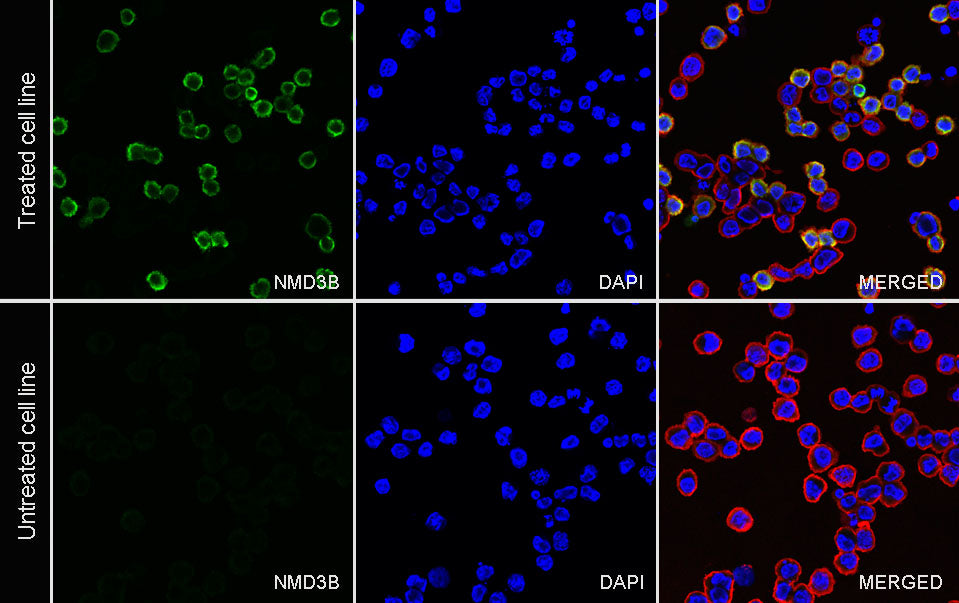
ICC shows positive staining in GluN3B-Myc-His fusion protein transfected CHO cells (top panel) and negative staining in vector-transfected CHO cells (below panel). Anti- GluN3B antibody was used at 1/500 dilution (Green) and incubated overnight at 4°C. Goat polyclonal Antibody to Mouse IgG - H&L (Alexa Fluor® 488) was used as secondary antibody at 1/1000 dilution. The cells were fixed with 4% PFA and permeabilized with 0.1% PBS-Triton X-100. Nuclei were counterstained with DAPI (Blue). Counterstain with tubulin (Red).