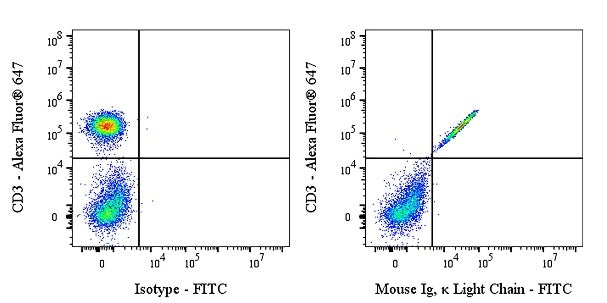
Flow cytometric analysis of mouse Ig, κ Light Chain Antibody expression on Human PBMC. Human PBMC were stained with Alexa Fluor® 647 Mouse Anti-Human CD3 Antibody(S0B8251) and either FITC Rat IgG1, κ Isotype Control (left panel) or FITC Rat Anti-Mouse Ig, κ Light Chain Antibody (right panel) at 0.25 μl/test. Flow cytometry and data analysis were performed using Agilent NovoCyte Quanteon and FlowJo™ software.
FITC Rat Anti-Mouse Ig, κ Light Chain Antibody (S-4252)
FITC Rat Anti-Mouse Ig, κ Light Chain Antibody (S-4252)
Price:
Regular price
$85 USD
Regular price
Sale price
$85 USD
Unit price
per
For shipping services or bulk orders, you may request a quotation.
Secure checkout with

View full details
Product Details
Product Details
Product Specification
| Host | Rat |
| Antigen | Ig, κ Light Chain |
| Synonyms | Immunoglobulin kappa constant; Igkc |
| Location | Cell membrane |
| Accession | P01837 |
| Clone Number | S-4252 |
| Antibody Type | Rat mAb |
| Isotype | IgG1,k |
| Application | FCM |
| Reactivity | Ms |
| Purification | Protein G |
| Concentration | 0.5 mg/ml |
| Conjugation | FITC |
| Physical Appearance | Liquid |
| Storage Buffer | PBS, 1% BSA, 0.3% Proclin 300 |
| Stability & Storage | 12 months from date of receipt / reconstitution, 2 to 8 °C as supplied |
Background
Immunoglobulin kappa (Igκ) light chains are one of the two types of polypeptide chains, alongside lambda chains, that constitute the antigen-binding fragment of antibodies in humans and many other mammals, playing a critical role in the adaptive immune system's ability to recognize diverse pathogens. Each antibody molecule typically comprises two identical heavy chains and two identical light chains, where the kappa light chain consists of a variable domain (Vκ) responsible for antigen specificity through hypervariable complementarity-determining regions (CDRs), and a constant domain (Cκ) that provides structural stability and facilitates proper folding and assembly with the heavy chain within the endoplasmic reticulum of B cells. In humans, the immunoglobulin light chain locus is located on chromosome 2, and during B cell development, V-J recombination generates immense diversity in the Vκ region, allowing the immune system to produce billions of unique antibodies; notably, each B cell expresses exclusively either kappa or lambda light chains, a phenomenon known as allelic exclusion, which ensures monospecificity, with kappa chains being more prevalent than lambda chains in human serum at an approximate ratio of 60:40. Clinically, the detection of free kappa light chains or an abnormal kappa-to-lambda ratio is a vital diagnostic marker for B-cell malignancies such as multiple myeloma and light chain amyloidosis, as clonal proliferation often results in the overproduction of a single type of light chain that can be measured in blood or urine to monitor disease progression and treatment response.
Picture
Picture
FC