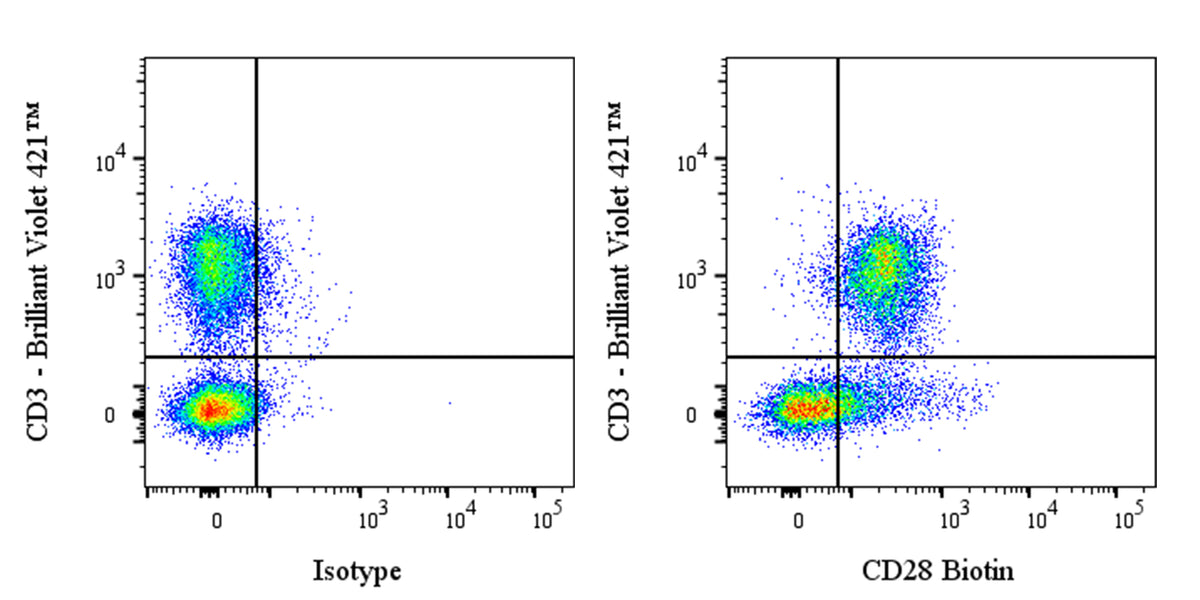
Flow cytometric analysis of mouse CD28 expression on BALB/c mouse splenocytes. BALB/c mouse splenocytes were stained with Brilliant Violet 421™ Rat Anti-Mouse CD3 Antibody and either Biotin Syrian hamster IgG Isotype Control (left panel) or SDT Biotin Syrian hamster Anti-Mouse CD28 Antibody (right panel) at 2 μl/test followed by Sav-iFluor 488. Total viable cells, as determined by Fixable Viability Dye 662 (S0D0016), were used for analysis. Flow cytometry and data analysis were performed using BD FACSymphony™ A1 and FlowJo™ software.
Biotin Syrian hamster Anti-Mouse CD28 Antibody (37.51)
Biotin Syrian hamster Anti-Mouse CD28 Antibody (37.51)
Price:
Regular price
$85 USD
Regular price
Sale price
$85 USD
Unit price
per
For shipping services or bulk orders, you may request a quotation.
Secure checkout with

View full details
Product Details
Product Details
Product Specification
| Host | Syrian Hamster |
| Antigen | CD28 |
| Synonyms | T-cell-specific surface glycoprotein CD28 |
| Location | Cell membrane |
| Accession | P31041 |
| Clone Number | 37.51 |
| Antibody Type | Recombinant mAb |
| Isotype | IgG |
| Application | FCM |
| Reactivity | Ms |
| Positive Sample | BALB/c mouse splenocytes |
| Purification | Protein G |
| Concentration | 0.5 mg/ml |
| Conjugation | Biotin |
| Physical Appearance | Liquid |
| Storage Buffer | PBS pH7.4, 0.03% Proclin 300 |
| Stability & Storage | 12 months from date of receipt / reconstitution, 2 to 8 °C as supplied |
Dilution
| application | dilution | species |
| FCM | 1μg per million cells in 100μl volume | Ms |
Background
CD28 is a critical costimulatory receptor expressed on the surface of T cells, particularly on CD4+ and CD8+ T cells, and plays a pivotal role in T cell activation, proliferation, and survival. It is a homodimer of 44kDa subunits, each containing a single immunoglobulin-like extracellular domain, and is part of the Ig superfamily. CD28 interacts with its ligands, CD80 (B7-1) and CD86 (B7-2), which are predominantly found on antigen-presenting cells (APCs) such as dendritic cells, macrophages, and B cells. The engagement of CD28 with these ligands is essential for providing the second signal required for full T cell activation, which complements the antigen-specific signal delivered by the T cell receptor (TCR). CD28 signaling leads to the upregulation of IL-2 and its receptor expression, enhances T cell proliferation, and promotes the production of various cytokines, including IL-4, IL-5, IL-13, IFN-γ, and TNF. It also plays a role in the differentiation of T cells into memory phenotypes and in maintaining immune homeostasis. The absence of CD28 signaling results in reduced T cell survival and impaired antibody responses to T-dependent antigens. CD28 is thus a key regulatory point for successful B cell, macrophage, and cytotoxic T cell responses.
Picture
Picture
FC