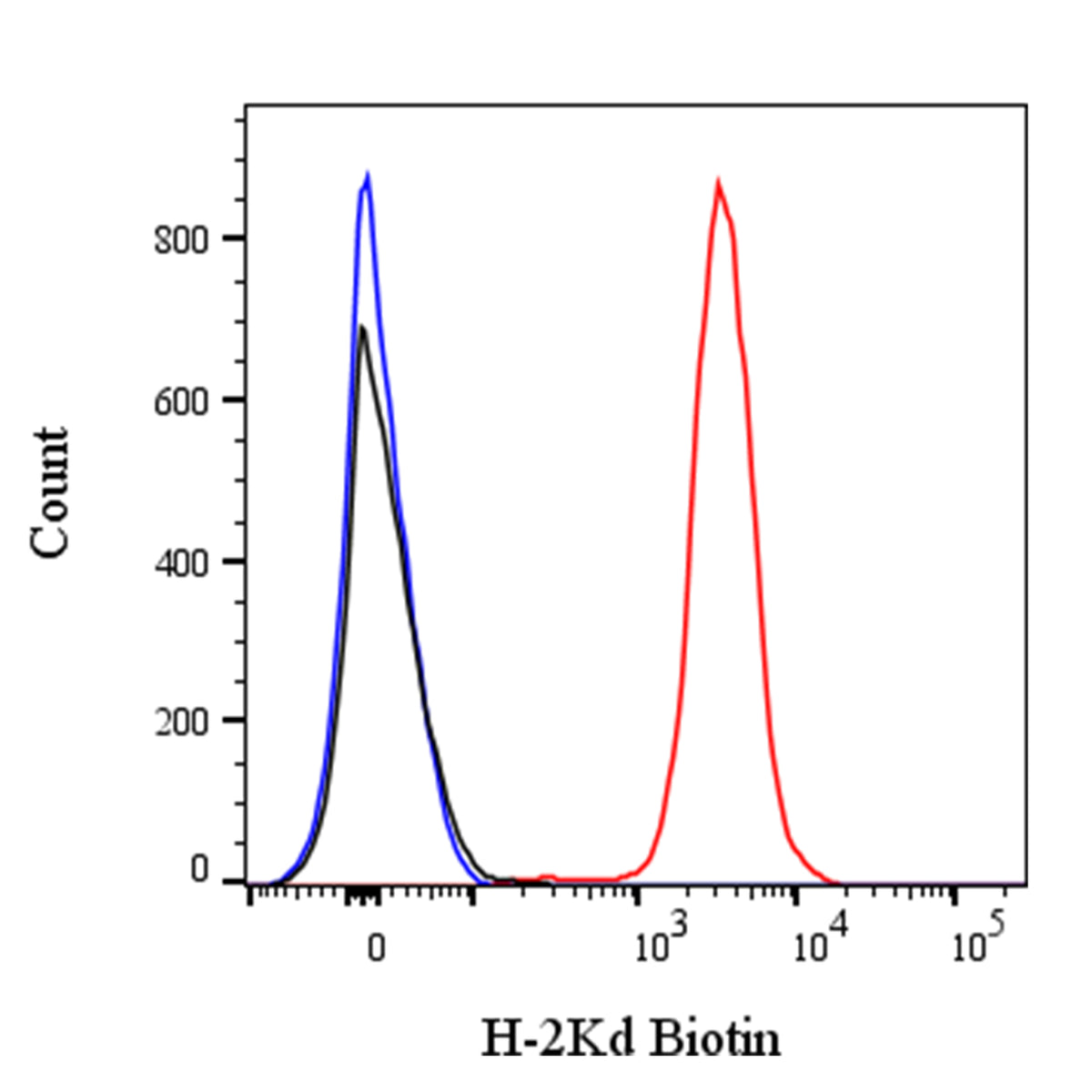
Flow cytometric analysis of mouse H-2Kd expression on BALB/c mouse splenocytes. BALB/c mouse splenocytes were stained with Biotin Mouse IgG2a, κ Isotype Control (black line histogram) or SDT Biotin Mouse Anti-Mouse H-2Kd Antibody (red line histogram) at 2 μl/test followed by Sav-iFluor 488, cells without incubation with primary antibody and secondary antibody (blue line histogram) was used as unlabeled control. Total viable cells, as determined by Fixable Viability Dye 452 (S0D0021), were used for analysis. Flow cytometry and data analysis were performed using BD FACSymphony™ A1 and FlowJo™ software.
Biotin Mouse Anti-Mouse H-2Kd Antibody (SF1-1.1)
Biotin Mouse Anti-Mouse H-2Kd Antibody (SF1-1.1)
Price:
Regular price
$85 USD
Regular price
Sale price
$85 USD
Unit price
per
For shipping services or bulk orders, you may request a quotation.
Secure checkout with

View full details
Product Details
Product Details
Product Specification
| Host | Mouse |
| Antigen | H-2Kd |
| Synonyms | H-2 class I histocompatibility antigen, K-D alpha chain; H-2K(D); H2-K1; H2-K |
| Location | Membrane |
| Accession | P01902 |
| Clone Number | SF1-1.1 |
| Antibody Type | Mouse mAb |
| Isotype | IgG2a,k |
| Application | FCM |
| Reactivity | Ms |
| Positive Sample | BALB/c mouse splenocytes |
| Purification | Protein A |
| Concentration | 0.5 mg/ml |
| Conjugation | Biotin |
| Physical Appearance | Liquid |
| Storage Buffer | PBS pH7.4, 0.03% Proclin 300 |
| Stability & Storage | 12 months from date of receipt / reconstitution, 2 to 8 °C as supplied |
Dilution
| application | dilution | species |
| FCM | 1μg per million cells in 100μl volume | Ms |
Background
H-2Kd protein is a major histocompatibility complex (MHC) class I molecule expressed in mice, particularly in BALB/c strains. It plays a critical role in antigen presentation by binding to antigenic peptides derived from pathogens, such as influenza nucleoprotein, and presenting them to CD8+ T cells to initiate an immune response. The crystal structure of H-2Kd in complex with beta-2 microglobulin and an influenza-derived peptide has been elucidated, revealing specific binding motifs and the structural basis for peptide recognition. This understanding is crucial for studies on immune responses and vaccine development.
Picture
Picture
FC