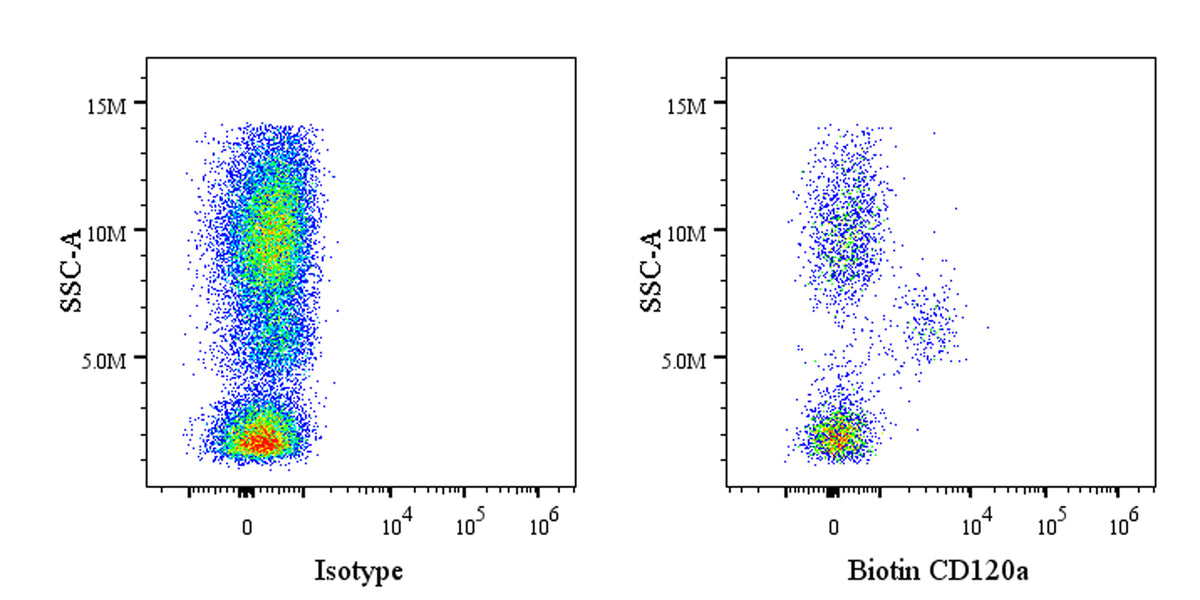
Flow cytometric analysis of Human CD120a expression on human peripheral blood cells. Human peripheral blood cells were stained with either Biotin IgG2a, k Isotype Control (left panel) or SDT Biotin Mouse Anti-Human CD120a Antibody (right panel) at 5 μl/test followed by Sav-PE. Flow cytometry and data analysis were performed using BD FACSymphony™ A1 and FlowJo™ software.
Biotin Mouse Anti-Human CD120a Antibody (S-4206)
Biotin Mouse Anti-Human CD120a Antibody (S-4206)
Price:
Regular price
$100 USD
Regular price
Sale price
$100 USD
Unit price
per
For shipping services or bulk orders, you may request a quotation.
Secure checkout with

View full details
Product Details
Product Details
Product Specification
| Host | Mouse |
| Antigen | CD120a |
| Synonyms | Tumor necrosis factor receptor superfamily member 1A; Tumor necrosis factor receptor 1 (TNF-R1); Tumor necrosis factor receptor type I (TNF-RI; TNFR-I); p55; p60 |
| Location | Secreted, Cell membrane, Golgi apparatus membrane |
| Accession | P19438 |
| Clone Number | S-4206 |
| Antibody Type | Mouse mAb |
| Isotype | IgG2a,k |
| Application | FCM |
| Reactivity | Hu |
| Positive Sample | Human Peripheral Blood cells |
| Purification | Protein A |
| Concentration | 0.2 mg/ml |
| Conjugation | Biotin |
| Physical Appearance | Liquid |
| Storage Buffer | PBS pH7.4, 0.03% Proclin 300 |
| Stability & Storage | 12 months from date of receipt / reconstitution, 2 to 8 °C as supplied |
Dilution
| application | dilution | species |
| FCM | 5μl per million cells in 100μl volume | Hu |
Background
CD120a protein, also known as tumor necrosis factor receptor type 1 (TNF-R1, p55/p60), is a key receptor in the tumor necrosis factor (TNF) signaling pathway. It belongs to the TNF receptor superfamily and is widely expressed on the surface of various nucleated cells. Upon binding to its ligands TNF-α and lymphotoxin-α (LT-α), CD120a recruits multiple adaptor proteins (such as TRADD) through its intracellular death domain (DD), thereby initiating two major downstream signaling pathways: one activates the caspase cascade to induce apoptosis, playing important roles in immune regulation, cellular homeostasis, and anti-tumor immunity; the other activates the NF-κB and MAPK pathways to promote the expression of inflammatory factors, cell survival, and proliferation. This dual “life-or-death” function makes CD120a a central regulatory molecule in inflammation, autoimmune diseases, tumorigenesis, and infectious diseases. For instance, in autoimmune conditions such as rheumatoid arthritis and inflammatory bowel disease, its abnormal activation can lead to excessive inflammatory damage. Consequently, biologics targeting the CD120a/TNF-α axis (e.g., infliximab, adalimumab) have become crucial clinical therapies. Additionally, CD120a is involved in systemic inflammatory responses, such as fever and acute-phase reactions, serving as a vital bridge between innate and adaptive immunity.
Picture
Picture
FC