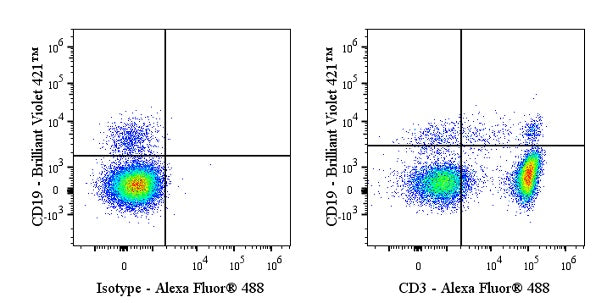
Flow cytometric analysis of human PBMC (human peripheral blood mononuclear cells) labeled with human CD3 antibody at 1/500 dilution (1 μg) / (right panel) compared with a Mouse IgG1, κ Isotype Control / (left panel). Goat Anti-Mouse IgG Alexa Fluor® 488 was used as the secondary antibody. Then cells were stained with CD19 - Brilliant Violet 421™ antibody separately. Flow cytometry and data analysis were performed using Agilent NovoCyte Quanteon and FlowJo™ software.
Invivo Anti-Human CD3 Recombinant mAb
Invivo Anti-Human CD3 Recombinant mAb
Price:
Regular price
$170 USD
Regular price
Sale price
$170 USD
Unit price
per
For shipping services or bulk orders, you may request a quotation.
Secure checkout with

View full details
Product Details
Product Details
Product Specification
| Host | Mouse |
| Antigen | CD3ε |
| Synonyms | T-cell surface glycoprotein CD3 epsilon chain; T-cell surface antigen T3/Leu-4 epsilon chain; T3E; CD3E |
| Location | Cell membrane |
| Accession | P07766 |
| Clone Number | UCHT1 |
| Antibody Type | Mouse mAb |
| Isotype | Mouse IgG1, κ |
| Isotype Control | Invivo mouse IgG1 isotype control |
| Application | FCM, in vivo cell specific depletion, in vivo cell specific stimulation/activation |
| Reactivity | Hu |
| Positive Sample | Human PBMC |
| Purification | Protein G |
| Concentration | 5 mg/ml |
| Purity | >95% (Determined by SDS-PAGE) |
| Endotoxin | <1EU/mg |
| Conjugation | Unconjugated |
| Physical Appearance | Liquid |
| Storage Buffer | PBS pH7.4, containing no preservative |
| Stability & Storage | 2 to 8 °C for 2 weeks under sterile conditions; |
Dilution
| application | dilution | species |
| FCM | 1:500 | Hu |
Background
CD3ε is a subunit of the CD3 complex, which is a critical component of the T-cell receptor (TCR) complex on T cells. Together with CD3γ, CD3δ, and CD3ζ, it forms the TCR-CD3 complex that plays a vital role in coupling antigen recognition to intracellular signaling pathways. This complex is essential for T cell activation, proliferation, and differentiation. CD3ε contains an extracellular immunoglobulin domain, a transmembrane region, and a cytoplasmic tail with an immunoreceptor tyrosine-based activation motif (ITAM). Upon antigen recognition, the ITAMs in CD3ε are phosphorylated, initiating downstream signaling cascades that lead to T cell activation. Additionally, CD3ε interacts with other signaling molecules like Lck and Nck through its unique motifs, further modulating T cell responses. Its importance in T cell function makes CD3ε a target for immunotherapies, including cancer treatments and autoimmune disease management.
Picture
Picture
FC