Sensitivity experiment of UA-Glo Nanoluc split Extracellular Assay System
HEK293 cells were seeded in 6-well culture plates, with a cell density of 80-90%. The target molecule expression plasmid with secreted type of cleavage enzyme small fragment tag was transfected. After 24 hours of transfection, the cells were resuspended in DMEM (10% FBS) medium, and added to 96-well clear cell plates with 1250 cells per well, 50 μL per well. After 24 hours, the cell plates were taken out for testing: add the UA-Glo micro cleavage luciferase extracellular detection reagent at room temperature for equilibrium for 30 minutes, and read the values and S/B (ratio of transfected cells to DMEM (10% FBS)).
UA-Glo® Nano luciferase split Extracellular Assay System
UA-Glo® Nano luciferase split Extracellular Assay System
Price:
Regular price
$125 USD
Regular price
Sale price
$125 USD
Unit price
per
For shipping services or bulk orders, you may request a quotation.
Secure checkout with

View full details
Product Details
Product Details
Product Specification
| Synonyms | Microsplit Luciferase Extracellular Assay Kit |
| Stability & Storage | Dry ice transportation. Store at -20°C or below, protected from light, with a shelf life of 12 months. For long-term storage, it is recommended to store the substrate at -80°C. After initial use, the substrate should be aliquoted and stored at -20°C or below, avoiding more than 3 freeze-thaw cycles. |
Background
The NanoLuciferase split enzyme technology divides the luciferase protein molecule into two distinct fragments, which are expressed separately. These fragments exhibit high affinity and can rapidly self-assemble into a complete, enzymatically active luciferase molecule within the same reaction system. Detection of the split NanoLuciferase activity can be utilized to study the expression levels, interactions, and dynamic changes of target proteins in cells.
The extracellular detection kit for split NanoLuciferase provides a non-lytic cell buffer and reaction substrate, while the small fragment of the split luciferase is cloned into an expression vector and co-expressed with the target protein as a tag. This target protein is either secreted or located on the extracellular side of the cell membrane. The expression vector carrying the small split luciferase fragment-tagged target protein must be constructed, prepared, and transfected into cells by the user.
Components
The buffer and substrate are separately filled into 10 ml or 100 ml brown bottles and 2 ml spiral tubes, with the specifications as follows:
Buffer |
Substrate |
Number of wells in 96-well plate |
Number of wells in 384-well plate |
10 ml |
50ml |
100 |
500 |
100 ml |
0.5ml |
1,000 |
5,000 |
10X100 ml |
10X0.5ml |
10,000 |
50,000 |
Protocol
Seed the cells to be tested at an appropriate density in 96-well or 384-well cell culture plates. The cells to be tested can be transiently transfected cells expressing the target protein with a split luciferase small fragment tag, stable cell lines, or endogenously expressing cell lines. White plates are recommended.
Perform relevant treatments on the cells according to project requirements and continue culturing for an appropriate duration.
Take out the assay buffer and equilibrate it to room temperature. Centrifuge the substrate tube for 10 seconds to collect the contents at the bottom, then place it on an ice box.
Take out the cell culture plate to be tested and equilibrate it to room temperature.
Prepare 1x assay working solution: Determine the volume of reagents to be prepared based on experimental needs. During preparation, add the required substrate and split enzyme large fragment (user-provided, optimal concentration needs optimization) to the buffer in the specified ratio, and mix thoroughly. The substrate in the kit is 200x, and it is recommended to prepare the split enzyme large fragment at a concentration of 100x. Dilute with buffer to 1x assay working solution before use. Protect from light.
Add an equal volume of 1x assay working solution to the test wells, e.g., add 100 μL of 1x assay working solution to 100 μL of medium. Shake the plate for 3 minutes and place it in the dark to continue lysing for 10 minutes.
Read the fluorescence signal on a fluorescence plate reader. Save the data and perform data processing and analysis.
Guidelines
1. Reagent dosage: It is not recommended to arbitrarily change the amount of reaction reagents without rigorous validation.
2. Reagents from different batches should not be mixed.
3. Aliquot storage: Store reaction reagents according to the instructions to ensure reagent stability.
Picture
Picture
Bioactivity
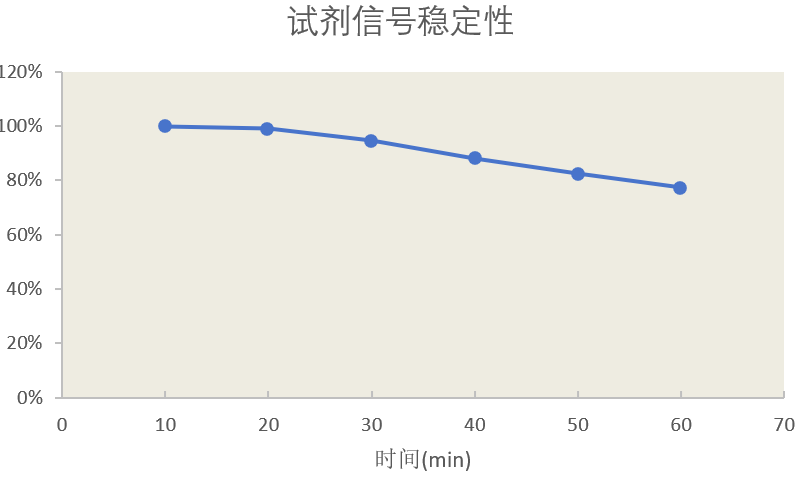
Stability test of UA-Glo Nanoluc split extracellular detection reagent:
HEK293 cells were seeded in 6-well culture plates with a density of 80-90%. The target molecule expression plasmid with the secretory mitotic enzyme small fragment tag was transfected. After 24 hours of transfection, the cells were resuspended in DMEM (10% FBS) medium and added to 96-well clear cell plates with 1250 cells per well, 50 μL per well. After 24 hours, the cell plates were taken out for testing: the detection reagent was added to balance at room temperature and the detection was conducted within 10 minutes to 60 minutes, with the reading at 10 minutes set as 100% as the basis for plotting the stability graph.
The signal half-life of UA-Glo micro-mitotic luciferase extracellular detection reagent is > 2 hours.