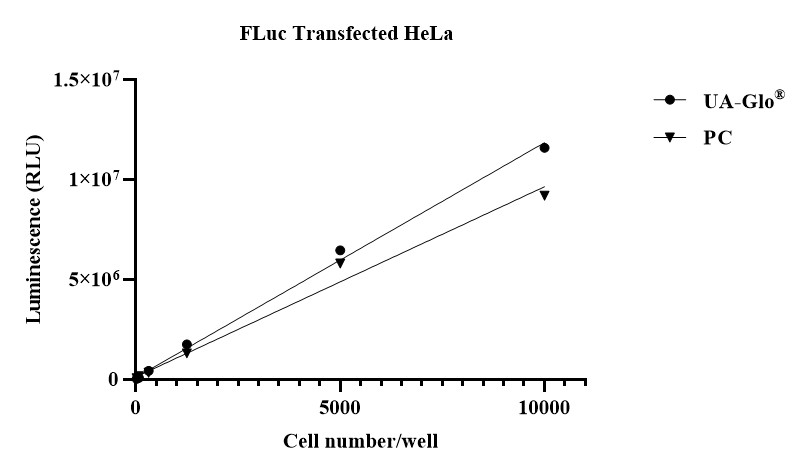
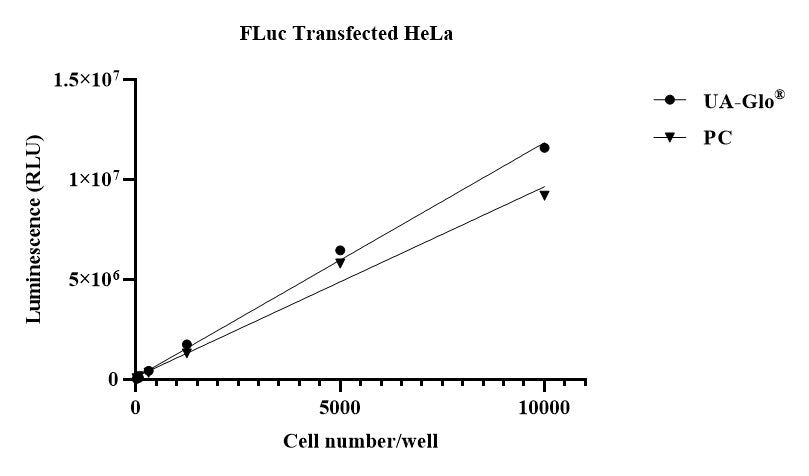
Cell Count Sensitivity Test
UA-Glo® Bright Luciferase Assay System
UA-Glo® Bright Luciferase Assay System
Price:
Regular price
$308 USD
Regular price
Sale price
$308 USD
Unit price
per
For shipping services or bulk orders, you may request a quotation.
Secure checkout with

View full details
Product Details
Product Details
Product Specification
| Synonyms | High-Intensity Luciferase Assay Kit |
| Stability & Storage |
Dry ice shipping. Store protected from light at -20°C or below, and long-term storage (>3 months) at -80°C is recommended. The expiration date is indicated on the reagent bottle label. After initial use, it is recommended to aliquot and store the reagent protected from light at -20°C or below. The reagent can undergo no more than 5 freeze-thaw cycles. Storage at 4°C for 24 hours or at room temperature (22°C) for 5 hours does not affect functionality, with activity retention >90%. |
Background
The UA-Glo® High-Luminance Luciferase Assay Kit can be used to quantitatively detect the expression level of the reporter gene luciferase in cells. The homogeneous, ready-to-use formulation requires only a single addition for detection, reducing experimental errors that may arise from multiple additions. This product features high sensitivity and a signal half-life > 0.5 hr, making it particularly suitable for high-throughput detection of samples with low luciferase expression levels.
Components
The components and specifications of the UA-Glo® High-Luminance Luciferase Assay Kit are as follows. The detectable reactions for 96-/384-well plates are calculated based on adding 100 μL/20 μL of detection reagent per well.
Specification |
Detectable 96-well plate reactions |
Detectable 384-well plate reactions |
10 mL |
100 |
500 |
100 mL |
1,000 |
5,000 |
10X100 mL |
10,000 |
50,000 |
Protocol
UA-Glo® The UA-Glo® High-Luminance Luciferase Assay Kit detects the activity of firefly luciferase reporter genes in cells through a luciferase reaction. The luciferase reaction exhibits extremely high sensitivity, and parameters such as pH, temperature, and experimental system setup significantly influence the reaction. Under most experimental conditions, direct comparison of absolute readings between samples is not recommended. It is advised to include the same reference controls on each experimental plate, and normalize the sample readings with the reference control and solvent carrier control readings before data processing and comparison.
- Seed experimental cells expressing the firefly luciferase reporter gene at an appropriate density in 96-well or 384-well white/clear cell culture plates according to experimental requirements.
- Perform cell treatments as required and proceed to detect luciferase expression levels.
- Take out the UA-Glo® High-Luminance Luciferase Assay Reagent. After complete thawing, equilibrate the reagent to room temperature (22℃-25℃) and invert to mix thoroughly.
Take out the experimental cell plate and equilibrate it to room temperature. The luciferase reaction is sensitive to temperature changes. Both the assay reagent and the cell plate must be equilibrated to room temperature, and the temperature should remain constant during testing (±1℃).
Add an equal volume of UA-Glo® High-Luminance Luciferase Assay Reagent to each well of the cell plate as the culture medium. For example, add 100 µL of assay reagent to 100 µL of cells in a 96-well plate, or 20 µL of assay reagent to 20 µL of cells in a 384-well plate.
- Shake the plate at medium speed for 1 min and incubate in the dark for 10 min to stabilize the luminescent signal.
- Read the luminescent signal on a luminometer or multifunctional plate reader, preferably within 30 min.
Guidelines
1) Different batches are not recommended for mixed use
2) Without strict validation, it is not recommended to change the dosage of detection reagents
3) For research use only
Picture
Picture
Bioactivity