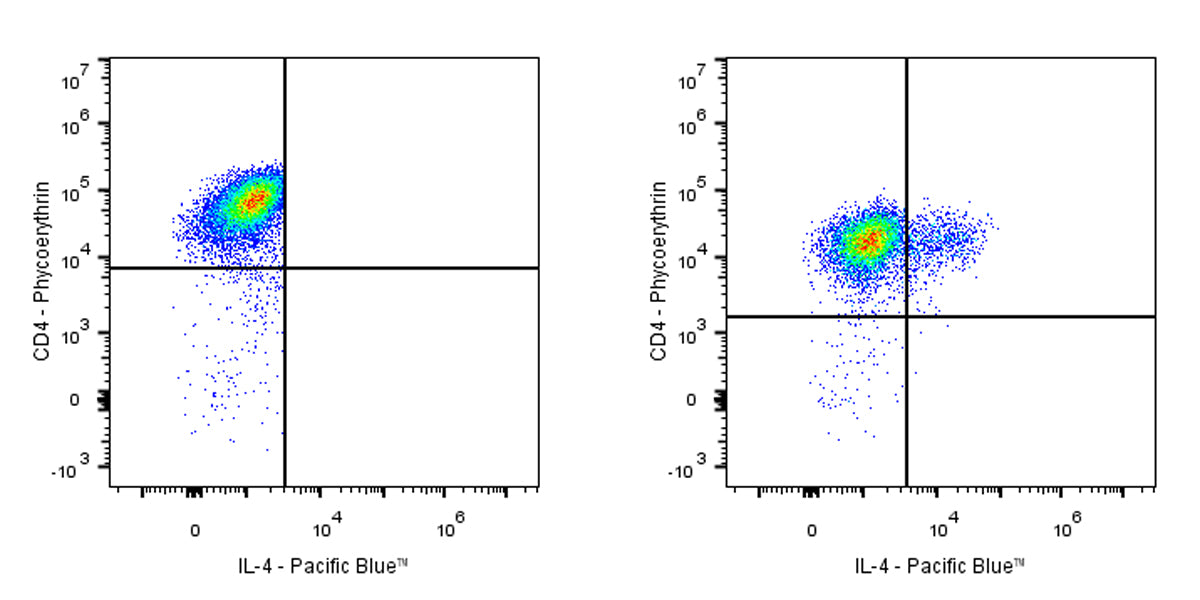
Flow cytometric analysis of IL-4 expression in Human PBMC polarized with Th2 Polarization Kit, Human (UA090018). Th2 polarized Human PBMC were harvested and restimulated for 5 hr with PMA and Ionomycin in the presence of Brefeldin A (Right Panel) or unstimulated (Left Panel).
The cells were harvested and fixed with 4% PFA and permeabilized with Intracellular Fixation & Permeabilization Buffer Set. The cells were then stained with PE Mouse Anti-Human CD4 and SDT Pacific Blue Rat Anti-Human IL-4 Antibody at 5μl/test. Total viable cells, as determined by Fixable Viability Dye 515 (S0D0013), were used for analysis. Flow cytometry and data analysis were performed using BD FACSymphony™ A1 and FlowJo™ software.
Pacific Blue Rat Anti-Human IL-4 Antibody (MP4-25D2)
Pacific Blue Rat Anti-Human IL-4 Antibody (MP4-25D2)
Price:
Regular price
$170 USD
Regular price
Sale price
$170 USD
Unit price
per
For shipping services or bulk orders, you may request a quotation.
Secure checkout with

View full details
Product Details
Product Details
Product Specification
| Host | Rat |
| Antigen | IL-4 |
| Synonyms | Interleukin-4; B-cell stimulatory factor 1 (BSF-1); Binetrakin; Lymphocyte stimulatory factor 1; Pitrakinra; IL4 |
| Location | Secreted |
| Accession | P05112 |
| Clone Number | MP4-25D2 |
| Antibody Type | Rat mAb |
| Isotype | IgG1 |
| Application | ICFCM |
| Reactivity | Hu |
| Positive Sample | Th2 polarized Human PBMC |
| Purification | Protein G |
| Concentration | 0.2 mg/ml |
| Conjugation | Pacific Blue |
| Physical Appearance | Liquid |
| Storage Buffer | PBS, 1% BSA, 0.3% Proclin 300 |
| Stability & Storage | 12 months from date of receipt / reconstitution, 2 to 8 °C as supplied |
Dilution
| application | dilution | species |
| ICFCM | 5μl per million cells in 100μl volume | Hu |
Background
Interleukin-4 (IL-4) is a 15–20 kDa, glycosylated, four-α-helical cytokine secreted primarily by Th2-polarized CD4⁺ T cells, mast cells, eosinophils and basophils that signals through a heterodimeric receptor complex composed of the IL-4Rα chain (shared with IL-13) and either the common γ-chain (type I receptor, hematopoietic cells) or IL-13Rα1 (type II receptor, non-hematopoietic cells) to activate STAT6-dependent transcriptional programs, thereby orchestrating the switch of B cells to IgE and IgG1 production, driving alternative activation of macrophages (M2), expanding Th2 and Treg subsets, suppressing Th1/Th17 responses, and exerting critical homeostatic and pathological roles in allergy, asthma, helminth immunity, tissue repair and tumor immune evasion.
Picture
Picture
FC