WB result of NFIB/NF1B2 Recombinant Rabbit mAb
Primary antibody: NFIB/NF1B2 Recombinant Rabbit mAb at 1/1000 dilution
Lane 1: RPMI-8226 whole cell lysate 20 µg
Lane 2: MCF7 whole cell lysate 20 µg
Lane 3: HeLa whole cell lysate 20 µg
Secondary antibody: Goat Anti- rabbit IgG, (H+L), HRP conjugated at 1/10000 dilution
Predicted MW: 47 kDa
Observed MW: 45-70 kDa
NFIB / NF1B2 Recombinant Rabbit mAb (S-3046-78)
NFIB / NF1B2 Recombinant Rabbit mAb (S-3046-78)
Price:
Regular price
$100 USD
Regular price
Sale price
$100 USD
Unit price
per
For shipping services or bulk orders, you may request a quotation.
Secure checkout with

View full details
Product Details
Product Details
Product Specification
| Host | Rabbit |
| Antigen | NFIB / NF1B2 |
| Synonyms | Nuclear factor 1 B-type; NF1-B; Nuclear factor 1/B; CCAAT-box-binding transcription factor (CTF); Nuclear factor I/B (NF-I/B; NFI-B); TGGCA-binding protein |
| Immunogen | Synthetic Peptide |
| Location | Nucleus |
| Accession | O00712 |
| Clone Number | S-3046-78 |
| Antibody Type | Recombinant mAb |
| Isotype | IgG |
| Application | WB |
| Reactivity | Hu, Ms, Rt |
| Positive Sample | RPMI-8226, MCF7, HeLa, NIH/3T3 |
| Predicted Reactivity | Bv, Hm |
| Purification | Protein A |
| Concentration | 0.5 mg/ml |
| Conjugation | Unconjugated |
| Physical Appearance | Liquid |
| Storage Buffer | PBS, 40% Glycerol, 0.05% BSA, 0.03% Proclin 300 |
| Stability & Storage | 12 months from date of receipt / reconstitution, -20 °C as supplied |
Dilution
| application | dilution | species |
| WB | 1:1000 | Hu, Ms, Rt |
Background
The NFIB protein, also known as Nuclear Factor I B or NF1B2, is a transcription factor belonging to the NFI (Nuclear Factor I) family of site-specific DNA-binding proteins that play crucial roles in regulating gene expression during development and cellular differentiation. Encoded by the NFIB gene located on human chromosome 9p23-p22, this protein contains a highly conserved N-terminal DNA-binding domain that recognizes the palindromic consensus sequence 5'-TTGGC(N)5GCCAA-3', thereby controlling the transcription of target genes involved in various biological processes including brain development, lung maturation, and skeletal patterning. NFIB functions as both a transcriptional activator and repressor depending on cellular context and promoter architecture, and it forms homodimers or heterodimers with other NFI family members (NFIA, NFIC, and NFID) to exert its regulatory effects. During embryonic development, NFIB is essential for proper formation of the corpus callosum, cerebellar vermis, and facial structures, while in the postnatal period it regulates terminal differentiation of various cell types including chondrocytes, osteoblasts, and respiratory epithelial cells. Aberrant NFIB expression or function has been implicated in multiple pathological conditions, including certain forms of intellectual disability, craniofacial abnormalities, and various cancers where it can act as either an oncogene or tumor suppressor depending on the tissue type. The protein's activity is modulated through post-translational modifications and interactions with various co-activators and co-repressors, making it a critical node in the gene regulatory networks that govern mammalian development and homeostasis.
Picture
Picture
Western Blot
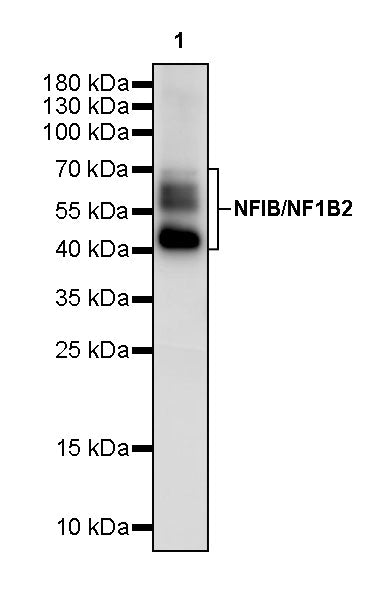
WB result of NFIB/NF1B2 Recombinant Rabbit mAb
Primary antibody: NFIB / NF1B2 Recombinant Rabbit mAb at 1/1000 dilution
Lane 1: NIH/3T3 whole cell lysate 20 µg
Secondary antibody: Goat Anti- rabbit IgG, (H+L), HRP conjugated at 1/10000 dilution
Predicted MW: 47 kDa
Observed MW: 45-70 kDa
WB result of NFIB/NF1B2 Recombinant Rabbit mAb
Primary antibody: NFIB/NF1B2 Recombinant Rabbit mAb at 1/1000 dilution
Lane 1: C6 whole cell lysate 20 µg
Secondary antibody: Goat Anti- rabbit IgG, (H+L), HRP conjugated at 1/10000 dilution
Predicted MW: 47 kDa
Observed MW: 45-70 kDa