WB result of Neurofibromin Recombinant Rabbit mAb
Primary antibody: Neurofibromin Recombinant Rabbit mAb at 1/1000 dilution
Lane 1: SW480 whole cell lysate 20 µg
Lane 2: HeLa whole cell lysate 20 µg
Lane 3: 293T whole cell lysate 20 µg
Lane 4: A204 whole cell lysate 20 µg
Lane 5: LNCaP whole cell lysate 20 µg
Lane 6: A431 whole cell lysate 20 µg
Secondary antibody: Goat Anti- rabbit IgG, (H+L), HRP conjugated at 1/10000 dilution
Predicted MW: 319 kDa
Observed MW: 280 kDa
Neurofibromin Recombinant Rabbit mAb (S-3540-15)
Neurofibromin Recombinant Rabbit mAb (S-3540-15)
Price:
Regular price
$100 USD
Regular price
Sale price
$100 USD
Unit price
per
For shipping services or bulk orders, you may request a quotation.
Secure checkout with

View full details
Product Details
Product Details
Product Specification
| Host | Rabbit |
| Antigen | Neurofibromin |
| Synonyms | Neurofibromatosis-related protein NF-1; NF1 |
| Immunogen | Synthetic Peptide |
| Location | Nucleus, Cell membrane |
| Accession | P21359 |
| Clone Number | S-3540-15 |
| Antibody Type | Recombinant mAb |
| Isotype | IgG |
| Application | WB |
| Reactivity | Hu, Ms, Rt |
| Positive Sample | SW480, HeLa, 293T, A204, LNCaP, A431, NIH/3T3, mouse brain, PC-12, rat brain |
| Purification | Protein A |
| Concentration | 0.5 mg/ml |
| Conjugation | Unconjugated |
| Physical Appearance | Liquid |
| Storage Buffer | PBS, 40% Glycerol, 0.05% BSA, 0.03% Proclin 300 |
| Stability & Storage | 12 months from date of receipt / reconstitution, -20 °C as supplied |
Dilution
| application | dilution | species |
| WB | 1:1000 | Hu, Ms, Rt |
Background
Neurofibromin is a large, ubiquitously expressed tumor suppressor protein encoded by the NF1 gene that functions primarily as a Ras GTPase-activating protein (GAP), negatively regulating the Ras/MAPK signaling cascade by accelerating the hydrolysis of GTP to GDP on active Ras proteins, thereby terminating downstream proliferative signals and maintaining cellular homeostasis. Loss-of-function mutations in the NF1 gene cause neurofibromatosis type 1 (NF1), a common autosomal dominant neurocutaneous disorder characterized by café-au-lait spots, benign peripheral nerve sheath tumors (neurofibromas), skeletal abnormalities, and predisposition to malignant peripheral nerve sheath tumors and other cancers, resulting from uncontrolled Ras activation and dysregulated cell growth. Structurally, neurofibromin comprises multiple functional domains including the central GAP-related domain (GRD) essential for Ras inactivation, cysteine-serine-rich domains (CSRD) involved in lipid metabolism and membrane targeting, and a C-terminal domain that mediates interactions with syndecans, microtubules, and cAMP signaling pathways, implicating the protein in diverse processes beyond tumor suppression, such as neural crest cell migration, synaptic plasticity, learning, and memory formation.
Picture
Picture
Western Blot
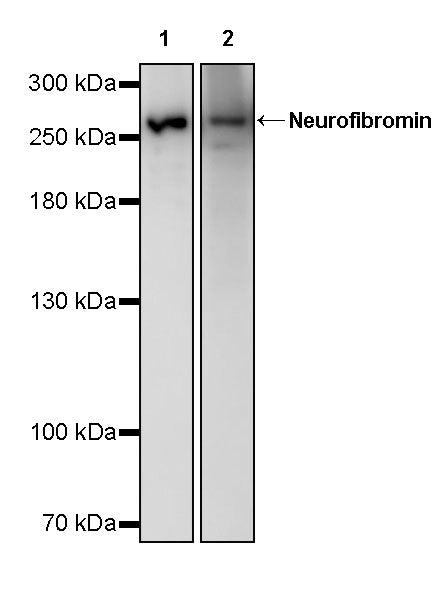
WB result of Neurofibromin Recombinant Rabbit mAb
Primary antibody: Neurofibromin Recombinant Rabbit mAb at 1/1000 dilution
Lane 1: NIH/3T3 whole cell lysate 20 µg
Lane 2: mouse brain lysate 20 µg
Secondary antibody: Goat Anti- rabbit IgG, (H+L), HRP conjugated at 1/10000 dilution
Predicted MW: 319 kDa
Observed MW: 280 kDa
WB result of Neurofibromin Recombinant Rabbit mAb
Primary antibody: Neurofibromin Recombinant Rabbit mAb at 1/1000 dilution
Lane 1: PC-12 whole cell lysate 20 µg
Lane 2: rat brain lysate 20 µg
Secondary antibody: Goat Anti- rabbit IgG, (H+L), HRP conjugated at 1/10000 dilution
Predicted MW: 319 kDa
Observed MW: 280 kDa