WB result of NAT10 Recombinant Rabbit mAb
Primary antibody: NAT10 Recombinant Rabbit mAb at 1/10000 dilution
Lane 1: 293T whole cell lysate 20 µg
Lane 2: HeLa whole cell lysate 20 µg
Lane 3: A549 whole cell lysate 20 µg
Secondary antibody: Goat Anti- rabbit IgG, (H+L), HRP conjugated at 1/10000 dilution
Predicted MW: 116 kDa
Observed MW: 120 kDa
NAT10 Recombinant Rabbit mAb (S-2547-125)
NAT10 Recombinant Rabbit mAb (S-2547-125)
Price:
Regular price
$100 USD
Regular price
Sale price
$100 USD
Unit price
per
For shipping services or bulk orders, you may request a quotation.
Secure checkout with

View full details
Product Details
Product Details
Product Specification
| Host | Rabbit |
| Antigen | NAT10 |
| Synonyms | RNA cytidine acetyltransferase; 18S rRNA cytosine acetyltransferase; N-acetyltransferase 10; N-acetyltransferase-like protein (hALP); ALP s; KIAA1709 |
| Immunogen | Synthetic Peptide |
| Location | Nucleus |
| Accession | Q9H0A0 |
| Clone Number | S-2547-125 |
| Antibody Type | Recombinant mAb |
| Isotype | IgG |
| Application | WB, ICC |
| Reactivity | Hu, Ms, Rt |
| Positive Sample | 293T, HeLa, A549, NIH/3T3, mouse brain, mouse heart, C6, rat brain, rat heart |
| Purification | Protein A |
| Concentration | 0.5 mg/ml |
| Conjugation | Unconjugated |
| Physical Appearance | Liquid |
| Storage Buffer | PBS, 40% Glycerol, 0.05% BSA, 0.03% Proclin 300 |
| Stability & Storage | 12 months from date of receipt / reconstitution, -20 °C as supplied |
Dilution
| application | dilution | species |
| WB | 1:1000 | Hu, Ms, Rt |
| ICC | 1:500 | Hu, Ms |
Background
NAT10 (N-acetyltransferase 10) is a 116 kDa, 1,025-amino-acid enzyme that constitutes the sole known “writer” of N4-acetylcytidine (ac4C) on RNA, an evolutionarily conserved modification it installs co-transcriptionally in tRNA, 18S rRNA, mRNA and snoRNA by coupling ATP/GTP hydrolysis to acetyl-CoA-dependent catalysis through its tri-domain architecture—an N-terminal GNAT acetyltransferase core, a central tRNA-binding THUMP domain, and a C-terminal RNA-helicase module—while also acting as a lysine acetyltransferase for histones and non-histone proteins such as α-tubulin and Eg5, thereby integrating epigenetic regulation, ribosome biogenesis, translation fidelity, cell-cycle progression and apoptosis; in human cancers NAT10 frequently undergoes nucleo-cytoplasmic mis-localization via mutations in its bipartite nuclear-localization signals (residues 68-75 and 989-1018), driving cytoskeletal remodeling, metastasis and chemo-resistance, and its expression is further controlled by PIWI-interacting RNAs and stress pathways, making it a central metabolic and oncogenic signaling node.
Picture
Picture
Western Blot
WB result of NAT10 Recombinant Rabbit mAb
Primary antibody: NAT10 Recombinant Rabbit mAb at 1/10000 dilution
Lane 1: NIH/3T3 whole cell lysate 20 µg
Secondary antibody: Goat Anti- rabbit IgG, (H+L), HRP conjugated at 1/10000 dilution
Predicted MW: 116 kDa
Observed MW: 120 kDa
WB result of NAT10 Recombinant Rabbit mAb
Primary antibody: NAT10 Recombinant Rabbit mAb at 1/1000 dilution
Lane 1: mouse brain lysate 20 µg
Lane 2: mouse heart lysate 20 µg
Secondary antibody: Goat Anti- rabbit IgG, (H+L), HRP conjugated at 1/10000 dilution
Predicted MW: 116 kDa
Observed MW: 120 kDa
WB result of NAT10 Recombinant Rabbit mAb
Primary antibody: NAT10 Recombinant Rabbit mAb at 1/1000 dilution
Lane 1: C6 whole cell lysate 20 µg
Lane 2: rat brain lysate 20 µg
Lane 3: rat heart lysate 20 µg
Secondary antibody: Goat Anti- rabbit IgG, (H+L), HRP conjugated at 1/10000 dilution
Predicted MW: 116 kDa
Observed MW: 120 kDa
Immunocytochemistry
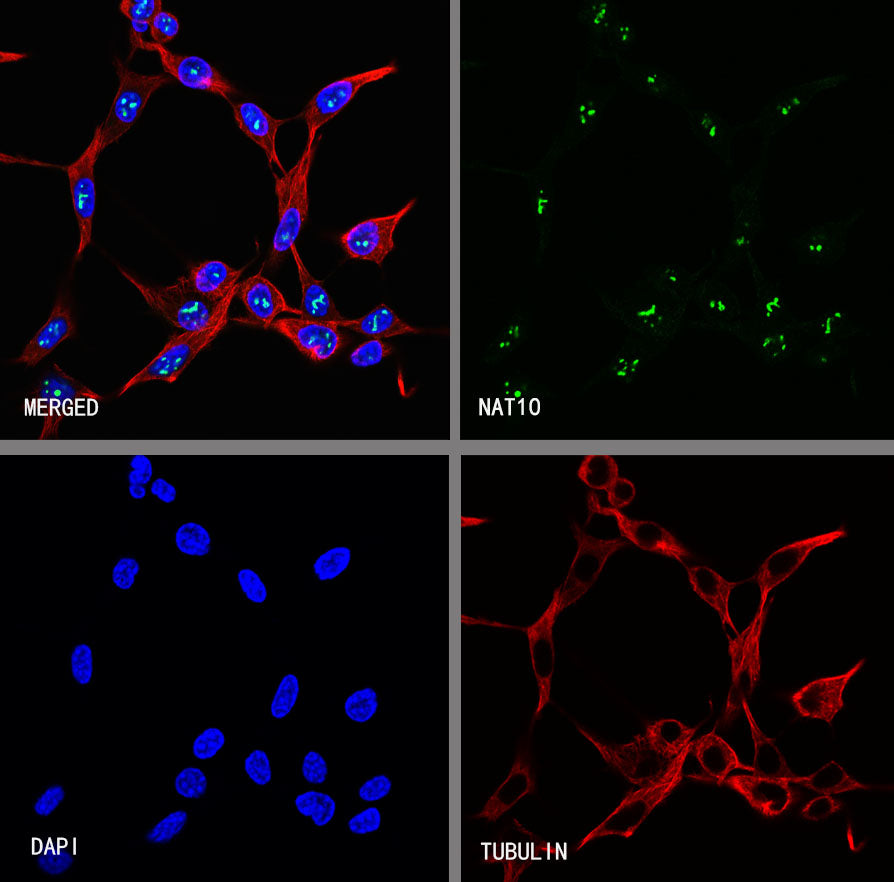
ICC shows positive staining in HeLa cells. Anti-NAT10 antibody was used at 1/500 dilution (Green) and incubated overnight at 4°C. Goat polyclonal Antibody to Rabbit IgG - H&L (Alexa Fluor® 488) was used as secondary antibody at 1/1000 dilution. The cells were fixed with 100% ice-cold methanol and permeabilized with 0.1% PBS-Triton X-100. Nuclei were counterstained with DAPI (Blue). Counterstain with tubulin (Red).
ICC shows positive staining in NIH/3T3 cells. Anti-NAT10 antibody was used at 1/500 dilution (Green) and incubated overnight at 4°C. Goat polyclonal Antibody to Rabbit IgG - H&L (Alexa Fluor® 488) was used as secondary antibody at 1/1000 dilution. The cells were fixed with 100% ice-cold methanol and permeabilized with 0.1% PBS-Triton X-100. Nuclei were counterstained with DAPI (Blue). Counterstain with tubulin (Red).