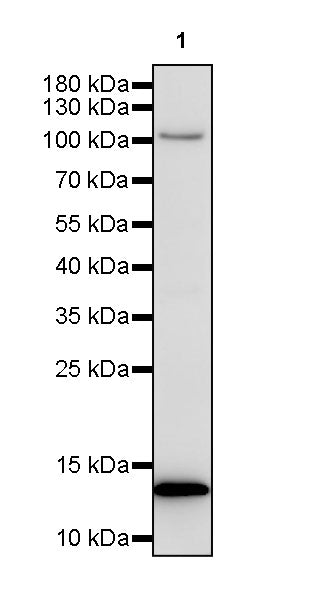
WB result of KCNQ2 Recombinant Rabbit mAb
Primary antibody: KCNQ2 Recombinant Rabbit mAb at 1/1000 dilution
Lane 1: mouse brain lysate 20 µg
Secondary antibody: Goat Anti- rabbit IgG, (H+L), HRP conjugated at 1/10000 dilution
Predicted MW: 96 kDa
Observed MW: 14, 105 kDa
KCNQ2 Recombinant Rabbit mAb (S-3465-49)
KCNQ2 Recombinant Rabbit mAb (S-3465-49)
Price:
Regular price
$100 USD
Regular price
Sale price
$100 USD
Unit price
per
For shipping services or bulk orders, you may request a quotation.
Secure checkout with

View full details
Product Details
Product Details
Product Specification
| Host | Rabbit |
| Antigen | KCNQ2 |
| Synonyms | Potassium voltage-gated channel subfamily KQT member 2; KQT-like 2; Neuroblastoma-specific potassium channel subunit alpha KvLQT2; Voltage-gated potassium channel subunit Kv7.2 |
| Immunogen | Synthetic Peptide |
| Location | Cell membrane |
| Accession | O43526 |
| Clone Number | S-3465-49 |
| Antibody Type | Recombinant mAb |
| Isotype | IgG |
| Application | WB |
| Reactivity | Hu, Ms, Rt |
| Positive Sample | mouse brain, rat brain |
| Purification | Protein A |
| Concentration | 2 mg/ml |
| Conjugation | Unconjugated |
| Physical Appearance | Liquid |
| Storage Buffer | PBS, 40% Glycerol, 0.05% BSA, 0.03% Proclin 300 |
| Stability & Storage | 12 months from date of receipt / reconstitution, -20 °C as supplied |
Dilution
| application | dilution | species |
| WB | 1:1000 | Hu, Ms, Rt |
Background
The KCNQ2 protein is a voltage-gated potassium channel α-subunit, encoded by the KCNQ2 gene, that plays a critical role in regulating neuronal excitability throughout the central nervous system. Predominantly expressed in the brain, KCNQ2 primarily forms heterotetrameric complexes with KCNQ3 subunits to constitute the M-current (IKM), a slowly activating, non-inactivating potassium current that acts as a crucial brake on repetitive neuronal firing by stabilizing the resting membrane potential and preventing excessive depolarization. Functionally, this current is activated at subthreshold membrane potentials and is essential for controlling action potential threshold, firing frequency, and burst accommodation in neurons. Clinically, mutations in KCNQ2 are associated with a spectrum of epileptic disorders, ranging from benign familial neonatal epilepsy (BFNE) to severe developmental and epileptic encephalopathies (DEE) characterized by refractory seizures, intellectual disability, and neurodevelopmental impairment. The KCNQ2 channel serves as the primary pharmacological target for retigabine (ezogabine), an antiepileptic drug that activates the channel by inducing a conformational shift favoring the open state, thereby enhancing the M-current and reducing neuronal hyperexcitability. Structurally, KCNQ2 contains six transmembrane domains (S1-S6), with the S4 segment functioning as the voltage sensor and the S5-S6 loop forming the channel pore, while intracellular domains mediate subunit assembly, trafficking, and calmodulin-dependent regulation of channel gating kinetics.
Picture
Picture
Western Blot
WB result of KCNQ2 Recombinant Rabbit mAb
Primary antibody: KCNQ2 Recombinant Rabbit mAb at 1/1000 dilution
Lane 1: rat brain lysate 20 µg
Secondary antibody: Goat Anti- rabbit IgG, (H+L), HRP conjugated at 1/10000 dilution
Predicted MW: 96 kDa
Observed MW: 14, 105 kDa