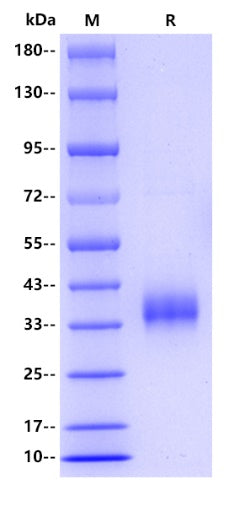
2 μg(R: reducing conditions)
Human Langerin/CD207 Protein, His tag
Human Langerin/CD207 Protein, His tag
Price:
Regular price
$235 USD
Regular price
Sale price
$235 USD
Unit price
per
For shipping services or bulk orders, you may request a quotation.
Secure checkout with

View full details
Product Details
Product Details
Product Specification
| Species | Human |
| Synonyms | C-type lectin domain family 4 member K, CLEC4K |
| Accession | Q9UJ71 |
| Amino Acid Sequence | Protein sequence (Q9UJ71, Pro65-Pro328, with C-His tag)PRFMGTISDVKTNVQLLKGRVDNISTLDSEIKKNSDGMEAAGVQIQMVNESLGYVRSQFLKLKTSVEKANAQIQILTRSWEEVSTLNAQIPELKSDLEKASALNTKIRALQGSLENMSKLLKRQNDILQVVSQGWKYFKGNFYYFSLIPKTWYSAEQFCVSRNSHLTSVTSESEQEFLYKTAGGLIYWIGLTKAGMEGDWSWVDDTPFNKVQSVRFWIPGEPNNAGNNEHCGNIKAPSLQAWNDAPCDKTFLFICKRPYVPSEP |
| Expression System | HEK293 |
| Molecular Weight | Predicted MW: 31.5 kDaObserved MW: 34-40 kDa |
| Purity | >90% by SDS-PAGE |
| Endotoxin | <1EU/μg |
| Conjugation | Unconjugated |
| Tag | with C-His Tag |
| Physical Appearance | Lyophilized powder |
| Storage Buffer | Lyophilized from a 0.2 μm filtered solution of PBS, pH7.4 with 3% trehalose. |
| Reconstitution | Reconstitute no more than 1 mg/mL according to the size in deionized water after rapid centrifugation. |
| Stability & Storage | 12 months from date of receipt, -20 to -70 °C as supplied. |
Background
Langerin (CD207) is a type II transmembrane protein which is encoded by the CD207 gene in humans. Langerin is C-type lectin receptor on Langerhans cells (LCs) and in mice also on dermal interstitial CD103+ dendritic cells (DC) and on resident CD8+ DC in lymph nodes. Langerin is expressed in LCs which are located in the epidermis and in vaginal and oral mucosa. Langerin recognizes and binds carbohydrates, such as mannose, fucose and N-acetylglucosamine. langerin has an antiviral activity and protects the cell against HIV-1 infection. If langerin is defect or titres of the virus are too high, the HIV-1 infection may happen. Langerin also binds mannose, which is in the outer membrane of fungi, and beta-glucans in membrane folds of fungi. By this way, LCs can protect themselves against pathogens like Candida, Saccharomyces and Malassezia furfur. Furthermore, langerin recognizes Gal-6-sulfated lactosamine of glioblastoma. In the respiratory epithelium, LCs recognize measles virus via langerin and then, they degrade it and present it to CD4+ T-cells.
Picture
Picture
SDS-PAGE