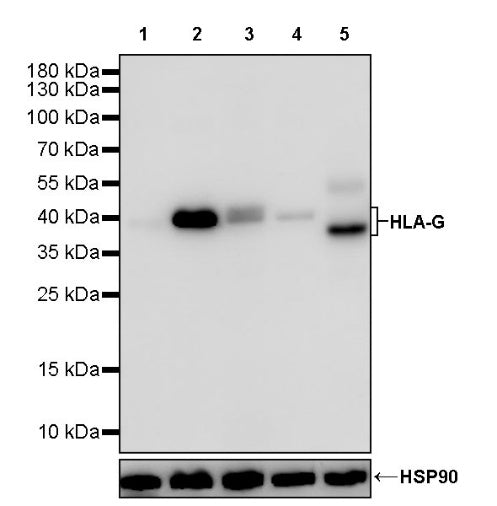
WB result of HLA-G Recombinant Rabbit mAb
Primary antibody: HLA-G Recombinant Rabbit mAb at 1/10000 dilution
Lane 1: LNCaP whole cell lysate 20 µg
Lane 2: SK-OV-3 whole cell lysate 20 µg
Lane 3: U937 whole cell lysate 20 µg
Lane 4: Jurkat whole cell lysate 20 µg
Lane 5: JEG-3 whole cell lysate 20 µg
Negative control: LNCaP whole cell lysate
Secondary antibody: Goat Anti-rabbit IgG, (H+L), HRP conjugated at 1/10000 dilution
Predicted MW: 38 kDa
Observed MW: 38, 40 kDa
HLA-G Recombinant Rabbit mAb (S-2711-78)
HLA-G Recombinant Rabbit mAb (S-2711-78)
Price:
Regular price
$100 USD
Regular price
Sale price
$100 USD
Unit price
per
For shipping services or bulk orders, you may request a quotation.
Secure checkout with

View full details
Product Details
Product Details
Product Specification
| Host | Rabbit |
| Antigen | HLA-G |
| Synonyms | HLA class I histocompatibility antigen, alpha chain G; HLA G antigen; MHC class I antigen G; HLA-6.0; HLAG |
| Immunogen | Recombinant Protein |
| Location | Secreted, Endosome, Cell membrane, Endoplasmic reticulum |
| Accession | P17693 |
| Clone Number | S-2711-78 |
| Antibody Type | Recombinant mAb |
| Isotype | IgG |
| Application | WB |
| Reactivity | Hu |
| Positive Sample | SK-OV-3, U937, Jurkat, JEG-3 |
| Purification | Protein A |
| Concentration | 0.5 mg/ml |
| Conjugation | Unconjugated |
| Physical Appearance | Liquid |
| Storage Buffer | PBS, 40% Glycerol, 0.05% BSA, 0.03% Proclin 300 |
| Stability & Storage | 12 months from date of receipt / reconstitution, -20 °C as supplied |
Dilution
| application | dilution | species |
| WB | 1:2000-1:10000 | Hu |
Background
HLA-G (human leukocyte antigen-G) is a non-classical, heavily glycosylated HLA class Ib molecule that is selectively expressed at the maternal-fetal interface (primarily on invading extravillous cytotrophoblasts) and in immune-privileged adult tissues, where it exerts potent tolerogenic functions through interaction with inhibitory receptors (ILT2, ILT4, KIR2DL4) on NK cells, T cells, macrophages and dendritic cells, thereby inhibiting cytotoxicity, proliferation and cytokine production, promoting regulatory T-cell generation, and ultimately contributing to immune evasion by tumors, acceptance of semi-allogeneic fetuses, and survival of transplanted grafts; its surface expression can be generated through alternative splicing of seven reported isoforms (HLA-G1 to -G7), with HLA-G1 being the full-length membrane-bound form that can also be proteolytically cleaved to generate soluble HLA-G5, while the other isoforms are either soluble or anchored via glycolipid, and its expression is tightly regulated by genetically polymorphic 5′-upstream regulatory elements, hypoxia, cytokines (IL-10, IFN-β, GM-CSF), and microRNAs, making HLA-G a key diagnostic, prognostic and therapeutic target in pregnancy complications, transplantation, autoimmunity and cancer.
Picture
Picture
Western Blot