| Usage |
1. Sample processing and requirements:
1、The detection range of the kit is not equivalent to the concentration range of the test substance in the sample
It is recommended to estimate the concentration of the test substance in the sample through relevant literature before the experiment and determine the actual concentration of the sample through pre-experiment.
If the concentration of the test substance in the sample is too high or too low, please dilute or concentrate the sample appropriately.
2、If the sample tested is not among the sample types listed in the instructions, it is recommended to conduct pre-experiments to verify its detection effectiveness.
3、Serum:
Whole blood samples collected in serum separation tubes were placed at room temperature 2 Hour or 2-8℃ Overnight, then 1000×g Centrifugation 20 Minutes, take the supernatant, or place the supernatant in -20℃ Or -80℃ Store, but repeated freezing and thawing should be avoided.
4、Plasma:
use EDTA Or heparin as an anticoagulant to collect a sample, and collect the sample after collection 30 Within minutes 2-8℃1000×g Centrifugation 15 Minutes, take the supernatant to detect, or place the supernatant in -20℃ Or -80℃ Store, but repeated freezing and thawing should be avoided.
5、Tissue homogenate:
With pre-cooled PBS (0.01M, pH=7.4) The tissue is flushed to remove residual blood (lysed red blood cells in the homogenate can affect the test results), and the tissue is weighed and cut into pieces.
Combining the shredded tissue with the corresponding volume PBS (Generally according to 1:9 Weight to volume ratio, such as 1g The tissue samples correspond to 9mL Of PBS The specific volume can be appropriately adjusted according to the experimental needs and recorded.
Recommended in PBS Add protease inhibitor) into a glass homogenizer and grind thoroughly on ice or grind in a homogenizer.
For further lysis of tissue cells, the homogenate can be sonicated, or freeze-thawed repeatedly.
Finally, the homogenate was mixed in 5000×g Centrifugation 5~10 Minutes, take the supernatant for detection.
6、Cell culture supernatant:
Please 1000×g Centrifugation 20 Minutes, take the supernatant to detect, or place the supernatant in -20℃ Or -80℃ Store, but repeated freezing and thawing should be avoided.
7、Other biological samples:
1000×g Centrifugation 20 Minutes, take the supernatant to detect.
8、Sample Appearance:
The sample should be clear and transparent, and the suspension should be removed by centrifugation.
9、Sample Preservation:
After sample collection, if 1 Those tested within weeks can be stored in 4℃ , if it cannot be detected in time, please pack it according to the one-time usage amount and freeze it in -20℃ (1 Within months), or -80℃ (6 Test within months) to avoid repeated freezing and thawing.
Hemolysis of the sample will affect the final test result, so hemolyzed samples are not suitable for this test.
2. Self-prepared test equipment required for the experiment:
1、plate reader (450nm)
2、high-precision pipettes and tips: 0.5-10uL、5-50uL、20-200uL、200-1000uL
3、37℃ Incubator
4、Distilled water or deionized water,
3. Preparation work before testing:
1、please advance 10 Minutes remove the kit from the refrigerator and equilibrate to room temperature.
2、Standard gradient working solution preparation:
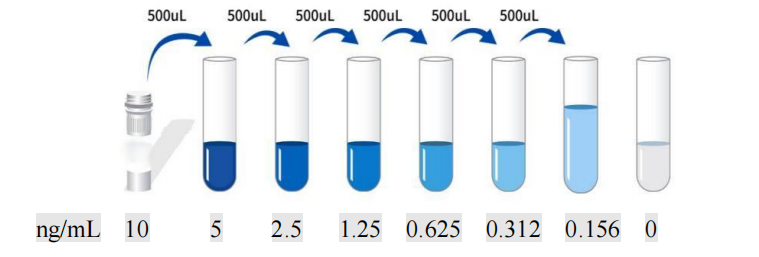
join 1mL Universal Diluent into Lyophilized Standard, let stand 15 Minutes until it is completely dissolved and then gently mix (The concentration is 10ng/mL).
And then according to the following concentrations: 10ng/mL、5ng/mL、2.5ng/mL、1.25ng/mL、0.625ng/mL、 0.312ng/mL、0.156ng/mL、0ng/mL The dilution was performed.
Double dilution method: Take 7 branch EP Tubes, each tube is added 500μL Universal diluent,10ng/mL Pipette from the standard working solution 500μL To the first EP Mix evenly in a tube 5ng/mL Standard of Standard working fluid, according to this step, absorb and mix evenly in turn.
The last tube is directly used as a blank hole, No longer need to draw liquid from the penultimate tube As shown in the figure below.
3、Biotin- Preparation of antibody working solution:
Before use 15 Minutes will concentrate Biotin- Antibody to 1000×g Centrifugation 1 Minutes, with a universal diluent 100× concentrate Biotin- The antibody is diluted into 1× Working concentration (Example: 10μL Concentrate +990μL Universal diluent), used on the same day.
4、Preparation of enzyme conjugate working solution:
Before use 15 Minutes will 100x Concentrated enzyme conjugate in 1000×g Centrifugation 1 minute, in a universal diluent 100× concentrate HRP The enzyme conjugate is diluted into 1× Working concentration (Example: 10μL Concentrate +990μL Universal diluent), used on the same day.
5、1× Wash liquid preparation:
Take 10mL 20× Wash liquid to 190mL In distilled water (the concentrated washing liquid taken out of the refrigerator may have crystals, which is a normal phenomenon. It can be left at room temperature and prepared after the crystals are completely dissolved).
4. Operation steps:
1、Equilibration from room temperature 10 After minutes, remove the required slats from the aluminum foil bag, and seal the remaining slats with ziplock bag and put them back 4℃。
2、Add samples: respectively add samples or different concentration standards according to 50μl Each well is added to the corresponding well, and the blank well is added 50μL Universal dilution followed by each well 50μL Biotin- Antibody working fluid.
After covering the sealing film 37℃ Incubation 1 Hours.
(Recommendation: minimum dilution of sample to be tested with universal diluent 1 Then add enzyme labeled in-plate test, so as to reduce the error of matrix effect on test results, influence, and finally calculate the sample concentration by multiplying it by the corresponding dilution factor.
It is recommended to set up double wells for all samples and standards to be tested during testing).
3、Plate washing: discard the liquid and add to each well 300uL 1x Wash liquid, stand 1 Minutes, throw off the washing liquid, pat dry on absorbent paper, and repeat washing the plate 3 Times (the plate can also be washed with a plate washing machine).
4、Adding enzyme conjugate working solution:
Enzyme conjugate working solution is added to each well 100μL, after covering the sealing film 37℃ Incubation 30 Minutes.
5、 Washing plate:
Discard liquid according to step 3 Washing Method, wash plate 5 Times.
6、Add substrate: add substrate per well (TMB)90uL Covered with a sealing film, 37℃ Incubation protected from light 15 Minutes.
7、Add stop solution: take out the enzyme label plate and directly add stop solution to each well 50uL, immediately in 450nm Wavelength measurement of each well OD Value.
5. Calculation of experimental results:
Result judgment:
1、calculate the average of the standard and sample replica well OD Value and subtract the blank hole OD Values as correction values.
Taking concentration as the abscissa, OD Value is ordinate, draw the standard curve of the four-parameter logic function on the double logarithmic coordinate paper.
2、If the sample OD If the value is higher than the upper limit of the standard curve, the test should be retested after appropriate dilution and multiplied by the corresponding dilution factor when calculating the sample concentration.
Typical data and reference curves:
The following data and curves are for reference only, the experimenter needs to establish a standard curve according to his own experiment.
| Concentration (ng/mL) |
10 |
5 |
2.5 |
1.25 |
0.625 |
0.312 |
0.156 |
0 |
| OD Value |
0.216 |
0.298 |
0.417 |
0.669 |
0.955 |
1.405 |
1.79 |
1.865 |

attention : This picture is for reference only , the specimen content should be calculated from the standard curve drawn by the same test standard.
6. Kit performance:
1、Repeatability: the coefficient of variation in the plate is less than 10%, the interplate coefficient of variation is less than 10%。
2、Recovery:
Adding serum and plasma of selected healthy universal species 3 Universal species at different concentration levels T, calculated recovery
Sample Type |
scope (%) |
Average recovery (%) |
| Serum (n=8) |
81-101 |
96 |
| Plasma (n=8) |
92-105 |
101 |
3、Linear dilution:
in the selected 4 A portion of healthy universal species serum and plasma is added with high concentration Tong Species PROG, the dilution was performed within the standard curve kinetic range, evaluating linearity.
| Dilution ratio |
Recovery (%) |
Serum |
Plasma |
| 1:2 |
scope |
83-95 |
88-96 |
| Average recovery |
91 |
93 |
| 1:4 |
scope |
89-104 |
87-108 |
| Average recovery |
93 |
97 |
|