
Human FlT-3L ELISA Kit
Human FlT-3L ELISA Kit

Product Details
Product Details
Product Specification
| Usage |
Sample handling and requirements1. 2. 3. 4. Note: Hemolysis of the specimen will affect the final test result, so hemolyzed specimens should not be tested. The kit should be removed from the refrigerated environment and equilibrated at room temperature before use. Dilution of 20 × wash buffer: Distilled water was diluted 1:20, i.e. 1 part of 20 × wash buffer plus 19 parts of distilled water. Operation steps1. 2. 3. 4. 5. 6. 7. Calculation of experimental resultsTaking the OD value of the measured standard product as the abscissa and the concentration value of the standard product as the ordinate, draw the standard curve on coordinate paper or with relevant software, and get the linear regression equation.
|
||||||||||||||||||||||||||||||
| Species Reactivity | Human | ||||||||||||||||||||||||||||||
| Theory | The kit uses a double-antibody one-step sandwich enzyme-linked immunosorbent assay (ELISA). Specimens, standards, and HRP-labeled detection antibodies were sequentially added to coated microwells previously coated with human FMS-like tyrosine kinase 3 ligand (Flt-3L; FLT3LG) capture antibodies, incubated and washed thoroughly. The color is developed with the substrate TMB, which is converted to blue under the catalysis of peroxidase and to the final yellow under the action of acid. There was a positive correlation between the depth of color and the human FMS-like tyrosine kinase 3 ligand (Flt-3L; FLT3LG) in the sample. The absorbance (OD value) was measured with a microplate reader at a wavelength of 450nm, and the sample concentration was calculated. | ||||||||||||||||||||||||||||||
| Synonym | FLT3LG; FLT3-LG; Flt3-L; FL; Fms-Related Tyrosine Kinase 3 ligand; SL cytokine | ||||||||||||||||||||||||||||||
| Composition |
Notes: 1. The standard concentration is 2000, 1000, 500, 250, 125, 62.5 pg/mL in order
|
||||||||||||||||||||||||||||||
| General Notes |
1. Incubate in strict accordance with the specified time and temperature to ensure accurate results. All reagents must reach room temperature 20-25 °C prior to use. Store reagents in refrigeration immediately after use. 2. Incorrect plate washing can lead to inaccurate results. Make sure to drain the liquid from the wells as much as possible before adding the substrate. Do not allow the wells to dry out during incubation. 3. Eliminate the residual liquid and fingerprints at the bottom of the plate, otherwise it will affect the OD value. 4. The substrate color development solution should be colorless or very light in color, and the substrate solution that has turned blue cannot be used. 5. Avoid cross-contamination of reagents and specimens to avoid wrong results. 6. Avoid direct exposure to strong light during storage and incubation. 7. After equilibrating to room temperature, open the sealed bag to prevent water droplets from condensing on the cold slats. 8. Any reaction reagent cannot come into contact with the bleaching solvent or the strong gas emitted by the bleaching solvent. Any bleaching component will destroy the biological activity of the reaction reagents in the kit. 9. Expired products cannot be used. 10. If it is possible to spread diseases, all samples should be managed, and the samples and testing devices should be handled according to the prescribed procedures. |
||||||||||||||||||||||||||||||
| Storage Temp. | Unopened kit, stored at 4 °C, shelf life 6 months. | ||||||||||||||||||||||||||||||
| Test Range | 62.5 pg/mL-2000 pg/mL; Sensitivity: The lowest detection concentration is less than 10 pg/mL. |
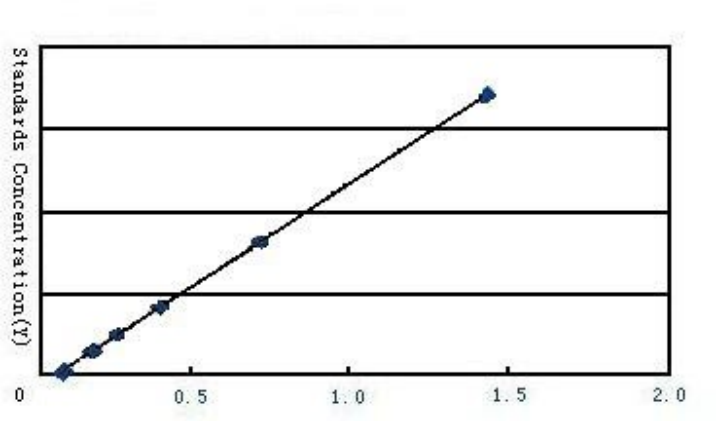 Standard curve