WB result of GM-CSF Recombinant Rabbit mAb
Primary antibody: GM-CSF Recombinant Rabbit mAb at 1/5000 dilution
Lane 1: untreated NK-92 whole cell lysate 20 µg
Lane 2: NK-92 treated with 80 nM TPA and 3 μM Ionomycin for 6 hours, then with 300 ng/mL Brefeldin A added for 4 hours whole cell lysate 20 µg
Secondary antibody: Goat Anti-rabbit IgG, (H+L), HRP conjugated at 1/10000 dilution
Predicted MW: 16 kDa
Observed MW: 14~25 kDa
GM-CSF Recombinant Rabbit mAb (S-725-327)
GM-CSF Recombinant Rabbit mAb (S-725-327)
Price:
Regular price
$100 USD
Regular price
Sale price
$100 USD
Unit price
per
For shipping services or bulk orders, you may request a quotation.
Secure checkout with

View full details
Product Details
Product Details
Product Specification
| Host | Rabbit |
| Antigen | GM-CSF |
| Synonyms | Granulocyte-macrophage colony-stimulating factor, Colony-stimulating factor (CSF), Molgramostin, Sargramostim, CSF2, GMCSF |
| Immunogen | Recombinant Protein |
| Location | Secreted |
| Accession | P04141 |
| Clone Number | S-725-327 |
| Antibody Type | Recombinant mAb |
| Isotype | IgG |
| Application | WB, IP |
| Reactivity | Hu |
| Purification | Protein A |
| Concentration | 0.5 mg/ml |
| Conjugation | Unconjugated |
| Physical Appearance | Liquid |
| Storage Buffer | PBS, 40% Glycerol, 0.05% BSA, 0.03% Proclin 300 |
| Stability & Storage | 12 months from date of receipt / reconstitution, -20 °C as supplied |
Dilution
| application | dilution | species |
| WB | 1:5000 | |
| IP | 1:50 |
Background
GM-CSF is an acidic glycoprotein with a molecular weight of approximately 23kDa, containing internal disulfide bonds. It is primarily produced by mesenchymal cells present in the hematopoietic environment and peripheral inflammatory sites, responding to various inflammatory mediators. GM-CSF stimulates the formation of granulocytes and macrophages from bone marrow precursor cells, promoting the production of neutrophil, macrophage, and mixed granulocyte-macrophage colonies. It can also stimulate eosinophil colony formation from fetal liver progenitor cells. GM-CSF is generally undetectable in the blood of healthy individuals, but its levels may increase under certain conditions such as inflammation or cancer treatment. It stimulates functional activities in mature granulocytes and macrophages. GM-CSF plays a crucial role in maintaining lung homeostasis as a key homeostatic factor in the alveoli. At low levels, it promotes the development and long-term maintenance of alveolar macrophages. In the absence of GM-CSF, there is a defect in alveolar macrophage function, increasing the risk of pulmonary infections and leading to lung diseases. Abnormal expression of GM-CSF can also lead to symptoms such as inflammation, pain, tissue damage, and may promote the production of other pathogenic cytokines.
Picture
Picture
Western Blot
IP
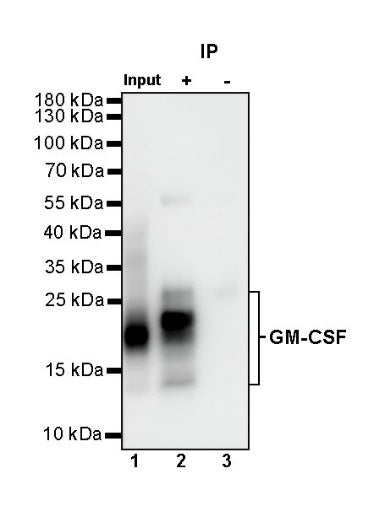
GM-CSF Rabbit mAb at 1/50 dilution (1 µg) immunoprecipitating GM-CSF in 0.4 mg NK-92 treated with 80 nM TPA and 3 μM Ionomycin for 6 hours, then with 300 ng/mL Brefeldin A added for 4 hours whole cell lysate.
Western blot was performed on the immunoprecipitate using GM-CSF Rabbit mAb at 1/1000 dilution.
Secondary antibody (HRP) for IP was used at 1/1000 dilution.
Lane 1:NK-92 treated with 80 nM TPA and 3 μM Ionomycin for 6 hours, then with 300 ng/mL Brefeldin A added for 4 hours whole cell lysate 20 µg (Input)
Lane 2: GM-CSF Rabbit mAb IP in NK-92 treated with 80 nM TPA and 3 μM Ionomycin for 6 hours, then with 300 ng/mL Brefeldin A added for 4 hours whole cell lysate
Lane 3: Rabbit monoclonal IgG IP in NK-92 treated with 80 nM TPA and 3 μM Ionomycin for 6 hours, then with 300 ng/mL Brefeldin A added for 4 hours whole cell lysate
Predicted MW: 16 kDa
Observed MW: 14~25 kDa