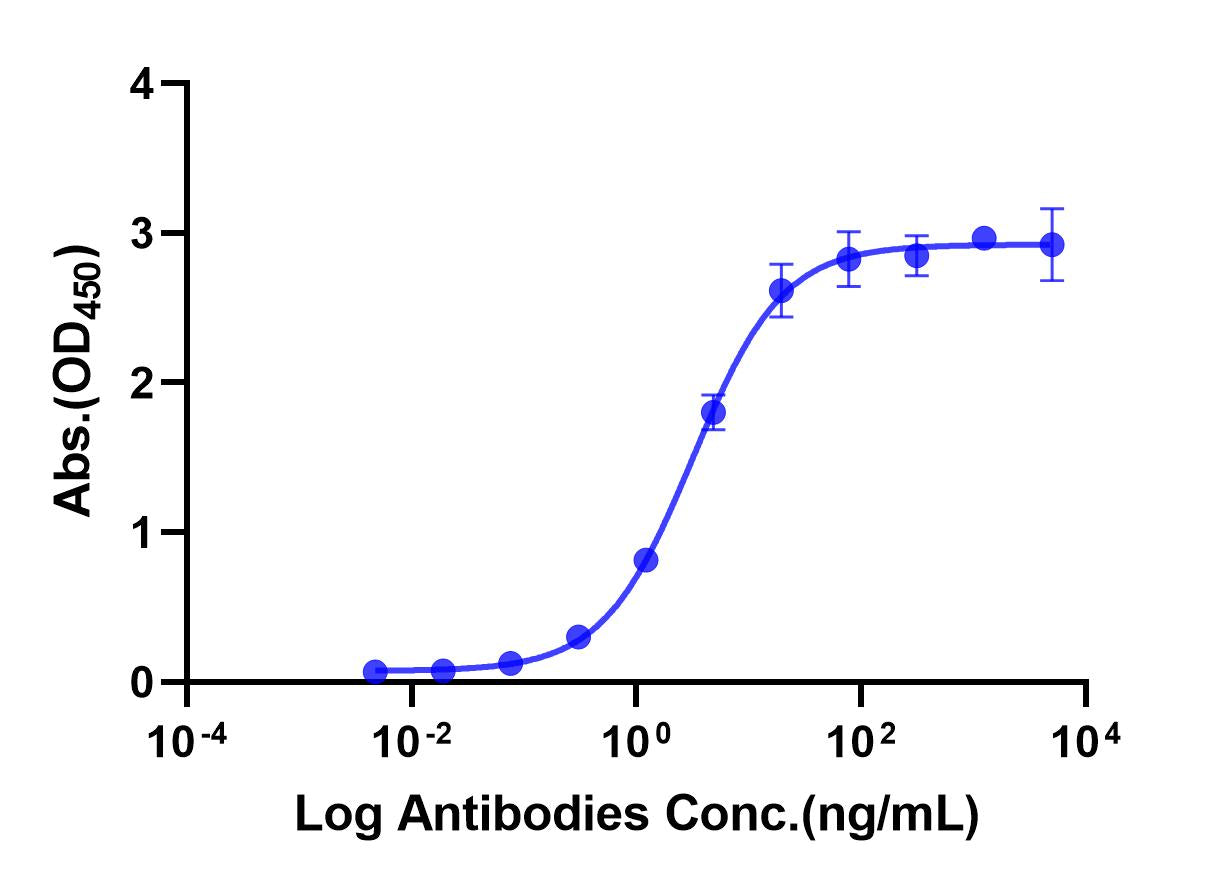


WB result of Anti-CD33 Monoclonal Antibody (Vadastuximab)
Primary antibody: Anti-CD33 Monoclonal Antibody (Vadastuximab) at 1/1000 dilution
Lane 1: Siglec-3 His Tag Protein, Human 1ug
Secondary antibody: Goat Anti- Human IgG, (H+L), HRP conjugated at 1/10000 dilution
Predicted MW: 40 kDa
Observed MW: 39 kDa
This blot was developed with high sensitivity substrate
Anti-CD33 Monoclonal Antibody (Vadastuximab)
Anti-CD33 Monoclonal Antibody (Vadastuximab)
Price:
Regular price
$0 USD
Regular price
Sale price
$0 USD
Unit price
per
For shipping services or bulk orders, you may request a quotation.
Secure checkout with

View full details
Product Details
Product Details
Product Specification
| Host | Human |
| Antigen | CD33 |
| Synonyms | Myeloid cell surface antigen CD33; Sialic acid-binding Ig-like lectin 3 (Siglec-3); gp67; SIGLEC3 |
| Location | Cell membrane |
| Accession | P20138 |
| Clone Number | S-5172 |
| Antibody Type | Recombinant mAb |
| Isotype | Human IgG1 |
| Reactivity | Hu |
| Purification | Protein A |
| Concentration | 5 mg/ml |
| Purity | >95% (Determined by SDS-PAGE) |
| Endotoxin | <1EU/mg |
| Conjugation | Unconjugated |
| Physical Appearance | Liquid |
| Storage Buffer | PBS pH7.4, containing no preservative |
| Stability & Storage | 2 to 8 °C for 2 weeks under sterile conditions; |
Background
CD33, also known as Siglec-3, is a 67 kDa type-I transmembrane sialic-acid-binding immunoglobulin-like lectin composed of an N-terminal V-set Ig domain that mediates glycan recognition, a membrane-proximal C2-set Ig domain, and a cytoplasmic tail harboring two immunoreceptor tyrosine-based inhibitory motifs (ITIMs); upon ligation by α2,3- or α2,6-linked sialylated glycoproteins or the complement component C1q, Src-family kinases phosphorylate these ITIMs, recruiting the SH2-domain-containing phosphatases SHP-1 and SHP-2 that dephosphorylate downstream signaling molecules, thereby suppressing calcium flux, PI3K activity, and activation of myeloid cells including monocytes, macrophages, dendritic cells, microglia, and myeloid-derived suppressor cells, while also modulating NK-cell cytotoxicity and cytokine production; CD33 is highly expressed on committed myeloid progenitors and over-expressed on >90 % of acute myeloid leukemias, making it the target of the antibody–drug conjugate gemtuzumab ozogamicin, and alternative splicing generates a shorter isoform lacking the ligand-binding V domain that can still dampen immune responses; genetically, the rs3865444(C) allele that reduces CD33 surface expression is protective against late-onset Alzheimer’s disease because lower microglial CD33 lessens inhibition of Aβ phagocytosis, implicating the receptor in neurodegeneration as well as in infection, autoimmunity, and cancer immune evasion.
Picture
Picture
Western Blot
ELISA
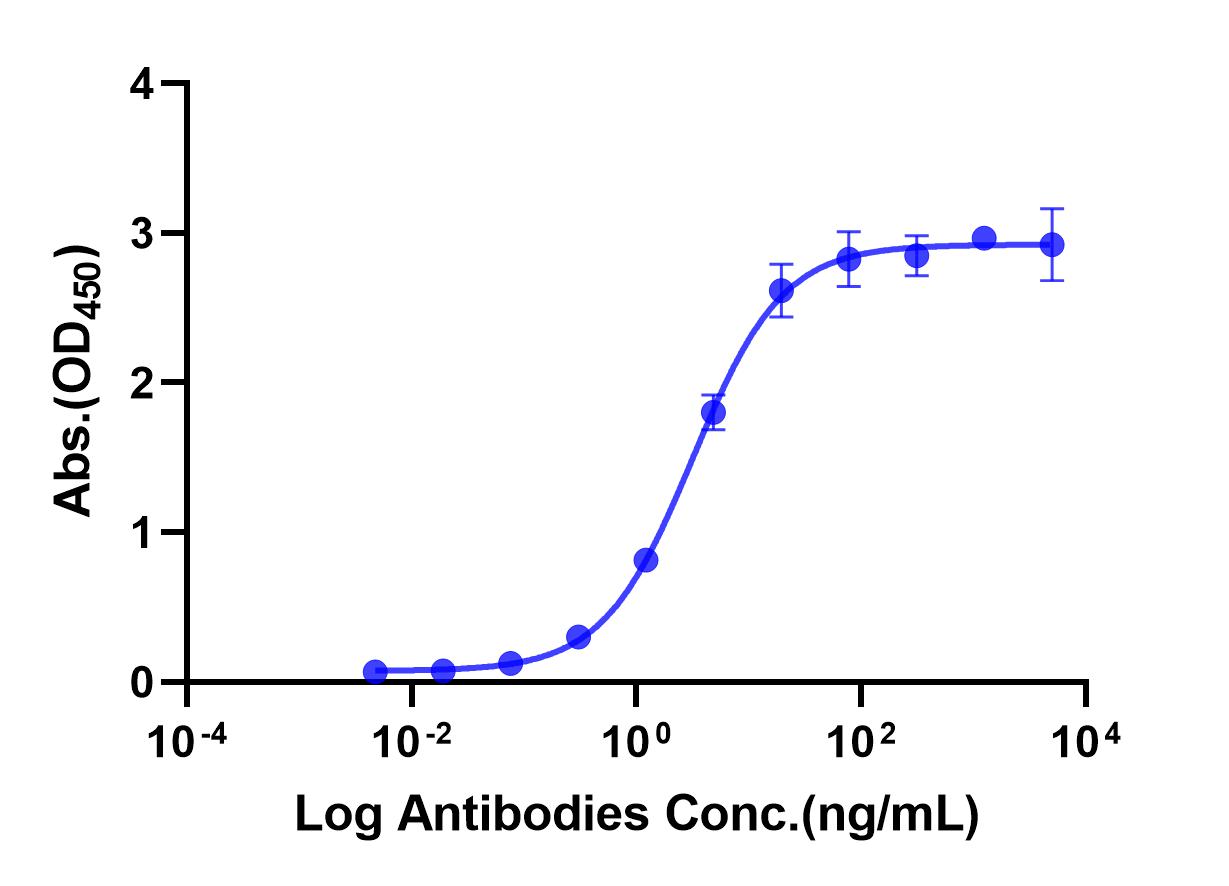
Immobilized Siglec-3 His Tag Protein, Human(UA010133) can bind Vadastuximab. The EC50 for this effect is 3.195 ng/mL.