WB result of ZNF217 Recombinant Rabbit mAb
Primary antibody: ZNF217 Recombinant Rabbit mAb at 1/1000 dilution
Lane 1: PC-3 whole cell lysate 20 µg
Lane 2: Caco-2 whole cell lysate 20 µg
Lane 3: PANC-1 whole cell lysate 20 µg
Lane 4: MCF7 whole cell lysate 20 µg
Lane 5: HEK 293 whole cell lysate 20 µg
Secondary antibody: Goat Anti-Rabbit IgG (H+L), HRP conjugated at 1/10000 dilution
Predicted MW: 115 kDa
Observed MW: 128 kDa
ZNF217 Recombinant Rabbit mAb (S-4699-14)
ZNF217 Recombinant Rabbit mAb (S-4699-14)
Price:
Regular price
$100 USD
Regular price
Sale price
$100 USD
Unit price
per
For shipping services or bulk orders, you may request a quotation.
Secure checkout with

View full details
Product Details
Product Details
Product Specification
| Host | Rabbit |
| Antigen | ZNF217 |
| Synonyms | Zinc finger protein 217; ZABC1 |
| Immunogen | Synthetic Peptide |
| Location | Nucleus |
| Accession | O75362 |
| Clone Number | S-4699-14 |
| Antibody Type | Recombinant mAb |
| Isotype | IgG |
| Application | WB, ICC |
| Reactivity | Hu, Mk |
| Purification | Protein A |
| Concentration | 1 mg/ml |
| Conjugation | Unconjugated |
| Physical Appearance | Liquid |
| Storage Buffer | PBS, 40% Glycerol, 0.05% BSA, 0.02% sodium azide |
| Stability & Storage | 12 months from date of receipt / reconstitution, -20 °C as supplied |
Dilution
| application | dilution | species |
| WB | 1:1000 | Hu, Mk |
| ICC | 1:1000 | Hu |
Background
ZNF217 protein (Zinc Finger Protein 217) is a member of the Krüppel-type C2H2 zinc finger transcription factor family, functioning as a potential oncogene in various tumors. Its C-terminus contains multiple C2H2-type zinc finger domains responsible for mediating specific binding to target gene DNA sequences, while the N-terminal SCAN domain mediates homo- or hetero-oligomerization between proteins and regulates its transcriptional activity. Functionally, ZNF217 participates in key processes such as cell cycle regulation, apoptosis, and epithelial-mesenchymal transition primarily through transcriptional regulation. Its most classic mechanism is repressing the transcription of tumor suppressor genes including CDKN1A/p21 and CDKN2A/p14ARF, thereby promoting cell proliferation and conferring resistance to apoptosis. In the oncology field, ZNF217 is considered a marker of poor prognosis; its gene copy number amplification or upregulated expression is commonly observed in multiple malignancies including ovarian cancer, breast cancer, colorectal cancer, and hepatocellular carcinoma, and is closely associated with chemoresistance, tumor invasion, and enhanced metastatic capacity. Furthermore, ZNF217 also interacts with hormone receptor signaling and participates in regulating estrogen receptor α expression, suggesting that it may exert additional pathological roles in hormone-dependent tumors.
Picture
Picture
Western Blot
WB result of ZNF217 Recombinant Rabbit mAb
Primary antibody: ZNF217 Recombinant Rabbit mAb at 1/1000 dilution
Lane 1: COS-7 whole cell lysate 20 µg
Secondary antibody: Goat Anti-Rabbit IgG (H+L), HRP conjugated at 1/10000 dilution
Predicted MW: 115 kDa
Observed MW: 130 kDa
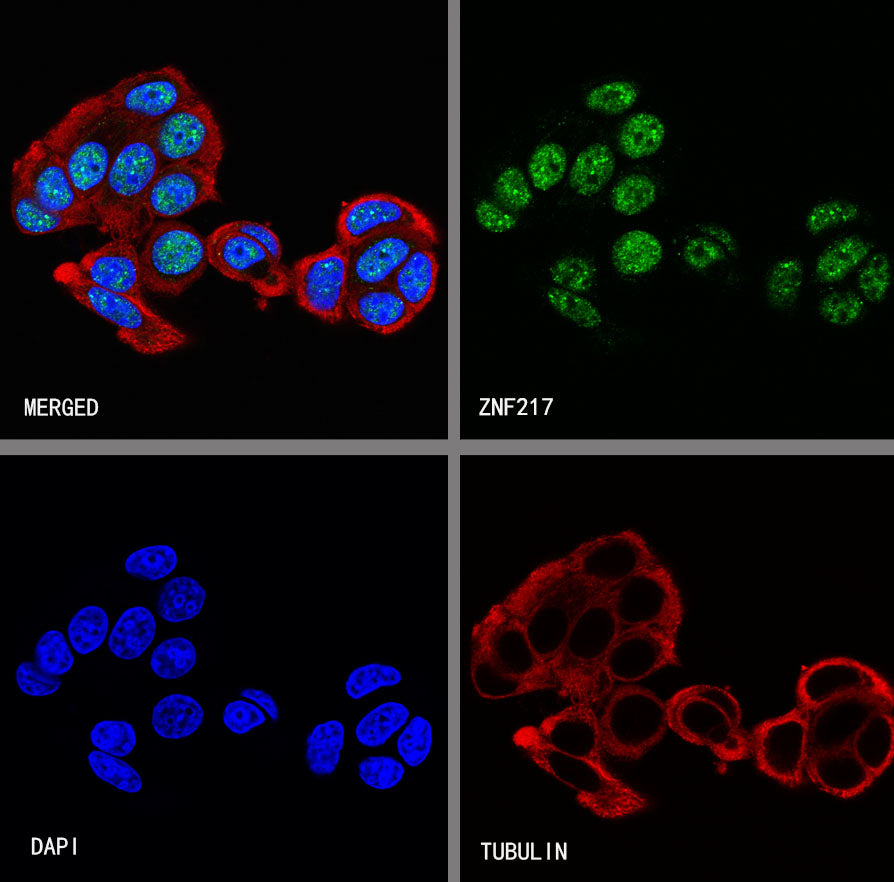
Immunocytochemistry
ICC shows positive staining in HeLa cells. Anti-ZNF217 antibody was used at 1/1000 dilution (Green) and incubated overnight at 4°C. Goat polyclonal Antibody to Rabbit IgG - H&L (Alexa Fluor® 488) was used as secondary antibody at 1/1000 dilution. The cells were fixed with 100% ice-cold methanol and permeabilized with 0.1% PBS-Triton X-100. Nuclei were counterstained with DAPI (Blue). Counterstain with tubulin (Red).