WB result of Zinc Alpha 2 Glycoprotein Recombinant Rabbit mAb
Primary antibody: Zinc Alpha 2 Glycoprotein Recombinant Rabbit mAb at 1/1000 dilution
Lane 1: Human plasma lysate 20 µg
Secondary antibody: Goat Anti-rabbit IgG (H+L), HRP conjugated at 1/10000 dilution
Predicted MW: 34 kDa
Observed MW: 40 kDa
Zinc Alpha 2 Glycoprotein Recombinant Rabbit mAb (S-6306)
Zinc Alpha 2 Glycoprotein Recombinant Rabbit mAb (S-6306)
Price:
Regular price
$100 USD
Regular price
Sale price
$100 USD
Unit price
per
For shipping services or bulk orders, you may request a quotation.
Secure checkout with

View full details
Product Details
Product Details
Product Specification
| Host | Rabbit |
| Antigen | Zinc Alpha 2 Glycoprotein |
| Synonyms | Zinc-alpha-2-glycoprotein; Zn-alpha-2-GP; Zn-alpha-2-glycoprotein; ZAG; ZNGP1; AZGP1 |
| Location | Secreted |
| Accession | P25311 |
| Clone Number | S-6306 |
| Antibody Type | Recombinant mAb |
| Isotype | IgG |
| Application | WB, IHC-P |
| Reactivity | Hu |
| Positive Sample | Human plasma |
| Purification | Protein A |
| Concentration | 0.5 mg/ml |
| Conjugation | Unconjugated |
| Physical Appearance | Liquid |
| Storage Buffer | PBS, 40% Glycerol, 0.05% BSA, 0.02% sodium azide |
| Stability & Storage | 12 months from date of receipt / reconstitution, -20 °C as supplied |
Dilution
| application | dilution | species |
| WB | 1:1000 | Hu |
| IHC-P | 1:2000 | Hu |
Background
Zinc Alpha 2 Glycoprotein (ZAG) is a soluble secreted glycoprotein of approximately 40 kDa encoded by the AZGP1 gene, named for its migration in the α2 region on electrophoresis and its ability to bind zinc ions. Its structural fold resembles that of MHC class I antigen-presenting molecules but lacks polymorphism, a feature suggesting that it may participate in the transport of non-polymorphic substances or in cell-cell recognition processes. The most studied function of ZAG is as a lipid-mobilizing factor capable of stimulating lipid degradation in adipocytes, and it is closely associated with the extensive fat loss characteristic of cancer cachexia. In addition, ZAG exhibits a variety of seemingly unrelated activities, including ribonuclease activity, regulation of melanogenesis, inhibition of tumor cell proliferation, participation in cell adhesion, and acting as a negative regulatory factor that suppresses the progression of fibrosis. In the metabolic field, ZAG promotes lipid metabolism and glucose utilization and modulates insulin sensitivity, and is therefore regarded as a novel adipokine. Because its expression level correlates with the grade, stage, and metastatic risk of various tumors, ZAG has also been extensively studied as a potential biomarker for cancer diagnosis and prognostic assessment.
Picture
Picture
Western Blot
Immunohistochemistry
IHC shows positive staining in paraffin-embedded human liver. Anti-Zinc alpha 2 glycoprotein antibody was used at 1/2000 dilution, followed by a HRP Polymer for Rabbit IgG (ready to use). Counterstained with hematoxylin. Heat mediated antigen retrieval with Tris/EDTA buffer pH9.0 was performed before commencing with IHC staining protocol.
IHC shows positive staining in paraffin-embedded human lung. Anti-Zinc alpha 2 glycoprotein antibody was used at 1/2000 dilution, followed by a HRP Polymer for Rabbit IgG (ready to use). Counterstained with hematoxylin. Heat mediated antigen retrieval with Tris/EDTA buffer pH9.0 was performed before commencing with IHC staining protocol.
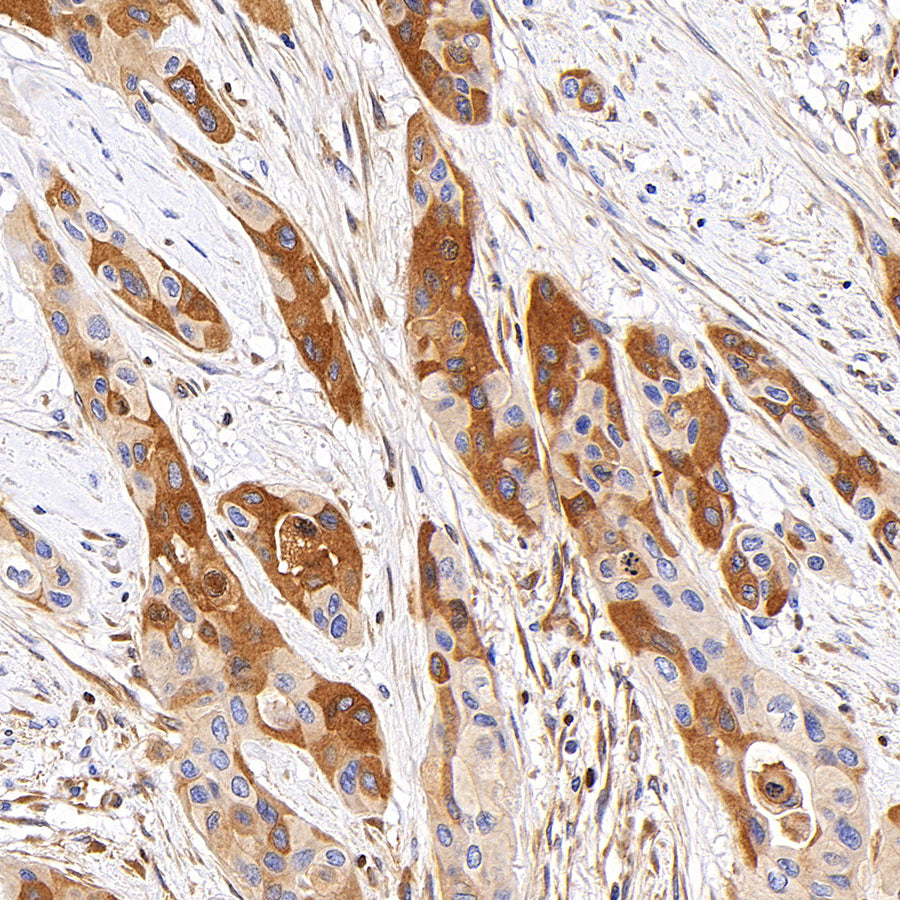
IHC shows positive staining in paraffin-embedded human cervical squamous cell carcinoma. Anti-Zinc alpha 2 glycoprotein antibody was used at 1/2000 dilution, followed by a HRP Polymer for Rabbit IgG (ready to use). Counterstained with hematoxylin. Heat mediated antigen retrieval with Tris/EDTA buffer pH9.0 was performed before commencing with IHC staining protocol.
IHC shows positive staining in paraffin-embedded human pancreatic cancer. Anti-Zinc alpha 2 glycoprotein antibody was used at 1/2000 dilution, followed by a HRP Polymer for Rabbit IgG (ready to use). Counterstained with hematoxylin. Heat mediated antigen retrieval with Tris/EDTA buffer pH9.0 was performed before commencing with IHC staining protocol.