WB result of ZC3H13 Recombinant Rabbit mAb
Primary antibody: ZC3H13 Recombinant Rabbit mAb at 1/1000 dilution
Lane 1: HEK-293 whole cell lysate 20 µg
Lane 2: SW480 whole cell lysate 20 µg
Secondary antibody: Goat Anti- rabbit IgG, (H+L), HRP conjugated at 1/10000 dilution
Predicted MW: 197 kDa
Observed MW: 270 kDa
This blot was developed with high sensitivity substrate.
ZC3H13 Recombinant Rabbit mAb (S-5530)
ZC3H13 Recombinant Rabbit mAb (S-5530)
Price:
Regular price
$100 USD
Regular price
Sale price
$100 USD
Unit price
per
For shipping services or bulk orders, you may request a quotation.
Secure checkout with

View full details
Product Details
Product Details
Product Specification
| Host | Rabbit |
| Antigen | ZC3H13 |
| Synonyms | Zinc finger CCCH domain-containing protein 13; KIAA0853 |
| Location | Nucleus |
| Accession | Q5T200 |
| Clone Number | S-5530 |
| Antibody Type | Recombinant mAb |
| Isotype | IgG |
| Application | WB, ICC |
| Reactivity | Hu |
| Positive Sample | HEK-293, SW480 |
| Purification | Protein A |
| Concentration | 0.5 mg/ml |
| Conjugation | Unconjugated |
| Physical Appearance | Liquid |
| Storage Buffer | PBS, 40% Glycerol, 0.05% BSA, 0.02% sodium azide |
| Stability & Storage | 12 months from date of receipt / reconstitution, -20 °C as supplied |
Dilution
| application | dilution | species |
| WB | 1:500-1:1000 | Hu |
| ICC | 1:500 | Hu |
Background
ZC3H13, also known as zinc finger CCCH domain-containing protein 13, is a core component of the RNA N⁶-methyladenosine (m⁶A) methyltransferase complex (i.e., the WMM complex) and plays a critical role in regulating gene expression and cellular functions. Acting as an "anchoring" and "bridging" protein within this complex, ZC3H13 is responsible for stably recruiting and tethering other components of the complex (such as WTAP and RBM15) to the nucleus, thereby ensuring that the methyltransferase complex can precisely install m⁶A modifications on the 3′ untranslated regions of mRNAs. This function deeply involves it in RNA metabolic processes including mRNA splicing and processing, and is essential for maintaining the stemness and pluripotency of embryonic stem cells. Given its central role in epitranscriptional regulation, dysregulation of ZC3H13 function has been closely linked to various diseases: in multiple cancers (such as colorectal cancer, liver cancer, and pancreatic cancer), alterations in its expression levels can affect tumor cell proliferation, invasion, chemotherapy sensitivity, and prognosis, exhibiting a "double-edged sword" effect—with some studies suggesting a tumor-suppressive role while others indicate a pro-tumorigenic function. Additionally, this protein has also been associated with genetic risk for schizophrenia, keloid formation, and various viral infections, among other pathological processes.
Picture
Picture
Western Blot
Immunocytochemistry
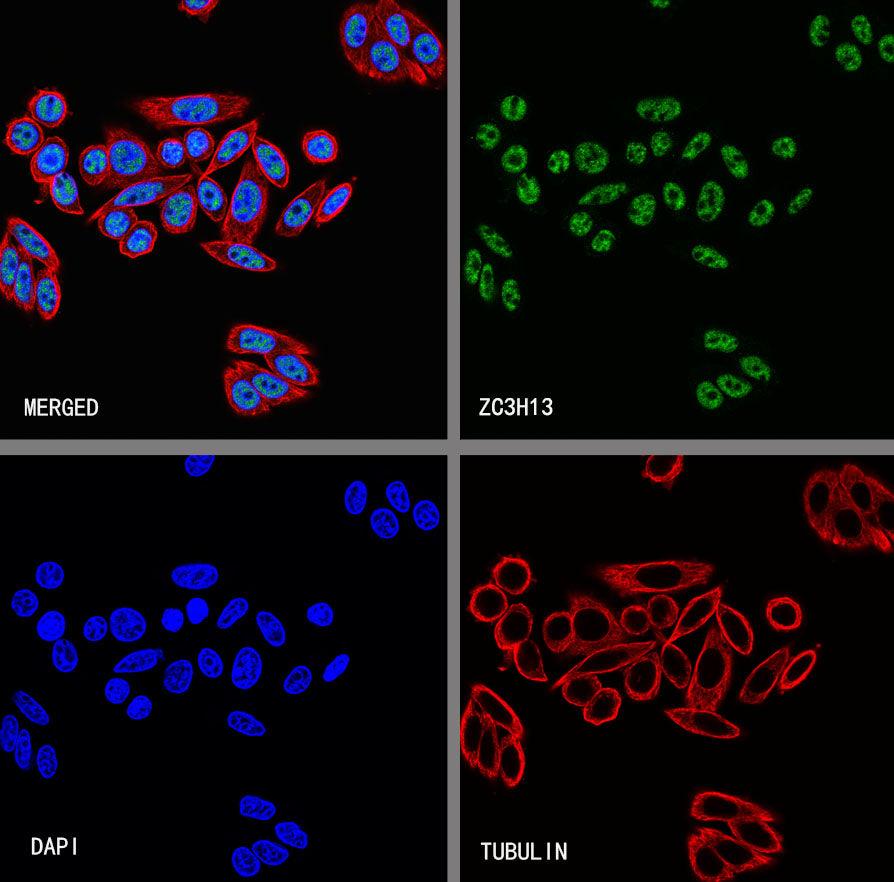
ICC shows positive staining in SW480 cells. Anti-ZC3H13 antibody was used at 1/500 dilution (Green) and incubated overnight at 4°C. Goat polyclonal Antibody to Rabbit IgG - H&L (Alexa Fluor® 488) was used as secondary antibody at 1/1000 dilution. The cells were fixed with 4% PFA and permeabilized with 0.1% PBS-Triton X-100. Nuclei were counterstained with DAPI (Blue). Counterstain with tubulin (Red).