WB result of WRN Recombinant Rabbit mAb
Primary antibody: WRN Recombinant Rabbit mAb at 1/1000 dilution
Lane 1: Saos-2 whole cell lysate 20 µg
Lane 2: HeLa whole cell lysate 20 µg
Lane 3: Ramos whole cell lysate 20 µg
Lane 4: MCF7 whole cell lysate 20 µg
Low expression control: Saos-2 whole cell lysate
Secondary antibody: Goat Anti-rabbit IgG (H+L), HRP conjugated at 1/10000 dilution
Predicted MW: 162 kDa
Observed MW: 180 kDa
This blot was developed with high sensitivity substrate
WRN Recombinant Rabbit mAb (S-3543-129)
WRN Recombinant Rabbit mAb (S-3543-129)
Price:
Regular price
$100 USD
Regular price
Sale price
$100 USD
Unit price
per
For shipping services or bulk orders, you may request a quotation.
Secure checkout with

View full details
Product Details
Product Details
Product Specification
| Host | Rabbit |
| Antigen | WRN |
| Immunogen | Recombinant Protein |
| Location | Nucleus |
| Accession | Q14191 |
| Clone Number | S-3543-129 |
| Antibody Type | Recombinant mAb |
| Isotype | IgG |
| Application | WB |
| Reactivity | Hu, Mk |
| Positive Sample | HeLa, Ramos, MCF7, COS-7 |
| Purification | Protein A |
| Concentration | 2 mg/ml |
| Conjugation | Unconjugated |
| Physical Appearance | Liquid |
| Storage Buffer | PBS, 40% Glycerol, 0.05% BSA, 0.02% sodium azide |
| Stability & Storage | 12 months from date of receipt / reconstitution, -20 °C as supplied |
Dilution
| application | dilution | species |
| WB | 1:1000 | Hu, Mk |
Background
WRN (Werner syndrome ATP-dependent helicase) is a unique multifunctional nuclear protein in the RecQ helicase family, encoded by the WRN gene located on chromosome 8p12, containing 1,432 amino acids with a molecular weight of approximately 162 kDa. Its structure comprises an N-terminal 3'-5' exonuclease domain, a central helicase domain (containing ATPase and RecQ C-terminal domains), a protein-interaction HRDC domain, and a C-terminal nuclear localization signal, making it the only member of the RecQ family that possesses both helicase and exonuclease activities. WRN plays a central role in DNA replication, recombination, repair, telomere maintenance, and transcriptional regulation, capable of processing various DNA structures such as replication forks, Holliday junctions, and G-quadruplexes, and participates in the selection of double-strand break repair pathways through interactions with key proteins such as Ku70/80 and MRE11. Loss-of-function mutations in the WRN gene cause Werner syndrome (adult progeria); patients are normal at birth but rapidly develop premature aging manifestations after puberty, including cataracts, skin sclerosis, premature graying of hair, osteoporosis, and type 2 diabetes, with malignant tumors and myocardial infarction being the main causes of death and an average age at death of 46–54 years.
Picture
Picture
Western Blot
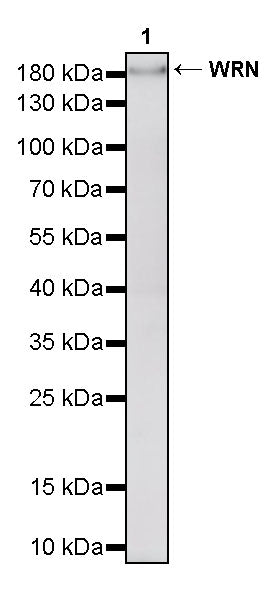
WB result of WRN Recombinant Rabbit mAb
Primary antibody: WRN Recombinant Rabbit mAb at 1/1000 dilution
Lane 1: COS-7 whole cell lysate 20 µg
Secondary antibody: Goat Anti-rabbit IgG (H+L), HRP conjugated at 1/10000 dilution
Predicted MW: 162 kDa
Observed MW: 180 kDa
This blot was developed with high sensitivity substrate