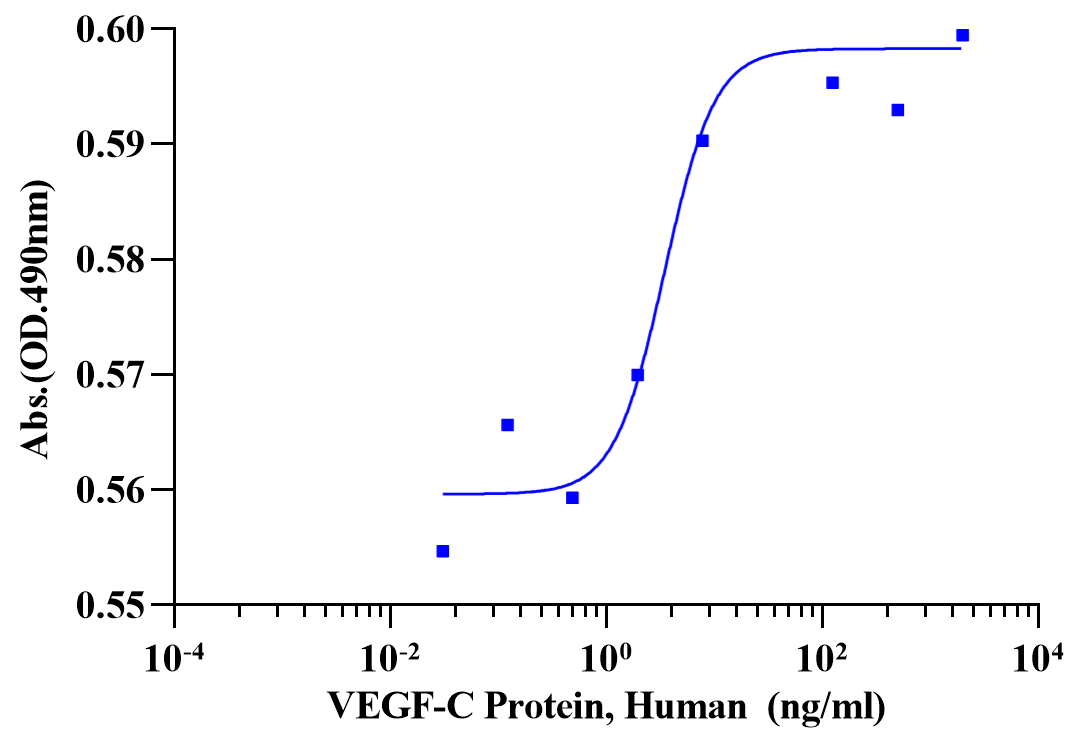
Measured in a cell proliferation assay using PUMC-HUVEC cells. The expected EC50 for this effect is 3.5 ng/ml.
VEGF-C Protein, Human
VEGF-C Protein, Human
Price:
Regular price
$150 USD
Regular price
Sale price
$150 USD
Unit price
per
For shipping services or bulk orders, you may request a quotation.
Secure checkout with

View full details
Product Details
Product Details
Product Specification
| Species | Human |
| Synonyms | Vascular endothelial growth factor C, VEGF-C, Flt4 ligand (Flt4-L), Vascular endothelial growth factor-related protein (VRP) |
| Accession | P49767 |
| Amino Acid Sequence | Ala112-Arg227 |
| Expression System | HEK293 |
| Molecular Weight | 18-24 kDa (Reducing) |
| Purity | >95% by SDS-PAGE |
| Endotoxin | <0.1EU/μg |
| Conjugation | Unconjugated |
| Tag | No Tag |
| Physical Appearance | Lyophilized Powder |
| Storage Buffer | 4 mM HCl |
| Reconstitution | Reconstitute at 0.1-1 mg/ml according to the size in Reconstitution Buffer after rapid centrifugation. |
| Stability & Storage | ·12 months from date of receipt, lyophilized powder stored at -20 to -80℃. |
| Reference | Science. 1997;276(5317):1423-1425. |
Background
Vascular endothelial growth factor-C (VEGF-C) is a pivotal member of the VEGF family of polypeptide growth factors, discovered in 1996 as the first specific ligand for VEGFR-3 (Flt-4). Encoded by the VEGFC gene on human chromosome 4q34, VEGF-C is secreted as a preproprotein that undergoes sequential proteolytic processing to generate a mature 21 kDa homodimer. This processing enhances its affinity for VEGFR-3 by ~400-fold and enables binding to VEGFR-2 (KDR), the primary VEGF-A receptor. The processed VEGF-C also interacts with neuropilin-2 (NRP-2), facilitating co-receptor function. VEGF-C is expressed in various human tissues, including heart, skeletal muscle, and vascular smooth muscle cells, with particularly high levels in malignant tumors. Physiologically, VEGF-C serves as the master regulator of lymphatic system development, promoting proliferation, migration, and survival of lymphatic endothelial cells during embryogenesis and adult tissue remodeling. In pathological contexts, VEGF-C induces lymphangiogenesis in tumors, inflammatory lesions, and fibrotic tissues.
Picture
Picture
Bioactivity
SDS-PAGE
2μg (R: reducing condition, N: non-reducing condition).
ELISA
Immobilized VEGF-C Protein, Human (Cat. No. UA040524) at 5.0μg/mL (100μL/well) can bind Biotinylated VEGFR3/FLT4 His&Avi Tag Protein, Human (Cat. No. UA010676) with EC50 of 9.09-11.21 ng/mL.