WB result of USP8 Recombinant Rabbit mAb
Primary antibody: USP8 Recombinant Rabbit mAb at 1/1000 dilution
Lane 1: U-2 OS whole cell lysate 20 µg
Lane 2: A549 whole cell lysate 20 µg
Lane 3: 293T whole cell lysate 20 µg
Lane 4: A431 whole cell lysate 20 µg
Lane 5: HCT 116 whole cell lysate 20 µg
Secondary antibody: Goat Anti- rabbit IgG, (H+L), HRP conjugated at 1/10000 dilution
Predicted MW: 127 kDa
Observed MW: 140 kDa
USP8 Recombinant Rabbit mAb (S-3848-146)
USP8 Recombinant Rabbit mAb (S-3848-146)
Price:
Regular price
$100 USD
Regular price
Sale price
$100 USD
Unit price
per
For shipping services or bulk orders, you may request a quotation.
Secure checkout with

View full details
Product Details
Product Details
Product Specification
| Host | Rabbit |
| Antigen | USP8 |
| Synonyms | Ubiquitin carboxyl-terminal hydrolase 8; Deubiquitinating enzyme 8; Ubiquitin isopeptidase Y (hUBPy); Ubiquitin thioesterase 8; Ubiquitin-specific-processing protease 8; KIAA0055; UBPY |
| Immunogen | Synthetic Peptide |
| Location | Cell membrane, Cytoplasm |
| Accession | P40818 |
| Clone Number | S-3848-146 |
| Antibody Type | Recombinant mAb |
| Isotype | IgG |
| Application | WB |
| Reactivity | Hu, Ms, Mk |
| Positive Sample | U-2 OS, A549, 293T, A431, HCT 116, NIH/3T3, mouse brain, mouse lung, COS-7 |
| Purification | Protein A |
| Concentration | 0.5 mg/ml |
| Conjugation | Unconjugated |
| Physical Appearance | Liquid |
| Storage Buffer | PBS, 40% Glycerol, 0.05% BSA, 0.02% sodium azide |
| Stability & Storage | 12 months from date of receipt / reconstitution, -20 °C as supplied |
Dilution
| application | dilution | species |
| WB | 1:1000 | Hu, Ms, Mk |
Background
USP8 (ubiquitin-specific protease 8) is a deubiquitinating enzyme that primarily functions to cleave and remove ubiquitin chains from substrate proteins, thereby regulating protein stability, signal transduction, and membrane trafficking. This enzyme contains multiple functional domains, including a microtubule-interacting and trafficking (MIT) domain, a catalytic domain, and several SH3-binding motifs, enabling it to interact with various proteins and localize to endosomal membranes. In its classical function, USP8 antagonizes the ubiquitination mediated by HECT-type E3 ligases (such as Nedd4), regulating the endosomal sorting and degradation of membrane receptors such as the epidermal growth factor receptor (EGFR), preventing their entry into the lysosomal pathway, thereby enhancing receptor signaling. Additionally, USP8 participates in maintaining endosomal homeostasis, regulating autophagic flux, and centrosome stability. In terms of disease, gain-of-function mutations in USP8 (particularly missense mutations in the catalytic domain or mutations in the 14-3-3 protein-binding motif) are the most common genetic cause of Cushing's disease (corticotroph adenoma). These mutations lead to increased USP8 protein stability and enhanced deubiquitinating activity, subsequently upregulating EGFR signaling and promoting pro-opiomelanocortin (POMC) expression and excessive ACTH secretion. Furthermore, USP8 is highly expressed in various cancers, where it promotes tumor cell proliferation and drug resistance by stabilizing EGFR, other receptor tyrosine kinases, or anti-apoptotic proteins such as MCL1, making it a potential therapeutic target. Therefore, USP8, as a key regulatory enzyme in the ubiquitination-deubiquitination dynamic balance, plays complex dual roles in endosomal trafficking, cell signaling, and disease development.
Picture
Picture
Western Blot
WB result of USP8 Recombinant Rabbit mAb
Primary antibody: USP8 Recombinant Rabbit mAb at 1/1000 dilution
Lane 1: NIH/3T3 whole cell lysate 20 µg
Lane 2: mouse brain lysate 20 µg
Lane 3: mouse lung lysate 20 µg
Secondary antibody: Goat Anti- rabbit IgG, (H+L), HRP conjugated at 1/10000 dilution
Predicted MW: 127 kDa
Observed MW: 140 kDa
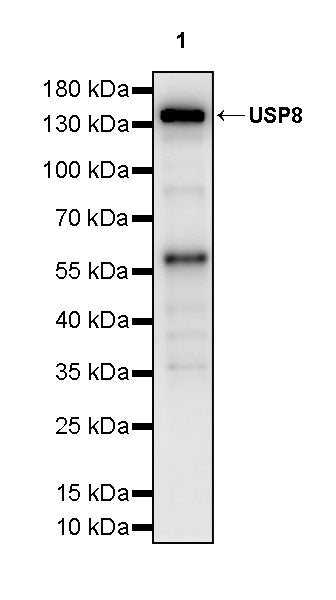
WB result of USP8 Recombinant Rabbit mAb
Primary antibody: USP8 Recombinant Rabbit mAb at 1/1000 dilution
Lane 1: COS-7 whole cell lysate 20 µg
Secondary antibody: Goat Anti- rabbit IgG, (H+L), HRP conjugated at 1/10000 dilution
Predicted MW: 127 kDa
Observed MW: 140 kDa