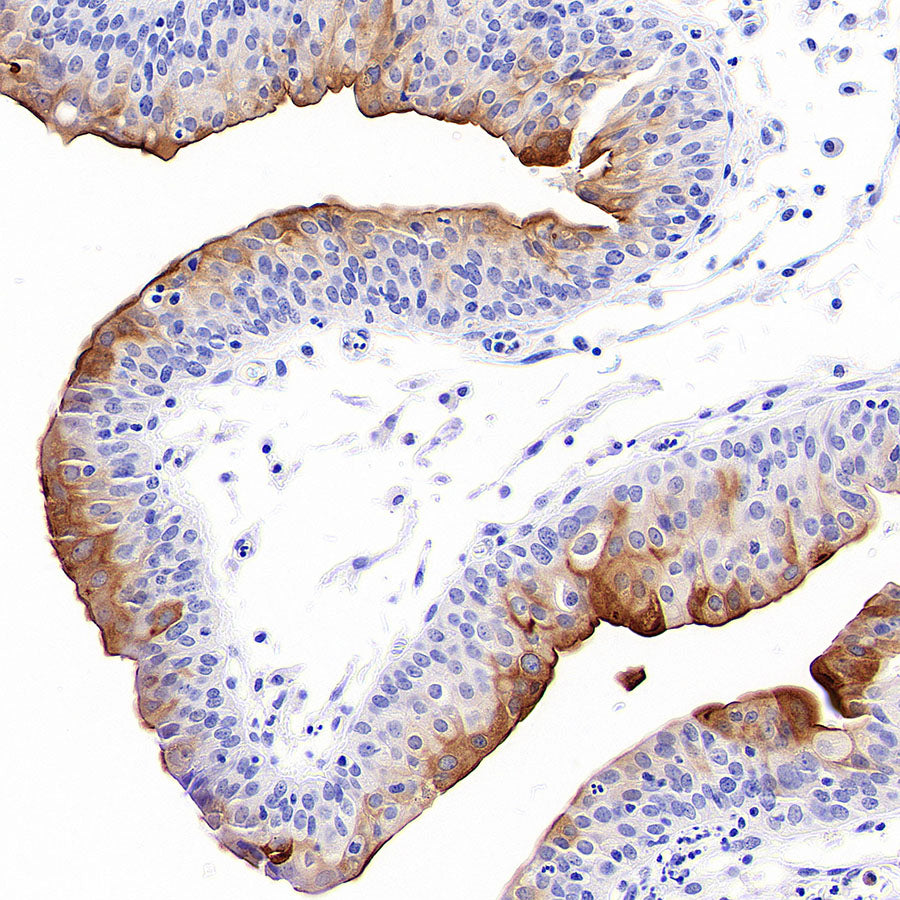
IHC shows positive staining in paraffin-embedded human bladder cancer. Anti-Uroplakin II/UPII antibody was used at 1/2000 dilution, followed by a HRP Polymer for Rabbit IgG (ready to use). Counterstained with hematoxylin. Heat mediated antigen retrieval with Tris/EDTA buffer pH9.0 was performed before commencing with IHC staining protocol.
Uroplakin II/UPII Recombinant Rabbit mAb (SDT-6121)
Uroplakin II/UPII Recombinant Rabbit mAb (SDT-6121)
Price:
Regular price
$100 USD
Regular price
Sale price
$100 USD
Unit price
per
For shipping services or bulk orders, you may request a quotation.
Secure checkout with

View full details
Product Details
Product Details
Product Specification
| Host | Rabbit |
| Antigen | Uroplakin II/UPII |
| Location | Cell membrane |
| Accession | O00526 |
| Clone Number | SDT-6121 |
| Antibody Type | Recombinant mAb |
| Isotype | IgG |
| Application | IHC-P |
| Reactivity | Hu |
| Purification | Protein A |
| Concentration | 0.25 mg/ml |
| Conjugation | Unconjugated |
| Physical Appearance | Liquid |
| Storage Buffer | PBS, 40% Glycerol, 0.05% BSA, 0.02% sodium azide |
| Stability & Storage | 12 months from date of receipt / reconstitution, -20 °C as supplied |
Dilution
| application | dilution | species |
| IHC-P | 1:2000 | Hu |
Background
Uroplakin II (UPII) is a single-pass transmembrane protein encoded by the UPK2 gene (located on chromosome 11q23.3), with a molecular weight of approximately 19.4 kDa, and is a core constituent of the asymmetric unit membrane (AUM) of the urothelium. This protein is highly specifically expressed in terminally differentiated superficial cells (umbrella cells) of the urinary tract mucosa. Its extracellular domain forms an obligate heterodimer with the tetraspanin UPK1a, which is a prerequisite for its export from the endoplasmic reticulum and correct localization to the apical cell membrane. Functionally, UPII serves as a structural molecule involved in assembling the hexagonal plaque arrays on the asymmetric unit membrane; these plaques are thought to enhance the mechanical strength of the urothelial apical surface, preventing cell rupture during bladder filling. Because its expression is strictly restricted to tissues of urothelial origin, UPII has become a highly valuable immunohistochemical marker in pathological diagnosis for confirming the urinary tract origin of tumors. Studies have shown that the sensitivity of UPII in urothelial carcinoma is significantly superior to the traditional UPIII marker, with even higher detection rates in variant subtypes such as micropapillary and plasmacytoid, and it exhibits nearly 100% specificity, holding important application value in the differential diagnosis of metastatic urothelial carcinoma.
Picture
Picture
Immunohistochemistry
IHC shows positive staining in paraffin-embedded human bladder. Anti-Uroplakin II/UPII antibody was used at 1/2000 dilution, followed by a HRP Polymer for Rabbit IgG (ready to use). Counterstained with hematoxylin. Heat mediated antigen retrieval with Tris/EDTA buffer pH9.0 was performed before commencing with IHC staining protocol.