WB result of UPF1 Rabbit pAb
Primary antibody: UPF1 Rabbit pAb at 1/1000 dilution
Lane 1: Raji whole cell lysate 20 µg
Lane 2: HEK-293 whole cell lysate 20 µg
Lane 3: RD whole cell lysate 20 µg
Lane 4: HepG2 whole cell lysate 20 µg
Lane 5: HeLa whole cell lysate 20 µg
Secondary antibody: Goat Anti- rabbit IgG, (H+L), HRP conjugated at 1/10000 dilution
Predicted MW: 124 kDa
Observed MW: 124 kDa
UPF1 Rabbit Polyclonal Antibody
UPF1 Rabbit Polyclonal Antibody
Price:
Regular price
$100 USD
Regular price
Sale price
$100 USD
Unit price
per
For shipping services or bulk orders, you may request a quotation.
Secure checkout with

View full details
Product Details
Product Details
Product Specification
| Host | Rabbit |
| Antigen | UPF1 |
| Synonyms | Regulator of nonsense transcripts 1; ATP-dependent helicase RENT1; Double-stranded nucleic acid 5'-3' helicase UPF1; Nonsense mRNA reducing factor 1Imported (NORF1Imported); Up-frameshift suppressor 1 homolog (hUpf1); KIAA0221; RENT1 |
| Immunogen | Synthetic Peptide |
| Location | Cytoplasm, Nucleus |
| Accession | Q92900 |
| Antibody Type | Polyclonal antibody |
| Isotype | IgG |
| Application | WB, ICC |
| Reactivity | Hu, Mk |
| Positive Sample | Raji, HEK-293, RD, HepG2, HeLa, COS-7 |
| Purification | Immunogen Affinity |
| Concentration | 0.5 mg/ml |
| Conjugation | Unconjugated |
| Physical Appearance | Liquid |
| Storage Buffer | PBS, 40% Glycerol, 0.05% BSA, 0.02% sodium azide |
| Stability & Storage | 12 months from date of receipt / reconstitution, -20 °C as supplied |
Dilution
| application | dilution | species |
| WB | 1:1000 | Hu, Mk |
| ICC | 1:100 | Hu |
Background
UPF1 (up-frameshift mutant 1) is an RNA helicase and a phosphorylation-regulated RNA-binding protein that serves as the core factor of the nonsense-mediated mRNA decay (NMD) pathway, playing a critical role in RNA quality surveillance in eukaryotes. UPF1 is the catalytic core of the SURF complex (comprising UPF1, UPF2, UPF3B, SMG1, etc.), and through coordination with the translation termination complex and the exon junction complex, it recognizes and degrades aberrant transcripts containing premature termination codons, thereby preventing the production of truncated proteins and their potential dominant-negative effects. The function of UPF1 is dynamically regulated by its phosphorylation status: SMG1 kinase phosphorylates UPF1 at multiple serine/threonine residues (e.g., within the Ser/Thr-rich region) to activate its helicase activity, while phosphatases such as SMG5, SMG6, and SMG7 are responsible for its dephosphorylation cycle—this phosphorylation-dephosphorylation rhythm is essential for the precise operation of the NMD pathway. Beyond its classical NMD function, UPF1 is also widely involved in various biological processes including mRNA degradation (such as Staufen-mediated decay), transcriptional regulation, DNA replication, and telomere maintenance, regulating gene expression through direct RNA binding or interactions with other proteins. Mutations or aberrant expression of UPF1 are closely associated with human genetic diseases (such as UPF1-related autosomal dominant intellectual disability), cancer development and progression, and viral infections (many viruses evade NMD surveillance by targeting and suppressing UPF1), making UPF1 an important target in RNA metabolism and disease research.
Picture
Picture
Western Blot
WB result of UPF1 Rabbit pAb
Primary antibody: UPF1 Rabbit pAb at 1/1000 dilution
Lane 1: COS-7 whole cell lysate 20 µg
Secondary antibody: Goat Anti- rabbit IgG, (H+L), HRP conjugated at 1/10000 dilution
Predicted MW: 124 kDa
Observed MW: 124 kDa
Immunocytochemistry
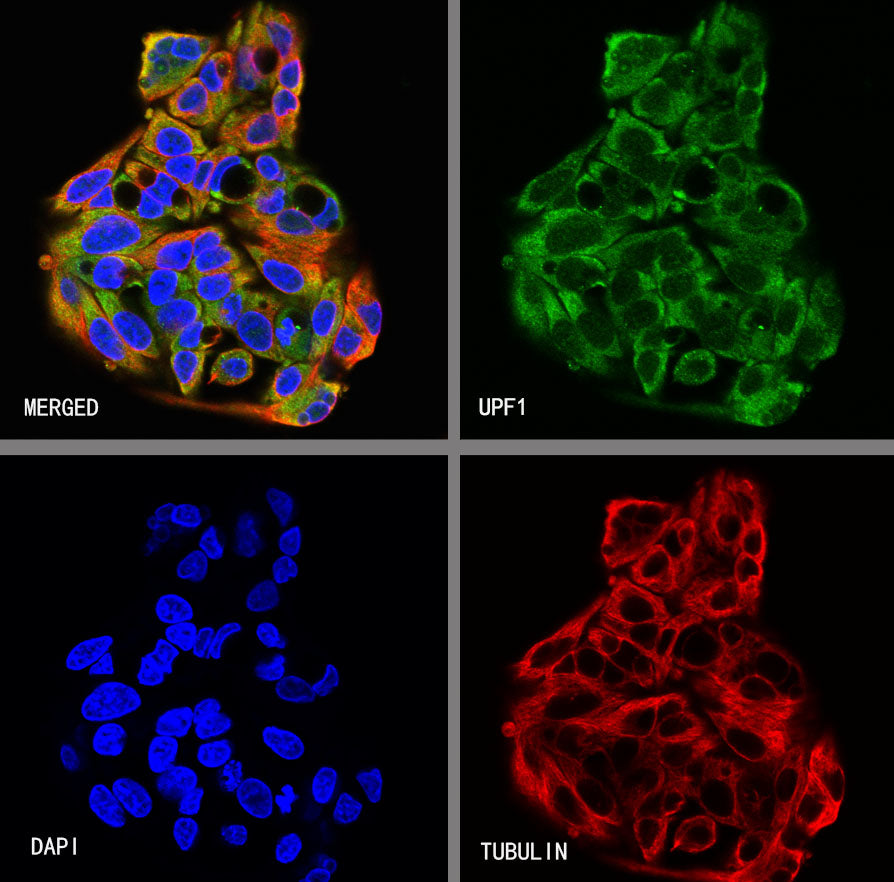
ICC shows positive staining in HepG2 cells. Anti-UPF1 antibody was used at 1/100 dilution (Green) and incubated overnight at 4°C. Goat polyclonal Antibody to Rabbit IgG - H&L (Alexa Fluor® 488) was used as secondary antibody at 1/1000 dilution. The cells were fixed with 4% PFA and permeabilized with 0.1% PBS-Triton X-100. Nuclei were counterstained with DAPI (Blue). Counterstain with tubulin (Red).