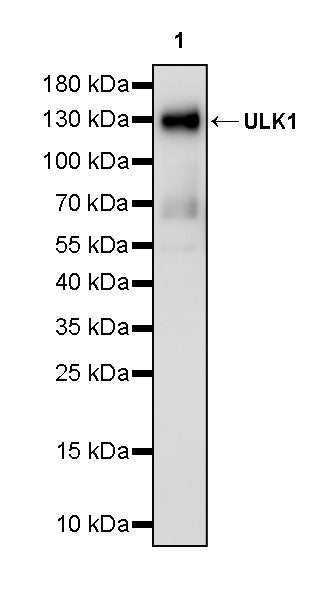
WB result of ULK1 Recombinant Rabbit mAb
Primary antibody incubation conditions: overnight at 4°C
Primary antibody: ULK1 Recombinant Rabbit mAb at 1/1000 dilution
Lane 1: SH-SY5Y whole cell lysate 20 µg
Secondary antibody: Goat Anti- rabbit IgG, (H+L), HRP conjugated at 1/10000 dilution
Predicted MW: 113 kDa
Observed MW: 130 kDa
This blot was developed with high sensitivity substrate
ULK1 Recombinant Rabbit mAb (S-5302)
ULK1 Recombinant Rabbit mAb (S-5302)
Price:
Regular price
$100 USD
Regular price
Sale price
$100 USD
Unit price
per
For shipping services or bulk orders, you may request a quotation.
Secure checkout with

View full details
Product Details
Product Details
Product Specification
| Host | Rabbit |
| Antigen | ULK1 |
| Synonyms | Serine/threonine-protein kinase ULK1; Autophagy-related protein 1 homolog (ATG1; hATG1); Unc-51-like kinase 1; KIAA0722 |
| Location | Cytoplasm |
| Accession | O75385 |
| Clone Number | S-5302 |
| Antibody Type | Recombinant mAb |
| Isotype | IgG |
| Application | WB |
| Reactivity | Hu, Ms, Rt, Mk |
| Positive Sample | SH-SY5Y, PC-12 |
| Purification | Protein A |
| Concentration | 0.5 mg/ml |
| Conjugation | Unconjugated |
| Physical Appearance | Liquid |
| Storage Buffer | PBS, 40% Glycerol, 0.05% BSA, 0.02% sodium azide |
| Stability & Storage | 12 months from date of receipt / reconstitution, -20 °C as supplied |
Dilution
| application | dilution | species |
| WB | 1:500-1:1000 | Hu, Ms, Rt, Mk |
Background
ULK1 (Unc-51-like kinase 1) is a serine/threonine protein kinase that serves as a core regulatory factor in autophagy initiation and plays a critical role in nutrient sensing and cellular homeostasis maintenance. As the mammalian homolog of the ATG1 kinase, ULK1 is the catalytic subunit of the ULK1 complex (comprising ULK1, ATG13, FIP200, and ATG101), which represents the most upstream component of the autophagy signaling pathway. Under nutrient-rich conditions, mTORC1 directly phosphorylates ULK1 at multiple sites (e.g., Ser757), inhibiting its kinase activity and thereby blocking autophagy initiation; conversely, under energy stress or nutrient deprivation, AMPK phosphorylates ULK1 at distinct sites (e.g., Ser317, Ser555) to activate its activity, while also relieving ULK1 from inhibition by suppressing mTORC1. Once activated, ULK1 promotes phagophore formation by phosphorylating downstream substrates (including ATG13, ATG14, Beclin-1, and VPS34 complex components), subsequently initiating autophagosome assembly and maturation. Beyond its classical role in autophagy regulation, ULK1 also participates in non-autophagy biological processes such as endoplasmic reticulum-Golgi trafficking, mitosis, and innate immune responses, regulating interferon responses through phosphorylation of immune modulators like STING. Dysfunction of ULK1 is closely associated with the development and progression of neurodegenerative diseases (such as Alzheimer's disease and Parkinson's disease), metabolic disorders, and various cancers, making it an important drug target for these conditions. Particularly in the field of oncology, ULK1 inhibitors are being extensively studied to enhance the sensitivity of chemotherapy and immunotherapy.
Picture
Picture
Western Blot
WB result of ULK1 Recombinant Rabbit mAb
Primary antibody incubation conditions: overnight at 4°C
Primary antibody: ULK1 Recombinant Rabbit mAb at 1/1000 dilution
Lane 1: PC-12 whole cell lysate 20 µg
Secondary antibody: Goat Anti- rabbit IgG, (H+L), HRP conjugated at 1/10000 dilution
Predicted MW: 113 kDa
Observed MW: 130 kDa
This blot was developed with high sensitivity substrate