UBR1 Recombinant Rabbit mAb (S-4166-11)
UBR1 Recombinant Rabbit mAb (S-4166-11)
Price:
Regular price
$100 USD
Regular price
Sale price
$100 USD
Unit price
per
For shipping services or bulk orders, you may request a quotation.
Secure checkout with

View full details
Product Details
Product Details
Product Specification
| Host | Rabbit |
| Antigen | UBR1 |
| Synonyms | E3 ubiquitin-protein ligase UBR1; N-recognin-1; Ubiquitin-protein ligase E3-alpha-1; Ubiquitin-protein ligase E3-alpha-I |
| Immunogen | Synthetic Peptide |
| Location | Cytoplasm |
| Accession | Q8IWV7 |
| Clone Number | S-4166-11 |
| Antibody Type | Recombinant mAb |
| Isotype | IgG |
| Application | WB |
| Reactivity | Hu, Ms, Rt, Mk |
| Positive Sample | A431, Caco-2, HUVEC, HepG2, NIH/3T3, C2C12, PC-12, rat skeletal muscle, COS-7 |
| Purification | Protein A |
| Concentration | 0.5 mg/ml |
| Conjugation | Unconjugated |
| Physical Appearance | Liquid |
| Storage Buffer | PBS, 40% Glycerol, 0.05% BSA, 0.02% sodium azide |
| Stability & Storage | 12 months from date of receipt / reconstitution, -20 °C as supplied |
Dilution
| application | dilution | species |
| WB | 1:1000 | Hu, Ms, Rt, Mk |
Background
UBR1 is an evolutionarily highly conserved E3 ubiquitin ligase encoded by the UBR1 gene and serves as a key recognition component of the N-end rule pathway. This protein contains a RING-type zinc finger domain for binding E2 ubiquitin-conjugating enzymes, as well as a UBR box domain for recognizing substrates bearing destabilizing N-terminal residues (such as basic or bulky hydrophobic amino acids), enabling specific binding to target proteins and mediating their polyubiquitination, ultimately leading to degradation via the ubiquitin-proteasome system. Beyond this classical function, UBR1 can also bind leucine and participate in cell growth regulation as a negative regulator of the leucine-mTOR signaling pathway. At the pathological level, UBR1 gene mutations lead to Johanson-Blizzard syndrome (JBS), an autosomal recessive disorder characterized by congenital pancreatic exocrine insufficiency, nasal wing hypoplasia, intellectual disability, and other multisystem anomalies, in which patients' pancreatic tissues lack UBR1 expression and exhibit destructive pancreatitis beginning in utero. Furthermore, recent studies have revealed that UBR1 plays an important role in regulating glutamate metabolic homeostasis, and its loss of function may lead to abnormal glutamate levels, providing new perspectives for understanding the pathogenesis of JBS
Picture
Picture
Western Blot
WB result of UBR1 Recombinant Rabbit mAb
Primary antibody: UBR1 Recombinant Rabbit mAb at 1/1000 dilution
Lane 1: A431 whole cell lysate 20 µg with loading buffer and incubate at 70°C for 10 minutes
Lane 2: Caco-2 whole cell lysate 20 µg with loading buffer and incubate at 70°C for 10 minutes
Lane 3: HUVEC whole cell lysate 20 µg with loading buffer and incubate at 70°C for 10 minutes
Lane 4: HepG2 whole cell lysate 20 µg with loading buffer and incubate at 70°C for 10 minutes
Secondary antibody: Goat Anti-Rabbit IgG, (H+L), HRP conjugated at 1/10000 dilution
Predicted MW: 200 kDa
Observed MW: 200 kDa
This blot was developed with high sensitivity substrate
WB result of UBR1 Recombinant Rabbit mAb
Primary antibody: UBR1 Recombinant Rabbit mAb at 1/1000 dilution
Lane 1: NIH/3T3 whole cell lysate 20 µg with loading buffer and incubate at 70°C for 10 minutes
Lane 2: C2C12 whole cell lysate 20 µg with loading buffer and incubate at 70°C for 10 minutes
Secondary antibody: Goat Anti-Rabbit IgG, (H+L), HRP conjugated at 1/10000 dilution
Predicted MW: 200 kDa
Observed MW: 200 kDa
This blot was developed with high sensitivity substrate
WB result of UBR1 Recombinant Rabbit mAb
Primary antibody: UBR1 Recombinant Rabbit mAb at 1/1000 dilution
Lane 1: PC-12 whole cell lysate 20 µg with loading buffer and incubate at 70°C for 10 minutes
Lane 2: Rat skeletal muscle lysate 20 µg with loading buffer and incubate at 70°C for 10 minutes
Secondary antibody: Goat Anti-Rabbit IgG, (H+L), HRP conjugated at 1/10000 dilution
Predicted MW: 200 kDa
Observed MW: 200 kDa
This blot was developed with high sensitivity substrate
WB result of UBR1 Recombinant Rabbit mAb
Primary antibody: UBR1 Recombinant Rabbit mAb at 1/1000 dilution
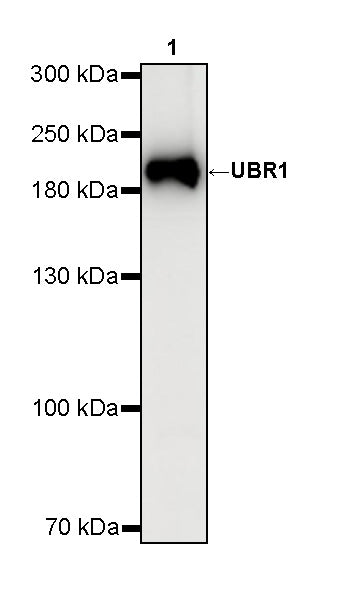
Lane 1: COS-7 whole cell lysate 20 µg with loading buffer and incubate at 70°C for 10 minutes
Secondary antibody: Goat Anti-Rabbit IgG, (H+L), HRP conjugated at 1/10000 dilution
Predicted MW: 200 kDa
Observed MW: 200 kDa
This blot was developed with high sensitivity substrate