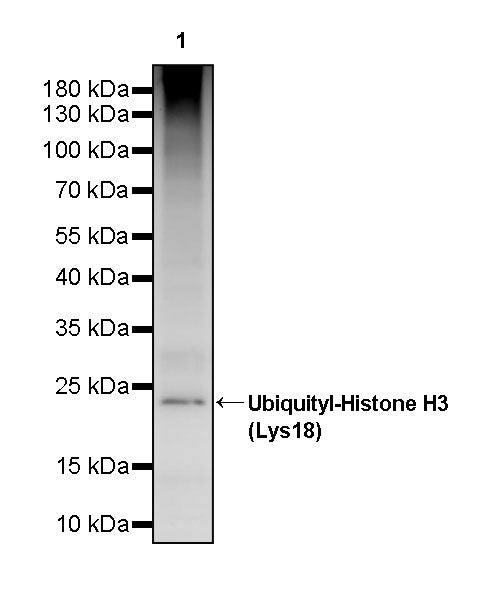
WB result of Ubiquityl-Histone H3 (Lys18) Recombinant Rabbit mAb
Primary antibody incubation conditions: overnight at 4°C
Primary antibody: Ubiquityl-Histone H3 (Lys18) Recombinant Rabbit mAb at 1/1000 dilution
Lane 1: C6 LNCaP whole cell hot lysate with 1% SDS 20 µg
Secondary antibody: Goat Anti- rabbit IgG, (H+L), HRP conjugated at 1/10000 dilution
Predicted MW: 15 kDa
Observed MW: 23 kDa
Ubiquityl-Histone H3 (Lys18) Recombinant Rabbit mAb (S-4790)
Ubiquityl-Histone H3 (Lys18) Recombinant Rabbit mAb (S-4790)
Price:
Regular price
$100 USD
Regular price
Sale price
$100 USD
Unit price
per
For shipping services or bulk orders, you may request a quotation.
Secure checkout with

View full details
Product Details
Product Details
Product Specification
| Host | Rabbit |
| Antigen | Ubiquityl-Histone H3 (Lys18) |
| Synonyms | Histone H3.1; Histone H3/a; Histone H3/b; Histone H3/c; Histone H3/d; Histone H3/f; H3FA; HIST1H3ANameH3C2 SynonymsH3FL; HIST1H3BNameH3C3 SynonymsH3FC HIST1H3CNameH3C4 SynonymsH3FB; HIST1H3DNameH3C6 SynonymsH3FD; HIST1H3EMore gene names; H3C1 |
| Location | Nucleus |
| Accession | P68431 |
| Clone Number | S-4790 |
| Antibody Type | Recombinant mAb |
| Isotype | IgG |
| Application | WB |
| Reactivity | Hu, Ms, Rt |
| Purification | Protein A |
| Concentration | 0.5 mg/ml |
| Conjugation | Unconjugated |
| Physical Appearance | Liquid |
| Storage Buffer | PBS, 40% Glycerol, 0.05% BSA, 0.03% Proclin 300 |
| Stability & Storage | 12 months from date of receipt / reconstitution, -20 °C as supplied |
Dilution
| application | dilution | species |
| WB | 1;1000 | Hu, Ms, Rt |
Background
Ubiquityl-Histone H3 (Lys18) refers to an epigenetic mark characterized by ubiquitination of histone H3 at its 18th lysine residue, representing a relatively recently recognized regulatory mode among histone post-translational modifications. This modification is catalyzed by specific E3 ubiquitin ligases (such as RNF168 and RNF20), which covalently attach ubiquitin molecules to the K18 site of H3, while deubiquitinases (such as USP51) can reverse it. Unlike classical histone ubiquitination sites (e.g., K120/K123 on H2B), H3K18 ubiquitination is primarily enriched at gene promoter regions and transcription elongation regions, and its function is closely associated with transcriptional activation—studies have shown that H3K18 ubiquitination promotes RNA polymerase II recruitment and promoter escape, thereby enhancing downstream gene expression. Additionally, this modification plays an important role in DNA damage repair: upon DNA double-strand breaks, RNF168-mediated H3K18 ubiquitination cooperates with H2A/H2AX ubiquitination to recruit repair proteins (such as 53BP1 and BRCA1) to the damage sites, regulating the choice of repair pathways. Under pathological conditions, aberrant changes in H3K18 ubiquitination levels are associated with various cancers (e.g., breast cancer, prostate cancer, colorectal cancer), neurological disorders (e.g., Huntington's disease), and developmental defects, potentially promoting tumor initiation and progression by affecting the transcription of oncogenes or tumor suppressor genes. In epigenetic research and clinical translation, detecting Ubiquityl-Histone H3 (Lys18) helps elucidate the mechanisms of gene transcription regulation, DNA damage response, and tumorigenesis, and provides a potential biomarker for the development of epigenetic drugs targeting the ubiquitination pathway.
Picture
Picture
Western Blot