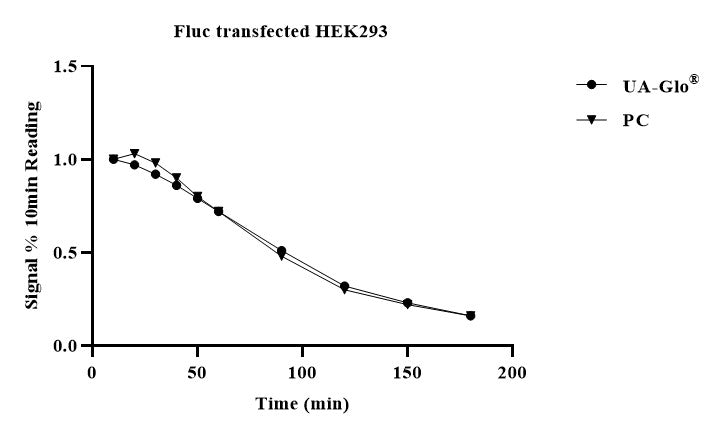
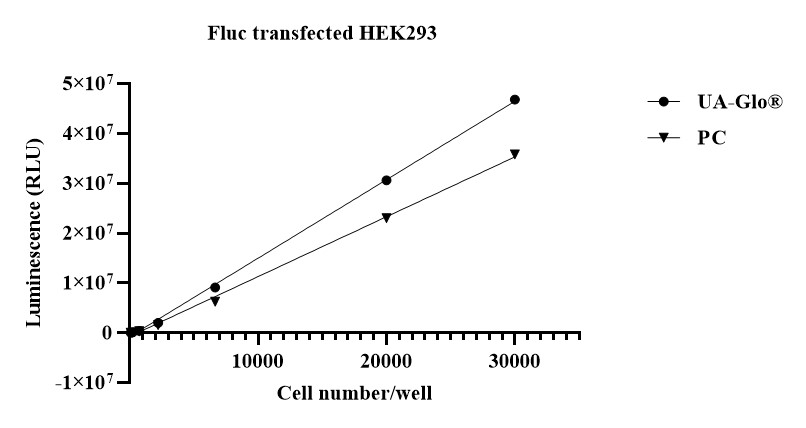
Cell Count Sensitivity Test
UA-Glo® Steady Luciferase Assay System
UA-Glo® Steady Luciferase Assay System
Price:
Regular price
$282 USD
Regular price
Sale price
$282 USD
Unit price
per
For shipping services or bulk orders, you may request a quotation.
Secure checkout with

View full details
Product Details
Product Details
Product Specification
| Synonyms | 稳定型荧光素酶检测试剂盒 |
| Stability & Storage | Dry ice transportation. Store in a dark place at -20℃ or below. It is recommended to store for a long term (>3 months) at -80℃. The validity period is indicated on the vial label. After the first use, it is suggested to aliquot the reagent and store it in a dark place at -20℃ or below. The reagent can be frozen and thawed no more than 5 times. |
Background
The UA-Glo® stable luciferase detection kit can be used for quantitative detection of the expression level of the reporter gene luciferase in cells. The kit is a homogeneous reagent and only requires one sample addition for testing, reducing the experimental errors that may be caused by multiple sample additions. This reagent has the characteristics of high signal-to-noise ratio, good repeatability, and good stability. Its stable luminescent signal makes this product particularly suitable for high-throughput screening experiments of compounds.
Components
ATP, luciferin, and buffer are mixed and then filled into 10 ml or 100 ml brown bottles. Specifications are as follows:
Product Specification |
Number of 96-well plate wells detectable |
Number of 384-well plate wells detectable |
10 ml |
100 |
500 |
100 ml |
1,000 |
5,000 |
10 x 100 ml |
10,000 |
50,000 |
Protocol
UA-Glo® Stable Luciferase Assay Ki detects the activity of the firefly luciferase reporter gene in cells through a luciferase reaction. The luciferase reaction is highly sensitive, and parameters such as pH, temperature, and experimental system settings have a significant impact on the reaction. Under most experimental conditions, direct comparison of absolute detection values between samples is not recommended. It is advised to set up the same reference control on each assay plate, and normalize the detection values of experimental samples against those of the reference control and vehicle control before data processing and comparison.
1) Seed the experimental cells expressing the firefly luciferase reporter gene at an appropriate density in a white, transparent-bottom 96-well or 384-well cell culture plate according to experimental requirements.
2) After treating the cells as required by the experiment, proceed with the luciferase reporter gene assay.
3) Take out the UA-Glo® Stable Luciferase Assay reagent. After complete thawing, equilibrate to room temperature (22°C–25°C) and mix thoroughly by inverting. The luciferase reaction is sensitive to temperature changes. Both the assay reagent and the cell plate must be equilibrated to room temperature, and the temperature should be kept constant (±1°C) during the assay.
4) Remove the experimental cell plate and equilibrate to room temperature.
5) Add an equal volume of assay reagent to the culture medium in each well of the cell plate. For example, add 100 µL of assay reagent to wells of a 96-well plate containing 100 µL of cells, or 20 µL of assay reagent to wells of a 384-well plate containing 20 µL of cells.
6) Shake the plate at medium speed for 1 minute, then incubate in the dark for 10 minutes to stabilize the luminescence signal.
7) Measure the luminescence signal using a luminometer or a multimode plate reader. The plate can be read within 2–3 hours.
Guidelines
1) It is not recommended to mix samples from different batches.
2) Without rigorous verification, it is not advisable to change the dosage of the detection reagents.
3) This is for research purposes only.
Picture
Picture
Bioactivity
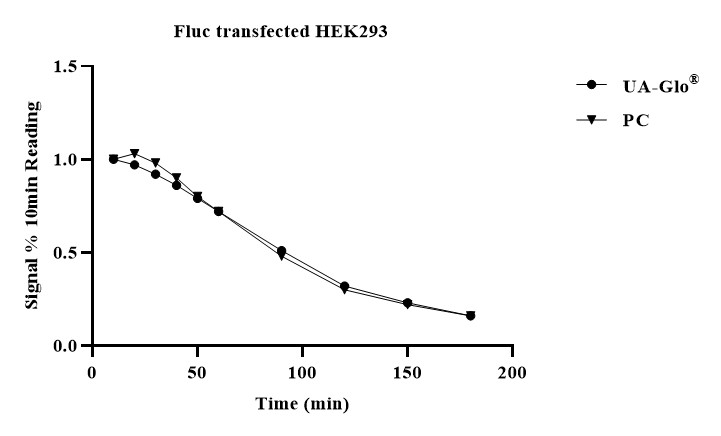
Stability testing