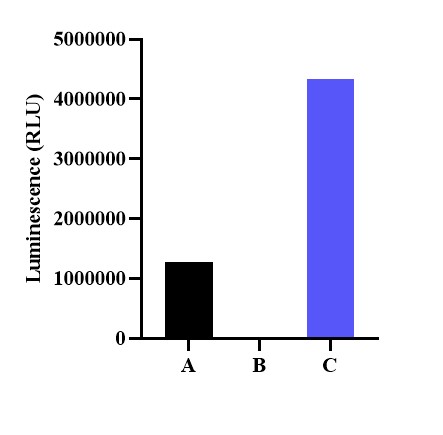
A: Fluc activity after R1 addition
B: Remaining FLuc activity after R1+R2 addition
C: Nluc activity after R1+(R2+Sub) addition
Remaining Fluc actity afer R2 Addition (%)=0.037%

| Synonyms | MicroSplit Luciferase Lysis-Based Assay Kit |
| Stability & Storage |
Dry ice transportation. Store at -20°C or below, protected from light, with a shelf life of 12 months. For long-term storage (>4 weeks), the substrate is recommended to be stored at -80°C. After initial use, the substrate should be aliquoted and stored at -20°C or below. The detection reagent is recommended to be freshly prepared as needed. The remaining detection reagent can be stored at -20°C or -80°C. |
The Nano-luc Split Enzyme Technology divides NanoLuc® Luciferase into two high-affinity fragments: a large fragment and a small fragment. The small fragment of NanoLuc® is expressed as a tag for the target protein and can rapidly combine with the large fragment in the same reaction system to form a complete enzyme molecule with NanoLuc® activity. Detecting the NanoLuc® activity resulting from the binding of the large and small fragments can be used to study protein expression, regulation, degradation, and protein-protein interactions in cells.
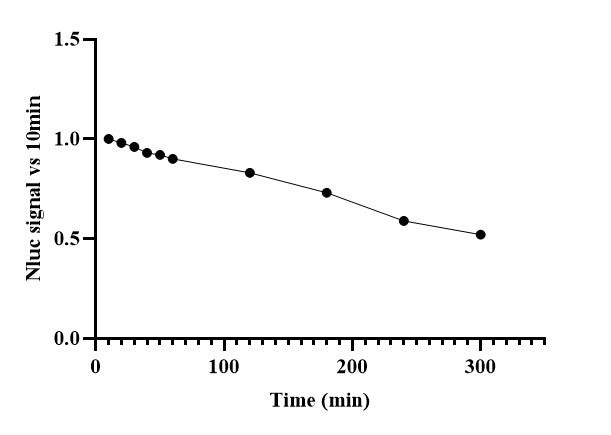
U-Excell Bio's Nano-luc Lytic Detection System includes proprietary cell lysis buffer and NanoLuc® substrate. This kit offers high detection sensitivity, low background, a wide detection range, and stable detection signals (with a half-life of approximately 3 hours), making it particularly suitable for high-throughput compound screening.
Specification |
Cell Lysis Buffer |
Micro-Luciferase Substrate |
96-Well Plate Test Wells |
384-Well Plate Test Wells |
10 ml |
10 ml |
50μl |
100 |
500 |
100 ml |
100 ml |
0.5ml |
1,000 |
5,000 |
10*100 ml |
10X100 ml |
10X0.5 ml |
10,000 |
50,000 |
The customer constructs a target protein expression vector tagged with a mini-luciferase small fragment and cells expressing this target protein according to experimental needs, including transient or stable exogenous expression, as well as endogenous expression cell lines constructed via techniques such asCRISPR-Cas9 Knock-IN technology. The mini-luciferase large fragment is provided by the customer.
Seed cells at an appropriate density in white transparent96-well or384-well cell culture plates, transfect with plasmids expressing the target protein tagged with the mini-luciferase small fragment, or directly seed stable cell lines expressing the target protein.
Treat the cells as required by the experiment and continue culturing for an appropriate duration.
Remove the cell lysate and equilibrate to room temperature (22℃-25℃). The luciferase reaction in the detection reagent is sensitive to temperature changes. Reagents and test samples/experimental plates need to be equilibrated to room temperature (22℃-25℃), and the temperature must remain constant (±1℃) during the assay.
Remove the substrate and mini-luciferase large fragment (provided by the customer), centrifuge briefly for10 sec to collect contents at the bottom of the tube, and place on ice.
Remove the experimental cell plate and equilibrate to room temperature.
Detection reagent preparation: Determine the required volume of detection reagent based on experimental needs. During preparation, first add the substrate at200x to the cell lysate, mix thoroughly, then add the mini-luciferase large fragment (customer-supplied). The concentration of the mini-luciferase large fragment requires optimization; its working concentration should be in excess relative to the target protein concentration. A recommended stock concentration is100x, which should be diluted to1x using the cell lysate containing1x substrate described above prior to use, and mixed thoroughly.
Add a volume of detection reagent equal to the culture medium to each well of the experimental cell plate. For example, add100μL of detection reagent to100μL of culture medium per well. Shake the plate for3min, then place in the dark to continue lysis for10min.
Read the luminescence signal using a multi-mode microplate reader.
1. This product is intended for research use only.
2. Mixing reagents from different batches is not recommended.
3. Arbitrary changes to the amount of detection reagents are not recommended without rigorous validation.
4. Store the detection reagents according to the instructions to ensure reagent stability.
A: Fluc activity after R1 addition
B: Remaining FLuc activity after R1+R2 addition
C: Nluc activity after R1+(R2+Sub) addition
Remaining Fluc actity afer R2 Addition (%)=0.037%
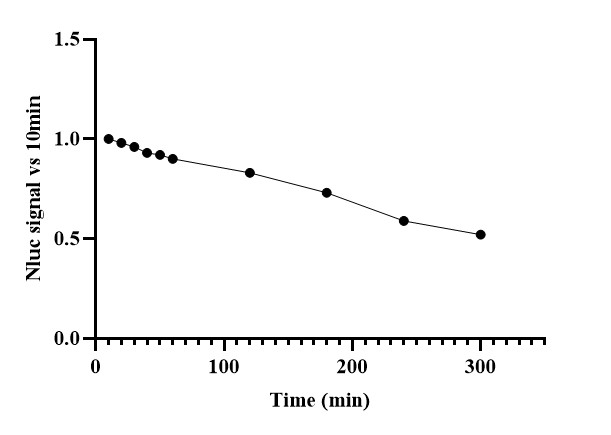
Stability testing