UA-Glo® GTPase Activity Detection Kit
UA-Glo® GTPase Activity Detection Kit

Product Details
Product Details
Product Specification
| Stability & Storage | Dry ice transport. Store protected from light at −20°C or lower; for long-term (>3 months) storage, −80°C is recommended. Refer to the vial label for the expiration date. After first use, it is advisable to aliquot the reagent as needed and store it protected from light at −20°C or below, avoiding repeated freeze-thaw cycles. When aliquoting the ATP assay reagent, exercise caution to prevent ATP contamination. |
Background
GTPases are GTP-hydrolyzing enzymes and constitute an essential component of many cellular signaling pathways. GTPases exhibit high affinity for both GTP and GDP; upon binding GTP, they adopt an active conformation, whereas hydrolysis of bound GTP to GDP converts them to an inactive state. Through the interconversion between these two conformations, GTPases regulate the activation and deactivation of numerous cellular signaling pathways. This conformational switch is modulated by two classes of proteins: GTPase-activating proteins (GAPs) and guanine nucleotide exchange factors (GEFs). GAPs enhance the GTPase's intrinsic GTP-hydrolyzing activity, thereby shutting down the signaling pathway, while GEFs facilitate the exchange of GDP bound to the inactive GTPase for GTP, restoring GTPase activity and activating the signaling cascade.
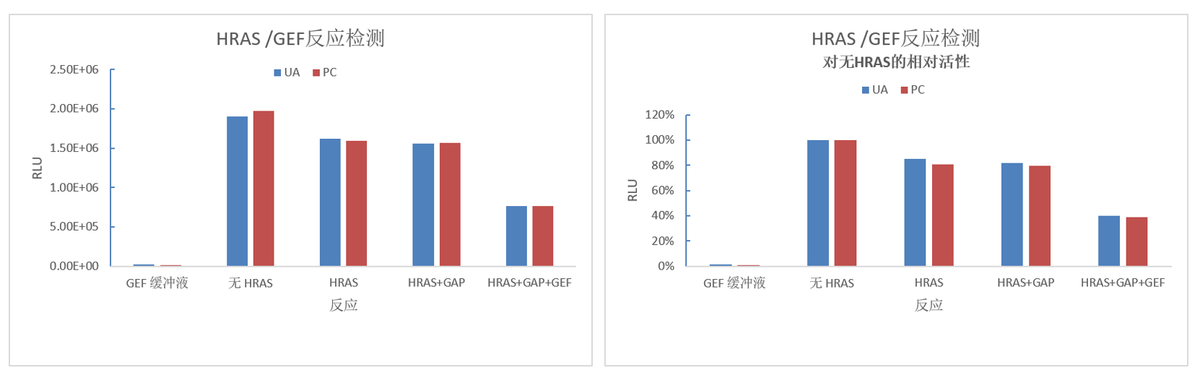
The UA-Glo® GTPase Assay Kit can detect GTPase activity and the effects of its associated GAPs and GEFs on that activity. During the GTPase reaction, GTP is consumed, and any remaining GTP can be converted to ATP by the G2A reagent included in the kit. The final ATP detection reagent contains luciferase, which catalyzes the reaction between ATP and luciferin, producing luminescence. The intensity of this luminescence is directly proportional to the amount of ATP—and thus to the remaining GTP—while being inversely proportional to GTPase activity. The UA-Glo® GTPase Assay Kit is suitable for measuring intrinsic GTPase activity, GAP-stimulated GTPase activity, GAP activity, and GEF activity. This kit offers a high signal-to-noise ratio, excellent reproducibility, and outstanding stability, making it particularly well suited for high-throughput compound screening assays.
Components
UA-Glo® GTPaseThe components and specifications of the test kit are as follows. Number of detectable samples384-well plate (low volume)According to the sample beingGTPasereaction5 μL, addG2Aconversion reagent5 μLandATPdetection reagent10 μLCalculation.For a 96-well plate, the number of detectable samples is calculated when each component is25 μL,25 μLand50 μLare used.
Specifications |
Components and specifications |
DetectionNumber of wells in a 96-well plate |
DetectionNumber of wells in a 384-well plate |
1000 assays |
GTPase/GAPBuffer:5 mL GEFbuffer:5 mL G2Abuffer:5 mL G2Areaction reagent(500x):15μL ADP (10mM):100μL ATPdetection reagent:10 mL rGTP (10mM):100μL DTT (100 mM):100μL |
200 |
1,000 |
10,000 assays |
GTPase/GAPBuffer:50 mL GEFBuffer:50 mL G2ABuffer:50 mL G2AReaction reagent(500x):120μL ADP (10 mM):100μL ATPTest reagent:100 mL rGTP (10 mM):100μL DTT (100 mM):1.25 mL |
2,000 |
10,000 |
Protocol
UA-Glo® GTPaseThe detection kit measures the enzymatic activity ofATPby detecting the content ofGTPasethrough a luciferase reaction. The luciferase reaction has extremely high sensitivity, and parameters such aspH,temperature, and experimental system setup can significantly affect the reaction. Under most experimental conditions, it is not recommended to directly compare absolute values of samples. It is suggested to set the same reference compound on each experimental plate and normalize the sample detection values using the reference compound and solvent control before data processing and comparison.
1. GTPaseActivity Assay
The following explanation uses a384-well assay plate as an example to illustrateGTPaseactivity detection.
1)According to experimental needs, set up assays forGTPaseintrinsic activity,GAPstimulatedGTPaseactivity,GAPactivity, andGEFactivity enzyme reactions; refer to the following3.2and3.3and3.4and3.5sections. The reaction system is10μL
2)Take outG2ABuffer, after complete thawing, equilibrate to room temperature(22℃-25℃), invert thoroughly to mix
3)Take outG2AReaction reagent(500x)andADP (10mM), after completely thawing, place on ice
4)PrepareG2Aconversion reagent:Add per well10μLCalculate the required amount ofG2Aconversion reagent, for example, to prepare1mL:998μL G2Abuffer+ 2μL G2Areaction reagent(500x) + 0.5μL ADP (10mM)
5)Take out the experimental steps1enzyme reaction plate, add per well10μL G2Aconversion reagent, shake the plate to mix, incubate at room temperature0.5hr
6)Take outATPdetection reagent, after completely thawing, invert thoroughly to mix. Add per well20μLtake the required amount ofATPBring the assay reagents to room temperature. The luciferase reaction is sensitive to temperature changes.ATPTest reagents and enzyme reaction assay plates must be equilibrated to room temperature, and the temperature during the assay must be maintained constant (±1°C)
7)Steps5Add to each well of the enzyme reaction assay plateTwentymuLATPTesting reagents, plate shaker1 minute, incubate in the dark10 minutes
8)Read the luminescence signal on a luminometer or a multifunctional microplate reader. The signal is highly stable and can be2-3 hoursInternal reading board
2. GTPaseEnzyme reaction
The following, with384-Taking the Kong experimental board as an example to illustrateGTPaseExperimental setup for enzyme reactions.GTPaseIn enzyme reactionsGTPThe final concentration is5muM, it is recommended toGTPaseIn enzymatic reactions, use no more than5muMof/'sGTP. InspectionGTPaseIt can be used when intrinsic activity is present.1muM GTP. BestGTPThe concentration may need to be adjusted based on the specific circumstances.GTPaseEnzyme reaction optimization. The reagent kit'sGTPase/GAPBuffer andGlobal Environment FacilityThe buffer is suitable for most.GTPaseEnzymatic reaction, certainGTPaseEnzymatic reactions may require additional metal ions or cofactors to enhance enzyme activity; refer to the relevant literature to determine whether their addition is necessary.
1)Preparation2X GTPReaction solution:GTPase/GAPBuffer addedGTPTo10 μM,Digital Terrestrial TelevisionTo1 mM
2)UseGTPase/GAPBuffer forGTPasePerform gradient dilution(Or dilute to an appropriate concentration.), join5 μLTo384-Kong white experimental board
3)Join5 μLSteps1Preparation2X GTPReaction solution
4)Incubation at room temperature1hr-2hr, The optimal incubation time may need to be determined based on the specific circumstances.GTPaseOptimization
5)To carry outGTPaseActivity assay; for detailed procedures, see3.1FestivalGTPaseActivity Assay
3. GAPExcitingGTPaseEnzyme reaction
1)Preparation2X GTP-GAPReaction solution:GTPase/GAPBuffer addedGTPto10 μM,DTTto1 mMand the correspondingGAPprotein concentration2xat the setGTPaseenzyme reaction concentration
2)UsingGTPase/GAPbuffer to performa gradient dilution onGTPase(or dilute it to an appropriate concentration), add5 μLto384-well white assay plate
3)add5 μLfrom step1prepare2X GTP-GAPreaction solution
4)incubate at room temperaturefor 1–2 hoursthe optimal incubation time may need to be adjusted according to the specificGTPaseoptimized
5)performGTPaseactivity assay; for specific procedures, seeSection 3.1[GTPaseactivity assay]
4. GAPactivity assay
1)prepare2X GTPasereaction solution:GTPase/GAPbuffer addedDTTto1 mMandGTPaseconcentration2xAt the setGTPaseenzyme reaction concentration
2)Using a solution containing10μM GTPin theGTPase/GAPbuffer to perform gradient dilutions of the relevantGAPprotein(or dilute it to an appropriate concentration), add5 μLto384-well white assay plate
3)add5 μLstep1prepare2X GTPasereaction solution
4)Incubate at room temperaturefor 1–2 hours, the optimal incubation time may need to be adjusted according to the specificGTPaseoptimized
5)performGTPaseactivity assay; for detailed procedures, seeSection 3.1section [GTPaseactivity assay]
5. GEFactivity assay
1)prepare2X GTPase-GAPreaction solution:GEFbuffer is added withDTTto reach1 mM,GTPaseand relatedGAPprotein concentrations2xat the setGTPaseenzyme reaction concentration
2)using a solution containing10μM GTPofGEFbuffer to dilute the relevantGEFPerform gradient dilution of the protein.(Or dilute to an appropriate concentration.), join5 μLTo384-Kong white experimental board
3)Join5 μLSteps1Preparation2X GTPase-GAPReaction solution
4)Incubation at room temperature1hr-2hr, The optimal incubation time may need to be determined based on the specific circumstances.GTPaseOptimization
5)To carry outGTPaseActivity assay; for detailed procedures, see3.1FestivalGTPaseActivity Assay
Guidelines
1) Mixing different batches is not recommended.