1μg (R: reducing condition, N:non-reducing condition).
TSLP His Tag Protein, Human
TSLP His Tag Protein, Human
Price:
Regular price
$200 USD
Regular price
Sale price
$200 USD
Unit price
per
For shipping services or bulk orders, you may request a quotation.
Secure checkout with

View full details
Product Details
Product Details
Product Specification
| Species | Human |
| Synonyms | thymic stromal lymphopoietin |
| Accession | Q969D9-1 |
| Amino Acid Sequence | Tyr29-Gln159 with His Tag at the C-Terminus |
| Expression System | HEK293 |
| Molecular Weight | 9-14&18-27kDa (Reducing) |
| Purity | >95% by SDS-PAGE & > 95% SEC-HPLC |
| Conjugation | Unconjugated |
| Tag | His Tag |
| Physical Appearance | Lyophilized powder |
| Storage Buffer | PBS, PH7.4, 5% trehalose |
| Reconstitution | Reconstitute at 0.1-1 mg/ml according to the size in ultrapure water after rapid centrifugation. |
| Stability & Storage | · 12 months from date of receipt, lyophilized powder stored at -20 to -80℃. |
| Reference | 1.Kui L, Huang J, Wang G, Zhao J, Wang S, Qin X, Liu L, Hu J, Chen L, Wang X, Li Q, Zhao Y, Tang Y, Xiong K, Zhan S, Ding H, Wang J, Cai H, Zhang Q, Zi X, Deng Q, Gao L, Wang X, Zou C, Yang H, Xiao Y, Yang B, Leng B, Zhang L, Hu G. Endolysin significantly improves symptoms with atopic dermatitis: bridging the gap from research to clinical practice. Front Immunol. 2025 Oct 22;16:1667195. |
Background
Thymic stromal lymphopoietin (TSLP) is a cytokine secreted by epithelial cells, encoded by a gene that produces a 159-amino acid precursor protein. This protein plays a dual regulatory role in the immune system: on one hand, it promotes type 2 T-helper cell immune responses by activating dendritic cells and directly acts on immune cells such as basophils, driving the development of allergic diseases like atopic dermatitis and asthma; on the other hand, it is involved in maintaining intestinal homeostasis and central immune tolerance. Due to its central role in allergic diseases, TSLP has become an important therapeutic target for conditions such as atopic dermatitis and asthma.
Picture
Picture
SDS-PAGE
SEC-HPLC
The purity of TSLP His Tag Protein, Human is more than 95% determined by SEC-HPLC.
ELISA
Immobilized TSLP His Tag Protein, Human (Cat. No. UA011336) at 5.0μg/mL (100μL/well) can bind TSLPR Fc Chimera Protein, Human (Cat. No. UA010907) with EC50 of 0.60-0.92 ng/mL.
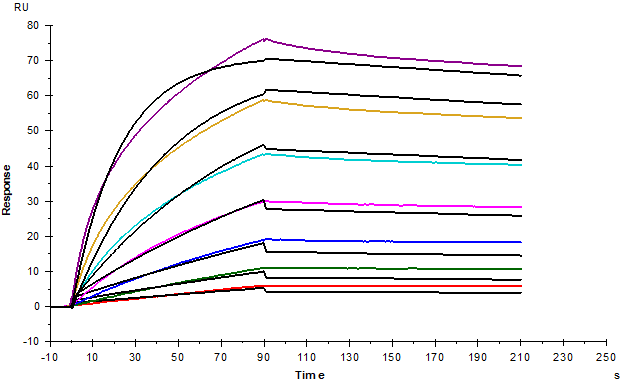
SPR
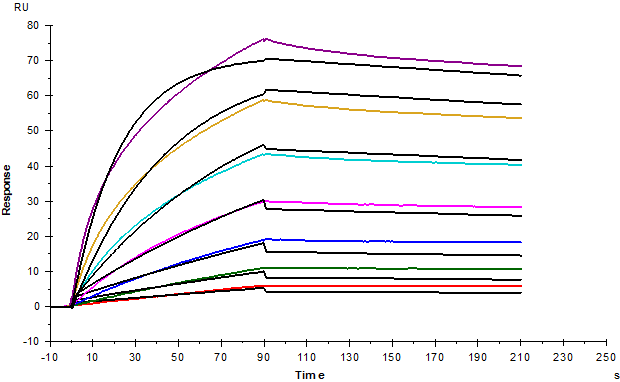
Anti-His antibody Immobilized on CM5 Chip captured TSLP His Tag Protein, Human (Cat. No. UA011336), can bind TSLPR Fc Chimera Protein, Human (Cat. No. UA010907) with an affinity constant of 0.21nM as determined in SPR assay。