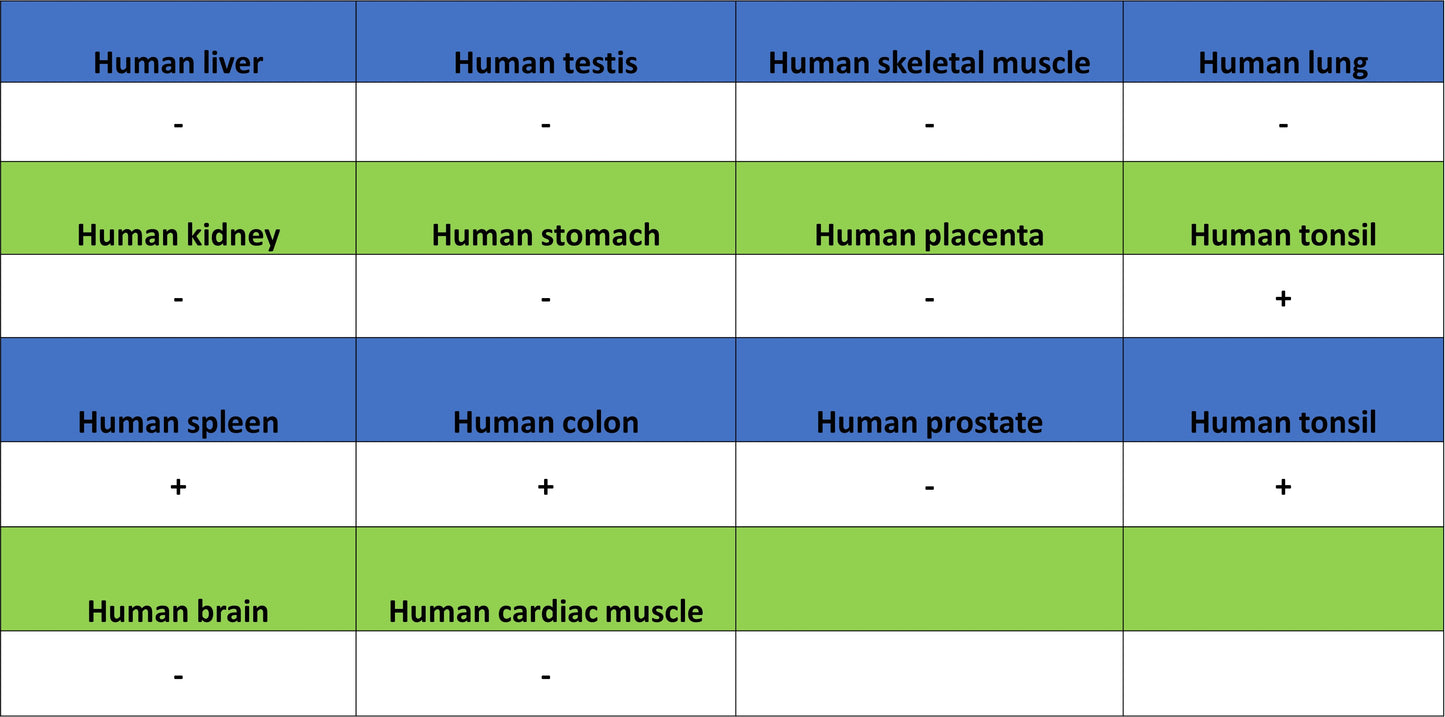
IHC shows positive staining in paraffin-embedded human colon. Anti-TRDC/TCR delta antibody was used at 1/100 dilution, followed by a HRP Polymer for Rabbit IgG (ready to use). Counterstained with hematoxylin. Heat mediated antigen retrieval with Tris/EDTA buffer pH9.0 was performed before commencing with IHC staining protocol.
TRDC/TCR delta Recombinant Rabbit mAb (S-5148)
TRDC/TCR delta Recombinant Rabbit mAb (S-5148)
Price:
Regular price
$100 USD
Regular price
Sale price
$100 USD
Unit price
per
For shipping services or bulk orders, you may request a quotation.
Secure checkout with

View full details
Product Details
Product Details
Product Specification
| Host | Rabbit |
| Antigen | TRDC/TCR delta |
| Synonyms | T cell receptor delta constant; TRDC |
| Location | Cell membrane |
| Accession | B7Z8K6 |
| Clone Number | S-5148 |
| Antibody Type | Recombinant mAb |
| Isotype | IgG |
| Application | IHC |
| Reactivity | Hu |
| Purification | Protein A |
| Concentration | 0.5 mg/ml |
| Conjugation | Unconjugated |
| Physical Appearance | Liquid |
| Storage Buffer | PBS, 40% Glycerol, 0.05% BSA, 0.03% Proclin 300 |
| Stability & Storage | 12 months from date of receipt / reconstitution, -20 °C as supplied |
Dilution
| application | dilution | species |
| IHC-P | 1:100 | Hu |
Background
TCR delta (T cell receptor delta chain) is one of the heterodimeric component chains of the γδ T cell receptor (TCR), covalently linked to the gamma chain via disulfide bonds to form the unique TCRγδ complex, playing an important immune surveillance role at the interface between innate and adaptive immunity. The structure of this protein consists of a variable region (Vδ), diversity region (Dδ), joining region (Jδ), and constant region (Cδ), with its gene locus located within the TCRα/δ locus (on human chromosome 14), generating an extremely diverse antigen recognition repertoire through somatic V(D)J gene recombination. Unlike conventional αβ T cells that recognize MHC-peptide complexes, the TCR delta chain endows γδ T cells with the ability to recognize non-classical antigens, including phosphoantigens, lipid molecules, stress-induced proteins (such as MICA/MICB, ULBP), and unprocessed small-molecule pyrophosphates. This recognition mode does not depend on MHC presentation, enabling γδ T cells to rapidly respond to pathogen infections and tumor-transformed cells. γδ T cells expressing specific TCR delta chains (particularly Vδ1, Vδ2, and Vδ3 subtypes) play critical roles in tissue-resident immunity, epithelial barrier maintenance, and tumor surveillance. Among these, the predominant Vγ9Vδ2 T cells in human peripheral blood specifically recognize microbial-derived pyrophosphate antigens (such as (E)-4-hydroxy-3-methyl-2-butenyl pyrophosphate) through the Vδ2 region of their TCR delta chain, leading to rapid activation in anti-infective immunity. Clinical studies have shown that γδ T cells infiltrating the tumor microenvironment exert direct cytotoxic effects or assist other immune cells through TCR delta chain-mediated recognition. Downregulation or functional deficiency of the TCR delta chain is associated with immune evasion and poor prognosis in various solid tumors (such as colorectal cancer, breast cancer, and melanoma), making immunocellular therapies based on γδ T cells (particularly those involving engineered TCR delta chain modifications) an emerging research direction in the field of cancer therapy.
Picture
Picture
Immunohistochemistry
IHC shows positive staining in paraffin-embedded human spleen. Anti-TRDC/TCR delta antibody was used at 1/100 dilution, followed by a HRP Polymer for Rabbit IgG (ready to use). Counterstained with hematoxylin. Heat mediated antigen retrieval with Tris/EDTA buffer pH9.0 was performed before commencing with IHC staining protocol.
IHC shows positive staining in paraffin-embedded human tonsil. Anti-TRDC/TCR delta antibody was used at 1/100 dilution, followed by a HRP Polymer for Rabbit IgG (ready to use). Counterstained with hematoxylin. Heat mediated antigen retrieval with Tris/EDTA buffer pH9.0 was performed before commencing with IHC staining protocol.
IHC shows positive staining in paraffin-embedded human cervical squamous cell carcinoma. Anti-TRDC/TCR delta antibody was used at 1/100 dilution, followed by a HRP Polymer for Rabbit IgG (ready to use). Counterstained with hematoxylin. Heat mediated antigen retrieval with Tris/EDTA buffer pH9.0 was performed before commencing with IHC staining protocol.
Negative control: IHC shows negative staining in paraffin-embedded human skeletal muscle. Anti-TRDC/TCR delta antibody was used at 1/100 dilution, followed by a HRP Polymer for Rabbit IgG (ready to use). Counterstained with hematoxylin. Heat mediated antigen retrieval with Tris/EDTA buffer pH9.0 was performed before commencing with IHC staining protocol.