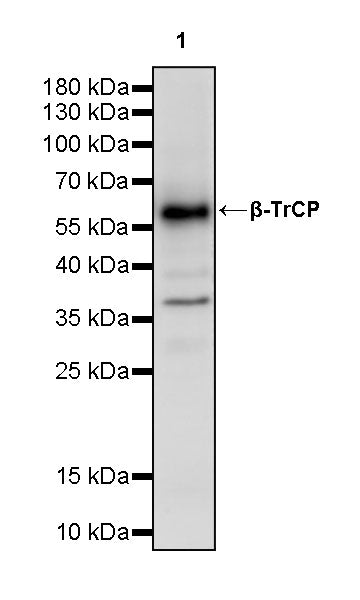
WB result of β-TrCP Recombinant Rabbit mAb
Primary antibody: β-TrCP Recombinant Rabbit mAb at 1/1000 dilution
Lane 1: HepG2 whole cell lysate 20 µg
Lane 2: HEK-293 whole cell lysate 20 µg
Secondary antibody: Goat Anti- rabbit IgG, (H+L), HRP conjugated at 1/10000 dilution
Predicted MW: 69 kDa
Observed MW: 62 kDa
This blot was developed with high sensitivity substrate
β-TrCP Recombinant Rabbit mAb (S-3941-63)
β-TrCP Recombinant Rabbit mAb (S-3941-63)
Price:
Regular price
$100 USD
Regular price
Sale price
$100 USD
Unit price
per
For shipping services or bulk orders, you may request a quotation.
Secure checkout with

View full details
Product Details
Product Details
Product Specification
| Host | Rabbit |
| Antigen | β-TrCP |
| Synonyms | F-box/WD repeat-containing protein 1A; E3RSIkappaB; Epididymis tissue protein Li 2a; F-box and WD repeats protein beta-TrCP; pIkappaBalpha-E3 receptor subunit; BTRCP; FBW1A; FBXW1A; BTRC |
| Immunogen | Synthetic Peptide |
| Location | Cytoplasm, Nucleus |
| Accession | Q9Y297 |
| Clone Number | S-3941-63 |
| Antibody Type | Recombinant mAb |
| Isotype | IgG |
| Application | WB |
| Reactivity | Hu, Mk |
| Positive Sample | HepG2, HEK-293, COS-7 |
| Purification | Protein A |
| Concentration | 2 mg/ml |
| Conjugation | Unconjugated |
| Physical Appearance | Liquid |
| Storage Buffer | PBS, 40% Glycerol, 0.05% BSA, 0.03% Proclin 300 |
| Stability & Storage | 12 months from date of receipt / reconstitution, -20 °C as supplied |
Dilution
| application | dilution | species |
| WB | 1:500-1:1000 | Hu, Mk |
Background
β-TrCP (beta-transducin repeat-containing protein, also known as FBXW1 or BTRC) is a key F-box substrate recognition subunit of the SCF (SKP1-Cullin1-F-box) E3 ubiquitin ligase complex. Its core structure consists of multiple WD40 repeats that form a propeller-like beta-propeller structure, responsible for specifically recognizing and binding to the phosphorylated degron motif (typically "DSGxxS" or "DSGxxT," where the serine/threonine residues require pre-phosphorylation by kinases) in substrate proteins. Through this phosphorylation-dependent recognition mechanism, β-TrCP mediates the ubiquitination and subsequent degradation of various key signaling molecules—such as β-catenin, IκBα, Snail, Claspin, and CDC25A—thereby broadly regulating core signaling pathways including Wnt/β-catenin, NF-κB, Hedgehog, and cell cycle checkpoints. Physiologically, β-TrCP participates in maintaining normal cell cycle progression, DNA damage repair, cell polarity, and epithelial-mesenchymal transition (EMT). Pathologically, its aberrant expression or mutations are closely associated with the development and progression of various malignancies (such as colorectal cancer, breast cancer, and hepatocellular carcinoma). It can function as a tumor suppressor by degrading oncogenic proteins, but under certain circumstances, it may also promote cancer progression by degrading tumor suppressors, exhibiting its complex dual regulatory functions.
Picture
Picture
Western Blot
WB result of β-TrCP Recombinant Rabbit mAb
Primary antibody: β-TrCP Recombinant Rabbit mAb at 1/1000 dilution
Lane 1: COS-7 whole cell lysate 20 µg
Secondary antibody: Goat Anti- rabbit IgG, (H+L), HRP conjugated at 1/10000 dilution
Predicted MW: 69 kDa
Observed MW: 62 kDa
This blot was developed with high sensitivity substrate