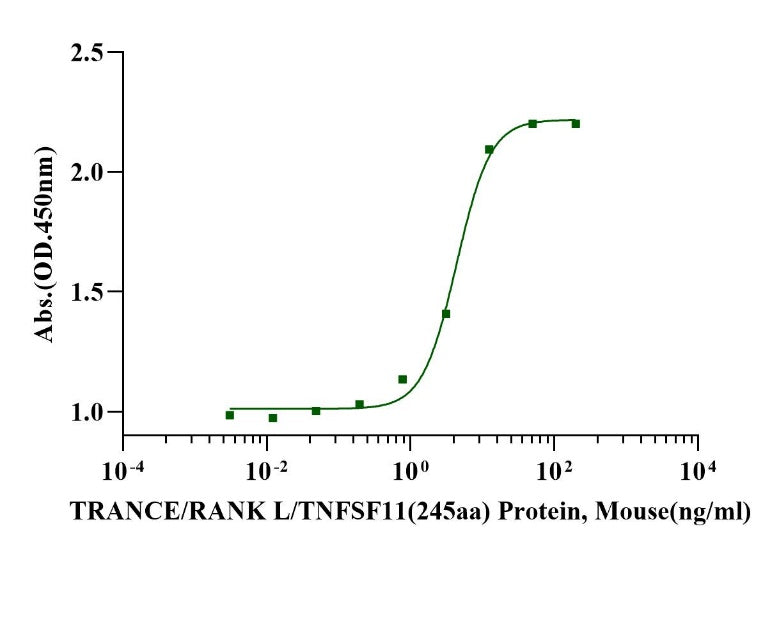
Measured by its ability to induce osteoclast differentiation of RAW 264.7 mouse monocyte/macrophage cells. The EC50 for this effect is less than 8ng/ml.
TRANCE/RANK L/TNFSF11 (245aa) Protein, Mouse
TRANCE/RANK L/TNFSF11 (245aa) Protein, Mouse
Price:
Regular price
$145 USD
Regular price
Sale price
$145 USD
Unit price
per
For shipping services or bulk orders, you may request a quotation.
Secure checkout with

View full details
Product Details
Product Details
Product Specification
| Species | Mouse |
| Accession | O35235 |
| Amino Acid Sequence | Arg72Asp316, with N-terminal His tag. |
| Expression System | HEK293 |
| Molecular Weight | 33 kDa (Reducing) |
| Purity | >95% by SDS-PAGE. |
| Endotoxin | <0.1EU/μg |
| Conjugation | Unconjugated |
| Tag | His Tag |
| Physical Appearance | Lyophilized Powder |
| Storage Buffer | 20mM Tris, 300mM NaCl, pH8.0 |
| Reconstitution | Reconstitute at 0.1-1 mg/ml according to the size in ultrapure water after rapid centrifugation. |
| Stability & Storage | ·12 months from date of receipt, lyophilized powder stored at -20 to -80℃. |
| Reference | Nat Rev Drug Discov. 2024 Dec;23(12):939-961. |
Background
TNFSF11, also known as Receptor Activator of Nuclear Factor-κB Ligand (RANKL), is a crucial cytokine belonging to the tumor necrosis factor (TNF) superfamily. It is expressed on osteoblasts or T cells and binds to TNFRSF11B (OPG) and TNFRSF11A (RANK) on osteoclasts and precursor cells to regulate their differentiation and proliferation. RANKL plays a vital role in bone remodeling by stimulating osteoclast activity and is essential for maintaining bone homeostasis. In mice, the TNFSF11 gene is located on chromosome 14 and encodes a glycoprotein with an extracellular domain that can be cleaved and released into the bloodstream.
TNFSF11 is a key regulator of osteoclastogenesis and bone resorption. In bone organoid models, TNFSF11 signaling is essential for maintaining the balance between osteoblasts and osteoclasts. By manipulating TNFSF11 levels, researchers can study bone diseases such as osteoporosis and osteopetrosis in a more physiologically relevant context.
TNFSF11 is involved in the development and function of secondary lymphoid organs. In immune organoids, TNFSF11 signaling can influence the formation of lymphoid structures and the activation of immune cells. This makes it a valuable target for studying immune responses and developing new therapeutic strategies for autoimmune diseases.
Picture
Picture
Bioactivity
SDS-PAGE
2μg (R: reducing condition, N: non-reducing condition).