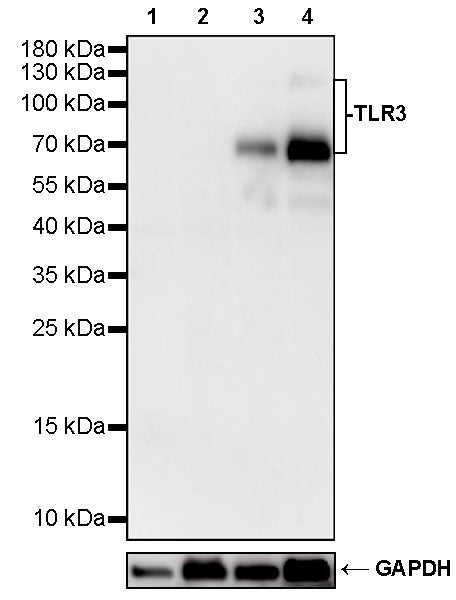
WB result of TLR3 Recombinant Rabbit mAb
Primary antibody: TLR3 Recombinant Rabbit mAb at 1/1000 dilution
Lane 1: A549 whole cell lysate 20 µg
Lane 2: HCT 116 whole cell lysate 20 µg
Lane 3: HT-29 whole cell lysate 20 µg
Lane 4: A204 whole cell lysate 20 µg
Negative control: A549 whole cell lysate 20 µg
HCT 116 whole cell lysate 20 µg
Secondary antibody: Goat Anti-rabbit IgG (H+L), HRP conjugated at 1/10000 dilution
Predicted MW: 104 kDa
Observed MW: 70, 125 kDa
This blot was developed with high sensitivity substrate
TLR3 Recombinant Rabbit mAb (S-4000-47)
TLR3 Recombinant Rabbit mAb (S-4000-47)
Price:
Regular price
$100 USD
Regular price
Sale price
$100 USD
Unit price
per
For shipping services or bulk orders, you may request a quotation.
Secure checkout with

View full details
Product Details
Product Details
Product Specification
| Host | Rabbit |
| Antigen | TLR3 |
| Synonyms | Toll-like receptor 3; CD283 |
| Immunogen | Synthetic Peptide |
| Location | Endosome, Endoplasmic reticulum |
| Accession | O15455 |
| Clone Number | S-4000-47 |
| Antibody Type | Recombinant mAb |
| Isotype | IgG |
| Application | WB |
| Reactivity | Hu |
| Positive Sample | HT-29, A204 |
| Predicted Reactivity | Bv |
| Purification | Protein A |
| Concentration | 1 mg/ml |
| Conjugation | Unconjugated |
| Physical Appearance | Liquid |
| Storage Buffer | PBS, 40% Glycerol, 0.05% BSA, 0.02% sodium azide |
| Stability & Storage | 12 months from date of receipt / reconstitution, -20 °C as supplied |
Dilution
| application | dilution | species |
| WB | 1:1000 | Hu |
Background
Toll-like receptor 3 (TLR3) is a critical pattern recognition receptor of the innate immune system that specifically detects double-stranded RNA (dsRNA), a molecular signature associated with viral infections and endogenous cellular damage, and is uniquely localized to intracellular endosomal compartments rather than the cell surface. Upon binding dsRNA, TLR3 undergoes dimerization and recruits the adaptor protein TRIF (TIR-domain-containing adapter-inducing interferon-β), distinguishing it from other TLRs that utilize MyD88, which subsequently activates the kinases TBK1 and IKKε to phosphorylate IRF3 as well as the NF-κB pathway, culminating in the transcriptional induction of type I interferons (particularly IFN-β) and pro-inflammatory cytokines essential for establishing an antiviral state. While vital for host defense against viruses such as herpes simplex virus, influenza, and SARS-CoV-2, dysregulated TLR3 signaling has been implicated in immunopathology, including autoimmune disorders and certain neurodegenerative conditions, highlighting its dual role as both a protective sentinel and a potential mediator of sterile inflammation when activated by self-RNA or overstimulated during infection.
Picture
Picture
Western Blot