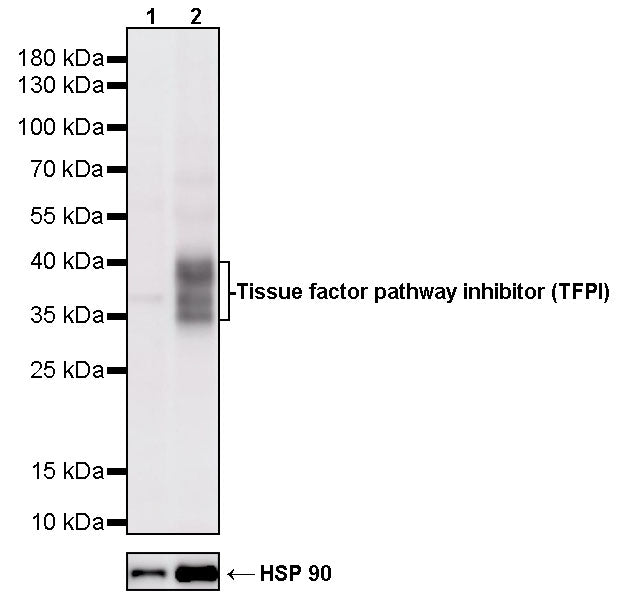
WB result of Tissue factor pathway inhibitor (TFPI) Recombinant Rabbit mAb
Primary antibody: Tissue factor pathway inhibitor (TFPI) Recombinant Rabbit mAb at 1/1000 dilution
Lane 1: LoVo whole cell lysate 20 µg
Lane 2: U-87 MG whole cell lysate 20 µg
Negative control: LoVo whole cell lysate
Secondary antibody: Goat Anti-rabbit IgG (H+L), HRP conjugated at 1/10000 dilution
Predicted MW: 35 kDa
Observed MW: 38 kDa
Tissue factor pathway inhibitor (TFPI) Recombinant Rabbit mAb (S-4436-30)
Tissue factor pathway inhibitor (TFPI) Recombinant Rabbit mAb (S-4436-30)
Price:
Regular price
$100 USD
Regular price
Sale price
$100 USD
Unit price
per
For shipping services or bulk orders, you may request a quotation.
Secure checkout with

View full details
Product Details
Product Details
Product Specification
| Host | Rabbit |
| Antigen | Tissue factor pathway inhibitor (TFPI) |
| Synonyms | Tissue factor pathway inhibitor; Extrinsic pathway inhibitor (EPI); Lipoprotein-associated coagulation inhibitor (LACI); LACI; TFPI1; TFPI |
| Immunogen | Recombinant Protein |
| Location | Secreted, Endoplasmic reticulum |
| Accession | P10646 |
| Clone Number | S-4436-30 |
| Antibody Type | Recombinant mAb |
| Isotype | IgG |
| Application | WB |
| Reactivity | Hu, Ms, Rt |
| Positive Sample | U-87 MG, mouse placenta, rat placenta |
| Predicted Reactivity | Mq |
| Purification | Protein A |
| Concentration | 0.5 mg/ml |
| Conjugation | Unconjugated |
| Physical Appearance | Liquid |
| Storage Buffer | PBS, 40% Glycerol, 0.05% BSA, 0.02% sodium azide |
| Stability & Storage | 12 months from date of receipt / reconstitution, -20 °C as supplied |
Dilution
| application | dilution | species |
| WB | 1:1000 | Hu, Ms, Rt |
Background
Tissue factor pathway inhibitor (TFPI) is a Kunitz-type serine protease inhibitor encoded by the TFPI gene, serving as a key negative regulator of the extrinsic coagulation pathway in vivo. TFPI primarily binds directly to coagulation factor Xa through its Kunitz-2 domain, forming a TFPI-Xa complex, which then binds to the coagulation factor VIIa/tissue factor (TF/VIIa) complex via its Kunitz-1 domain in a calcium-dependent manner, thereby forming a quaternary inhibitory complex that effectively terminates the initiation of the extrinsic coagulation pathway. This mechanism positions TFPI as a "brake" in maintaining the coagulation-anticoagulation balance, and its dysfunction leads to a significantly increased risk of thrombosis. At the pharmacological level, due to its inhibitory effects, TFPI has shown potential as a hemostatic drug target in the treatment of hemophilia—inhibiting TFPI can enhance thrombin generation and improve the bleeding phenotype in hemophilia patients. In addition, TFPI is also considered a contact-phase coagulation inhibitor and may enhance its anticoagulant activity through complex formation with heparin. These multifaceted roles make TFPI of great significance in anticoagulant therapy, hemostatic regulation, and the development of novel antithrombotic agents.
Picture
Picture
Western Blot
WB result of Tissue factor pathway inhibitor (TFPI) Recombinant Rabbit mAb
Primary antibody: Tissue factor pathway inhibitor (TFPI) Recombinant Rabbit mAb at 1/1000 dilution
Lane 1: mouse colon lysate 20 µg
Lane 2: mouse placenta lysate 20 µg
Negative control: mouse colon whole cell lysate
Secondary antibody: Goat Anti-rabbit IgG (H+L), HRP conjugated at 1/10000 dilution
Predicted MW: 35 kDa
Observed MW: 38 kDa
WB result of Tissue factor pathway inhibitor (TFPI) Recombinant Rabbit mAb
Primary antibody: Tissue factor pathway inhibitor (TFPI) Recombinant Rabbit mAb at 1/1000 dilution
Lane 1: rat colon lysate 20 µg
Lane 2: rat placenta lysate 20 µg
Negative control: rat colon whole cell lysate
Secondary antibody: Goat Anti-rabbit IgG (H+L), HRP conjugated at 1/10000 dilution
Predicted MW: 35 kDa
Observed MW: 35-40 kDa