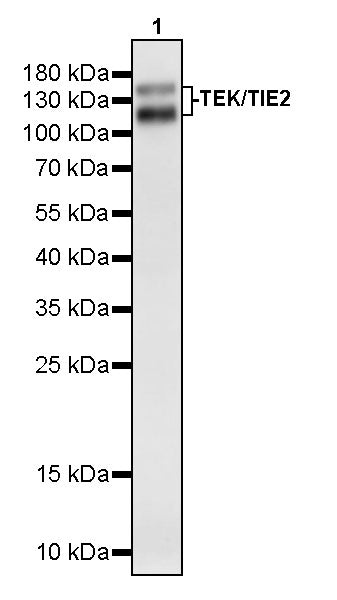
WB result of TEK/TIE2 Recombinant Rabbit mAb
Primary antibody: TEK/TIE2 Recombinant Rabbit mAb at 1/1000 dilution
Lane 1: mouse lung lysate 20 µg
Secondary antibody: Goat Anti-rabbit IgG, (H+L), HRP conjugated at 1/10000 dilution
Predicted MW: 126 kDa
Observed MW: 120-140 kDa
TEK/TIE2 Recombinant Rabbit mAb (S-3846-54)
TEK/TIE2 Recombinant Rabbit mAb (S-3846-54)
Price:
Regular price
$100 USD
Regular price
Sale price
$100 USD
Unit price
per
For shipping services or bulk orders, you may request a quotation.
Secure checkout with

View full details
Product Details
Product Details
Product Specification
| Host | Rabbit |
| Antigen | TEK/TIE2 |
| Synonyms | Angiopoietin-1 receptor; Endothelial tyrosine kinase; HYK; STK1; Tunica interna endothelial cell kinase; Tyrosine kinase with Ig and EGF homology domains-2; CD202b; Tie-2; Tie2; Tek |
| Immunogen | Synthetic Peptide |
| Location | Cell membrane |
| Accession | Q02858 |
| Clone Number | S-3846-54 |
| Antibody Type | Recombinant mAb |
| Isotype | IgG |
| Application | WB |
| Reactivity | Ms, Rt |
| Positive Sample | mouse lung, rat lung |
| Predicted Reactivity | Bv |
| Purification | Protein A |
| Concentration | 0.5 mg/ml |
| Conjugation | Unconjugated |
| Physical Appearance | Liquid |
| Storage Buffer | PBS, 40% Glycerol, 0.05% BSA, 0.02% sodium azide |
| Stability & Storage | 12 months from date of receipt / reconstitution, -20 °C as supplied |
Dilution
| application | dilution | species |
| WB | 1:1000 | Ms, Rt |
Background
TEK protein, also known as Tie2 (Tyrosine kinase with Ig and EGF homology domains 2), is a receptor tyrosine kinase expressed on vascular endothelial cells and belongs to the Tie receptor family, playing an irreplaceable core role in embryonic vascular development and adult vascular homeostasis maintenance. Its specific ligands are members of the angiopoietin family (Angiopoietins). Among them, Ang1 acts as an agonist that, upon binding to TEK, induces receptor dimerization and phosphorylation, activating downstream PI3K-AKT signaling pathways to promote endothelial cell survival, migration, adhesion, and pericyte recruitment, thereby stabilizing mature blood vessels and suppressing vascular permeability. In contrast, Ang2, under specific conditions (such as hypoxia or inflammatory stimulation), functions as an antagonist or partial agonist, interfering with sustained TEK signaling and rendering vessels responsive to pro-angiogenic factors like VEGF, thereby creating conditions for vascular sprouting and remodeling. This "stabilization/remodeling" switch function of TEK makes it a pivotal player in vascular biology—its gene mutations lead to hereditary vascular disorders such as familial venous malformations and primary congenital glaucoma. In the field of oncology, aberrant TEK signaling is closely associated with abnormal tumor vasculature, hyperpermeability, and immune evasion. Consequently, small-molecule inhibitors or neutralizing antibodies targeting the TEK/Angiopoietin axis, such as Trebananib, have been extensively evaluated in clinical trials across various solid tumors (including ovarian cancer and renal cancer) to explore their potential in inhibiting tumor angiogenesis and sensitizing tumors to chemotherapy.
Picture
Picture
Western Blot
WB result of TEK/TIE2 Recombinant Rabbit mAb
Primary antibody: TEK/TIE2 Recombinant Rabbit mAb at 1/1000 dilution
Lane 1: rat lung lysate 20 µg
Secondary antibody: Goat Anti-rabbit IgG, (H+L), HRP conjugated at 1/10000 dilution
Predicted MW: 126 kDa
Observed MW: 120-140 kDa