2μg (R: reducing condition, N: non-reducing condition).
TDGF1/Cripto His Tag Protein, Human
TDGF1/Cripto His Tag Protein, Human
Price:
Regular price
$235 USD
Regular price
Sale price
$235 USD
Unit price
per
For shipping services or bulk orders, you may request a quotation.
Secure checkout with

View full details
Product Details
Product Details
Product Specification
| Species | Human |
| Synonyms | CRIPTO-1, TDGF1 |
| Accession | P13385 |
| Amino Acid Sequence | Leu31-Thr172 with His Tag at the C-Terminus |
| Expression System | HEK293 |
| Molecular Weight | 25-35kDa (Reducing) |
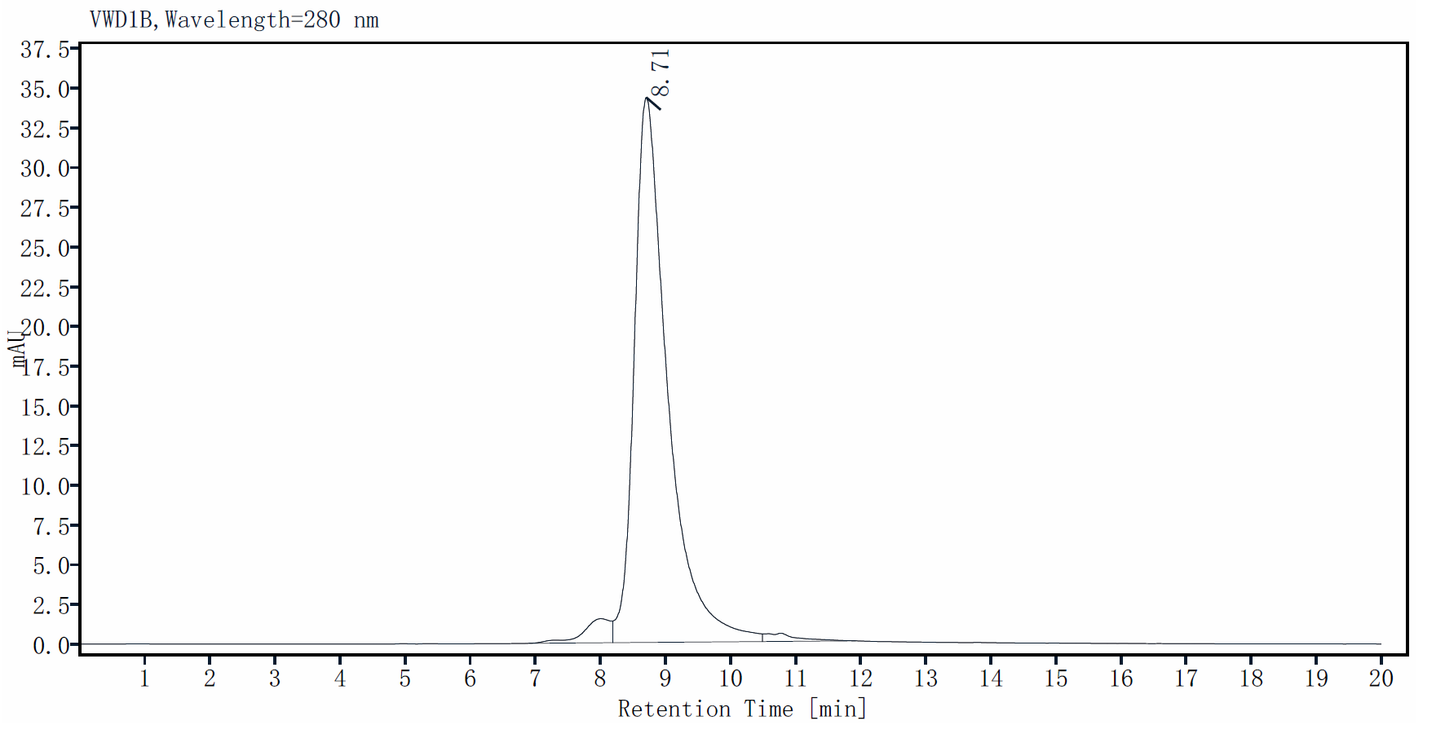
| Purity | >95% by SDS-PAGE & HPLC |
| Conjugation | Unconjugated |
| Tag | His Tag |
| Physical Appearance | Lyophilized powder |
| Storage Buffer | PBS, pH7.4, 5% trehalose |
| Reconstitution | Reconstitute at 0.1-1 mg/ml according to the size in ultrapure water after rapid centrifugation. |
| Stability & Storage |
· 12 months from date of receipt, lyophilized powder stored at -20 to -80℃. · 3 months, -20 to -80℃ under sterile conditions after reconstitution. · 1 week, 2 to 8℃ under sterile conditions after reconstitution. · Please avoid repeated freeze-thaw cycles. |
| Reference | 1. Freeman, D.W., et al. (2021). Whence CRIPTO: The Reemergence of an Oncofetal Factor in 'Wounds' That Fail to Heal. International Journal of Molecular Sciences, 22(18), 10164. |
Background
TDGF1 (Teratocarcinoma-Derived Growth Factor 1) encodes a protein more widely known as CRIPTO (or CR-1). It is the founding member of the vertebrate EGF-CFC (Epidermal Growth Factor-Cripto/FRL-1/Cryptic) gene family. TDGF1 is a GPI-anchored cell membrane protein that can also be shed as a soluble form. Its protein structure contains an EGF-like domain.
As an oncofetal protein, TDGF1/CRIPTO plays a critical role in embryonic development, potentially determining the differentiation of epiblastic cells into mesoderm. In tumorigenesis, TDGF1/CRIPTO is "reactivated" or aberrantly overexpressed in various cancers, including prostate, colon, lung, and breast cancers. Its functions include promoting tumor initiation and progression, driving tumor aggressiveness, and maintaining stem cell properties and cellular plasticity. At the signaling level, TDGF1/CRIPTO is a key co-receptor for the Nodal signaling pathway. It interacts with the Activin type-1 receptor (ACVR1B) and modulates SMAD2/3 activation. Furthermore, it can exert oncogenic effects through various signaling axes, such as Nodal/Smad2 and Glypican-1/MAPK-AKT. Consequently, TDGF1/CRIPTO has become a promising tumor biomarker and therapeutic target.
Picture
Picture
SDS-PAGE
SEC-HPLC
The purity of TDGF1/Cripto His Tag Protein, Human is more than 95% determined by SEC-HPLC.
SPR
ALK4 (24-126) Fc Chimera Protein, Human captured on Protein A Chip can bind TDGF1/Cripto His Tag Protein, Human (Cat. No. UA016040) with an affinity constant of 0.23 μM as determined in SPR assay.