Standard curve
Example of Syrian Hamster IgG standard curve in Assay Diluent A1.
Syrian Hamster IgG OneStep ELISA Kit
Syrian Hamster IgG OneStep ELISA Kit
Price:
Regular price
$500 USD
Regular price
Sale price
$500 USD
Unit price
per
For shipping services or bulk orders, you may request a quotation.
Secure checkout with

View full details
Product Details
Product Details
Product Specification
| Antigen | IgG |
| Immunogen | Recombinant Protein |
| Antibody Type | Recombinant mAb |
| Purification | Protein A |
| Stability & Storage | 12 months from date of receipt / reconstitution, 2 to 8'C as supplied. |
Kit
| Precision | Intra-assay: 2.6%; Inter-assay: 6.2% |
| Sample type | Cell culture supernatant; Serum; Plasma |
| Assay type | Sandwich (quantitative) |
| Sensitivity | 0.050 ng/mL |
| Range | 0.156 ng/mL – 10 ng/mL |
| Recovery | Cell culture supernatant: 83% Serum: 96% Plasma: 87% |
| Assay time | 60 minutes |
| Species reactivity | Syrian Hamster |
Background
Syrian hamster IgG (Immunoglobulin G) refers to the predominant class of antibody found in the serum of Syrian hamsters (Mesocricetus auratus). As a key component of the adaptive immune system, it plays a crucial role in antigen recognition, opsonization, complement activation, and neutralization of pathogens. Syrian hamster IgG is particularly significant in biomedical research due to the hamster's established role as an important animal model for studying various human diseases, including viral infections (e.g., SARS-CoV-2, hantaviruses), metabolic disorders, and certain cancers. Researchers frequently utilize anti-Syrian hamster IgG secondary antibodies in immunoassays (such as ELISA) to detect primary antibodies of hamster origin, thereby enabling the study of immune responses and pathogen-specific antibodies in this model organism. Its unique utility supports virology, immunology, and infectious disease research where the Syrian hamster's physiological similarities to humans are advantageous.
Picture
Picture
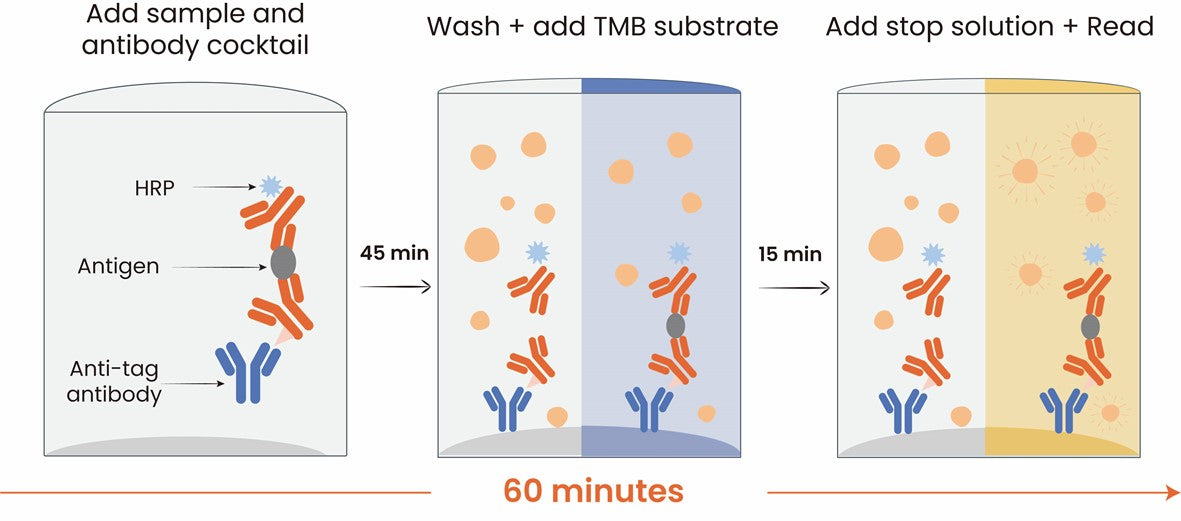
ELISA
Protocol Diagram