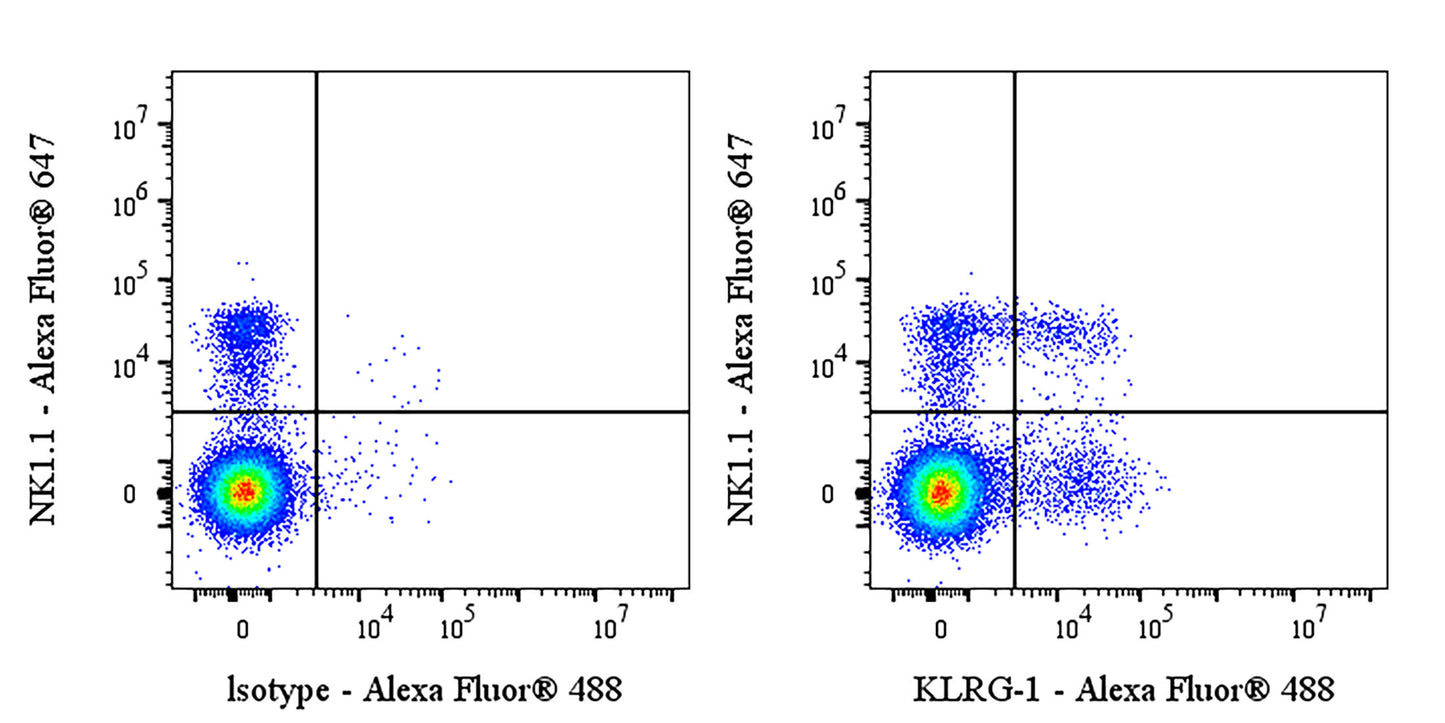
Flow cytometric analysis of C57BL/6 mouse splenocytes labeled KLRG1 antibody at 1/100 dilution (2 μg) / (right panel) compared with a Syrian Hamster IgG Isotype Control / (left panel). Goat Anti- Syrian Hamster IgG Alexa Fluor® 488 was used as the secondary antibody. Then cells were stained with NK1.1 - Alexa Fluor® 647 antibody separately. Flow cytometry and data analysis were performed using Agilent NovoCyte Quanteon and FlowJo™ software.
Syrian hamster Anti-Mouse/Human KLRG-1 Antibody (S-3757)
Syrian hamster Anti-Mouse/Human KLRG-1 Antibody (S-3757)
Price:
Regular price
$100 USD
Regular price
Sale price
$100 USD
Unit price
per
For shipping services or bulk orders, you may request a quotation.
Secure checkout with

View full details
Product Details
Product Details
Product Specification
| Host | Syrian Hamster |
| Antigen | KLRG1 |
| Synonyms | Killer cell lectin-like receptor subfamily G member 1; C-type lectin domain family 15 member A; ITIM-containing receptor MAFA-L; MAFA-like receptor; Mast cell function-associated antigen; CLEC15A; MAFA; MAFAL; KLRG1 |
| Location | Cell membrane |
| Accession | Q96E93、O88713 |
| Clone Number | S-3757 |
| Antibody Type | Recombinant mAb |
| Isotype | IgG |
| Application | FCM |
| Reactivity | Hu, Ms |
| Positive Sample | C57BL/6 mouse splenocytes |
| Purification | Protein G |
| Concentration | 2 mg/ml |
| Conjugation | Unconjugated |
| Physical Appearance | Liquid |
| Storage Buffer | PBS pH7.4 |
| Stability & Storage | 12 months from date of receipt / reconstitution, 2 to 8 °C as supplied |
Dilution
| application | dilution | species |
| FCM | 1:100 | Hu, Ms |
Background
Killer cell lectin-like receptor G1 (KLRG1) is a 30–35 kDa C-type lectin-like inhibitory receptor expressed predominantly on the surface of late-differentiated effector and effector-memory CD8⁺ T, NK, NKT and some CD4⁺ T cells, where its engagement by ubiquitous E-, N- or R-cadherins on epithelial or vascular structures delivers SHP-1/2-dependent signals that terminate calcium flux, cytotoxic granule release and proliferation, thereby acting as a crucial “brake” on acute and chronic immune responses; up-regulated by repeated antigen or IL-2/IL-15 stimulation, KLRG1 demarcates short-lived effector cells destined for apoptosis versus long-lived memory precursors, and its genetic or antibody blockade enhances viral clearance, tumor control and vaccine efficacy, while its sustained expression correlates with T-cell exhaustion, immunosenescence and impaired survival in infections, cancer and autoimmunity, positioning KLRG1 as a key biomarker and therapeutic target for immune rejuvenation.
Picture
Picture
FC