WB result of SULT1A1 Recombinant Rabbit mAb
Primary antibody: SULT1A1 Recombinant Rabbit mAb at 1/1000 dilution
Lane 1: HepG2 whole cell lysate 20 µg
Lane 2: HEK-293 whole cell lysate 20 µg
Lane 3: U-2 OS whole cell lysate 20 µg
Secondary antibody: Goat Anti- rabbit IgG, (H+L), HRP conjugated at 1/10000 dilution
Predicted MW: 34 kDa
Observed MW: 30, 35 kDa
SULT1A1 Recombinant Rabbit mAb (S-4125-51)
SULT1A1 Recombinant Rabbit mAb (S-4125-51)
Price:
Regular price
$100 USD
Regular price
Sale price
$100 USD
Unit price
per
For shipping services or bulk orders, you may request a quotation.
Secure checkout with

View full details
Product Details
Product Details
Product Specification
| Host | Rabbit |
| Antigen | SULT1A1 |
| Synonyms | Sulfotransferase 1A1; Aryl sulfotransferase 1; HAST1/HAST2; Phenol sulfotransferase 1; Phenol-sulfating phenol sulfotransferase 1 (P-PST 1); ST1A3; Thermostable phenol sulfotransferase (Ts-PST); STP; STP1 |
| Immunogen | Recombinant Protein |
| Location | Cytoplasm |
| Accession | P50225 |
| Clone Number | S-4125-51 |
| Antibody Type | Recombinant mAb |
| Isotype | IgG |
| Application | WB |
| Reactivity | Hu, Rt |
| Positive Sample | HepG2, HEK-293, U-2 OS, rat liver |
| Purification | Protein A |
| Concentration | 0.5 mg/ml |
| Conjugation | Unconjugated |
| Physical Appearance | Liquid |
| Storage Buffer | PBS, 40% Glycerol, 0.05% BSA, 0.02% sodium azide |
| Stability & Storage | 12 months from date of receipt / reconstitution, -20 °C as supplied |
Dilution
| application | dilution | species |
| WB | 1:1000 | Hu, Rt |
Background
SULT1A1, also known as sulfotransferase family 1A member 1, is one of the most important phase II metabolic enzymes in the human body, primarily responsible for catalyzing the sulfation of endogenous and exogenous substrates. Through its highly conserved catalytic domain, this protein transfers sulfonate groups to substrate molecules containing hydroxyl or amino groups, using 3'-phosphoadenosine-5'-phosphosulfate (PAPS) as the sulfate donor, thereby increasing the water solubility of substrates and facilitating their excretion from the body. SULT1A1 is widely expressed in multiple tissues, with particularly abundant levels in the liver, small intestine, and platelets, and its substrate spectrum is remarkably broad, encompassing endogenous substances such as dopamine, thyroid hormones, and steroid hormones, as well as a wide range of exogenous compounds including numerous drugs, environmental toxins, and carcinogens. This protein plays a critical role in drug metabolism, hormone homeostasis maintenance, and chemical defense in the body, and its enzymatic activity and expression levels exhibit significant inter-individual variability, primarily influenced by genetic polymorphisms (such as the SULT1A1*2 allele). Aberrant expression or dysfunction of SULT1A1 is associated with various diseases; for example, reduced activity may increase the risk of hormone-dependent cancers such as breast and prostate cancer, while certain polymorphisms are also linked to Parkinson's disease, adverse drug reactions, and tumor susceptibility, positioning SULT1A1 as an important target in drug metabolism, toxicology, and personalized medicine research. Furthermore, its high expression in platelets makes it closely related to the metabolic responses to drugs such as aspirin, further highlighting its potential value as a biomarker and therapeutic intervention node.
Picture
Picture
Western Blot
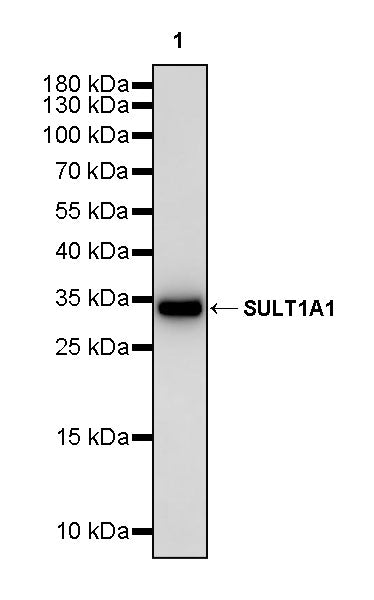
WB result of SULT1A1 Recombinant Rabbit mAb
Primary antibody: SULT1A1 Recombinant Rabbit mAb at 1/1000 dilution
Lane 1: rat liver lysate 20 µg
Secondary antibody: Goat Anti- rabbit IgG, (H+L), HRP conjugated at 1/10000 dilution
Predicted MW: 34 kDa
Observed MW: 35 kDa