2μg (R: reducing condition, N: non-reducing condition).
STUB1/CHIP His Tag Protein, Human
STUB1/CHIP His Tag Protein, Human
Price:
Regular price
$240 USD
Regular price
Sale price
$240 USD
Unit price
per
For shipping services or bulk orders, you may request a quotation.
Secure checkout with

View full details
Product Details
Product Details
Product Specification
| Species | Human |
| Synonyms | CHIP, PP1131, STUB1, E3 ubiquitin-protein ligase CHIP, Antigen NY-CO-7 |
| Accession | Q9UNE7 |
| Amino Acid Sequence | Ser23-Tyr303 with His Tag at the N-Terminus |
| Expression System | E.coli |
| Molecular Weight | 33-43kDa (Reducing) |
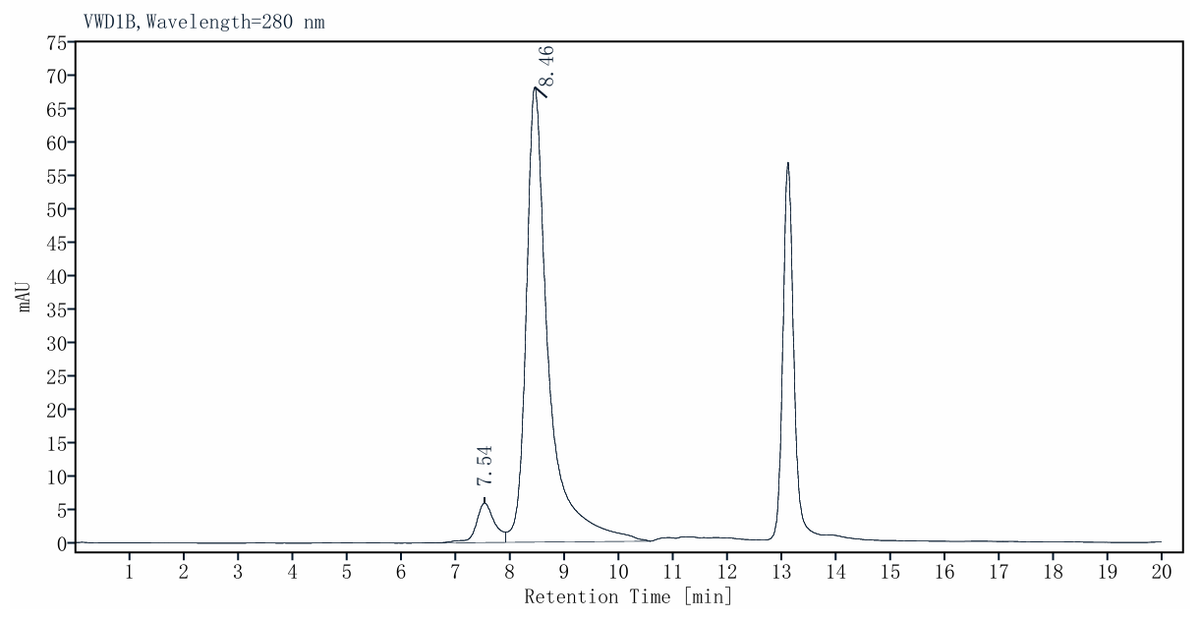
| Purity | >95% by SDS-PAGE,> 90% by HPLC |
| Conjugation | Unconjugated |
| Tag | His Tag |
| Physical Appearance | Liquid |
| Storage Buffer | 50mM Tris, 150mM NaCl, pH7.5, 1mM DTT, 10%Glycerol |
| Stability & Storage |
Stable for 12 months upon stored at -80℃ from the date of receipt. And avoid repeated freeze-thaws cycles. |
| Reference | 1. Ballinger, C.A., et al. (1999). Identification of CHIP, a novel tetratricopeptide repeat-containing protein that interacts with heat shock proteins and negatively regulates chaperone functions. Molecular and Cellular Biology, 19(6), 4535-4545. |
Background
STUB1 (STIP1 Homology and U-Box Containing Protein 1), commonly known as CHIP (C-terminus of Hsc70 Interacting Protein), is a crucial dual-function protein in cellular proteostasis. It serves as both a co-chaperone and an E3 ubiquitin ligase. As a co-chaperone, it binds to the molecular chaperones Hsp70/Hsc70 and Hsp90 via its N-terminal tetratricopeptide repeat (TPR) domain, assisting in client protein folding and stabilization. Its central role lies in its C-terminal U-box domain, which confers E3 ubiquitin ligase activity. This unique combination allows CHIP to ubiquitinate misfolded or damaged client proteins that are delivered by the chaperones, thereby targeting them for proteasomal degradation. It is a central component of the Protein Quality Control (PQC) system, clearing toxic protein aggregates and maintaining proteome integrity.Dysregulation of CHIP function is linked to various human diseases. Loss-of-function mutations or reduced expression are associated with neurodegenerative disorders (e.g., spinocerebellar ataxia, Alzheimer's, Parkinson's) due to defective clearance of pathogenic proteins like tau and α-synuclein. Conversely, its role in degrading oncogenic clients (e.g., HER2, c-Myc) positions it as a potential tumor suppressor in certain cancers. It also plays key roles in aging, cardiac function, and immune responses, making it a significant therapeutic target.
Picture
Picture
SDS-PAGE
SEC-HPLC
The purity of STUP1/CHIP His Tag Protein, Human is more than 90% determined by SEC-HPLC.