WB result of STOML2 Mouse mAb
Primary antibody: STOML2 Mouse mAb at 1/10000 dilution
Lane 1: A431 whole cell lysate 20 µg
Lane 2: HepG2 whole cell lysate 20 µg
Lane 3: MCF7 whole cell lysate 20 µg
Secondary antibody: Goat Anti-mouse IgG, (H+L), HRP conjugated at 1/10000 dilution
Predicted MW: 39 kDa
Observed MW: 39 kDa
STOML2 Mouse mAb
STOML2 Mouse mAb
Price:
Regular price
$100 USD
Regular price
Sale price
$100 USD
Unit price
per
For shipping services or bulk orders, you may request a quotation.
Secure checkout with

View full details
Product Details
Product Details
Product Specification
| Host | Mouse |
| Antigen | STOML2 |
| Synonyms | Stomatin-like protein 2, mitochondrial; EPB72-like protein 2; Paraprotein target 7 (Paratarg-7); SLP2 |
| Location | Cytoplasm, Cytoskeleton, Mitochondrion, Cell membrane |
| Accession | Q9UJZ1 |
| Antibody Type | Mouse mAb |
| Isotype | IgG2b |
| Application | WB |
| Reactivity | Hu, Ms, Rt |
| Positive Sample | A431, HepG2, MCF7, RAW264.7, mouse brain, C6, rat brain |
| Purification | Protein A |
| Concentration | 1.6 mg/ml |
| Conjugation | Unconjugated |
| Physical Appearance | Liquid |
| Storage Buffer | PBS, 40% Glycerol, 0.05% BSA, 0.02% sodium azide |
| Stability & Storage | 12 months from date of receipt / reconstitution, -20 °C as supplied |
Dilution
| application | dilution | species |
| WB | 1:5000-1:20000 | Hu, Ms, Rt |
Background
STOML2 (Stomatin-like protein 2) is an evolutionarily highly conserved membrane protein belonging to the stomatin family, widely expressed on the mitochondrial outer membrane and plasma membrane, where it participates in various biological processes including maintenance of membrane structure, ion channel regulation, and signal transduction. At the functional level, the most prominent role of STOML2 is to influence cellular metabolism through regulating mitochondrial morphology and function—it interacts with mitochondrial fusion proteins MFN1/2 and the fission protein DRP1, promoting mitochondrial fusion and maintaining normal cristae structure, thereby safeguarding oxidative phosphorylation efficiency and reducing reactive oxygen species production. Meanwhile, STOML2 also participates in regulating cellular pH and sodium ion balance by binding to and negatively modulating the activity of acid-sensing ion channels (ASICs) and epithelial sodium channels (ENaCs). Furthermore, STOML2 is significantly overexpressed in various tumors (such as colorectal cancer, liver cancer, and breast cancer), where it promotes tumor cell proliferation, migration, invasion, and chemotherapy resistance through activating signaling pathways such as PI3K-AKT-mTOR or STAT3, and is closely associated with poor patient prognosis, making it a promising prognostic biomarker and therapeutic target in oncology. Importantly, STOML2 dysfunction is also associated with pathological processes including cardiac ischemia-reperfusion injury, lipid metabolism disorders, and neurodegenerative diseases, highlighting its significant status as a multifunctional protein under both physiological and pathological conditions.
Picture
Picture
Western Blot
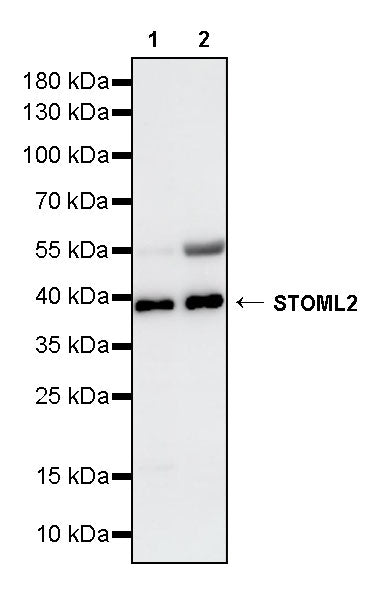
WB result of STOML2 Mouse mAb
Primary antibody: STOML2 Mouse mAb at 1/10000 dilution
Lane 1 RAW264.7 whole cell lysate 20 µg
Lane 2 mouse brain lysate 20 µg
Secondary antibody: Goat Anti-mouse IgG, (H+L), HRP conjugated at 1/10000 dilution
Predicted MW: 39 kDa
Observed MW: 39 kDa
WB result of STOML2 Mouse mAb
Primary antibody: STOML2 Mouse mAb at 1/10000 dilution
Lane 1: C6 whole cell lysate 20 µg
Lane 2: rat brain lysate 20 µg
Secondary antibody: Goat Anti-mouse IgG, (H+L), HRP conjugated at 1/10000 dilution
Predicted MW: 39 kDa
Observed MW: 39 kDa